You can enjoy your job and still move for something exceptional: a mission you believe in, a meaningful step up in compensation, or the chance to work with people you admire. Enjoying your job doesn’t mean it’s your dream job.
The problem is finding it. Exploring the market means sifting through irrelevant approaches, researching companies and repeating conversations alongside a demanding job and a busy life.
Applying means tailoring a resume, filling out forms and waiting for a response that may never come. Half an hour with a recruiter might uncover one interesting role. An agency might have a handful. Neither gives you much visibility into what else is out there.
You can want a better job without wanting to take on the work of finding it. So you wait, often until staying put becomes frustrating enough to make searching worthwhile.
For employers, that leaves much of the talent market difficult to engage. Finding someone’s LinkedIn profile is straightforward. Understanding what would persuade them to move, and bringing them an opportunity that meets that bar, is harder.
Why employers prize passive candidates
Recruiters divide people into “active” and “passive” candidates. Those labels describe whether someone is looking for a job. They tell you little about how good that person is.
Yet passive candidates are often treated as more desirable. Part of that perception comes from how the market works.
When exploring takes substantial effort, people need a strong reason to begin. Dissatisfaction is one trigger. A change in circumstances or a clear ambition can be another. People start applying when they have enough reason to make the effort worthwhile.
Meanwhile, some excellent professionals move through a former colleague, a founder or a headhunter before they ever start searching. Employers see those hires and conclude that the best people have to be approached.
But they’re seeing a market shaped by the cost of entering it. An exceptional person applying today might have ignored every approach six months ago. Their circumstances have changed. Their ability hasn’t.
Lower the cost of exploring, and more people can participate before they have an urgent reason to leave.
One conversation changes the calculation
Jack is our AI career agent. One conversation gives someone a personal recruiter who keeps monitoring the market on their behalf. Jack does the searching and sifting, then brings them relevant opportunities with an explanation of why they might fit.
They tell him what would make a move worthwhile: more ownership, a particular mission, a compensation target, a different kind of team. Then they get on with their work and life while he looks.
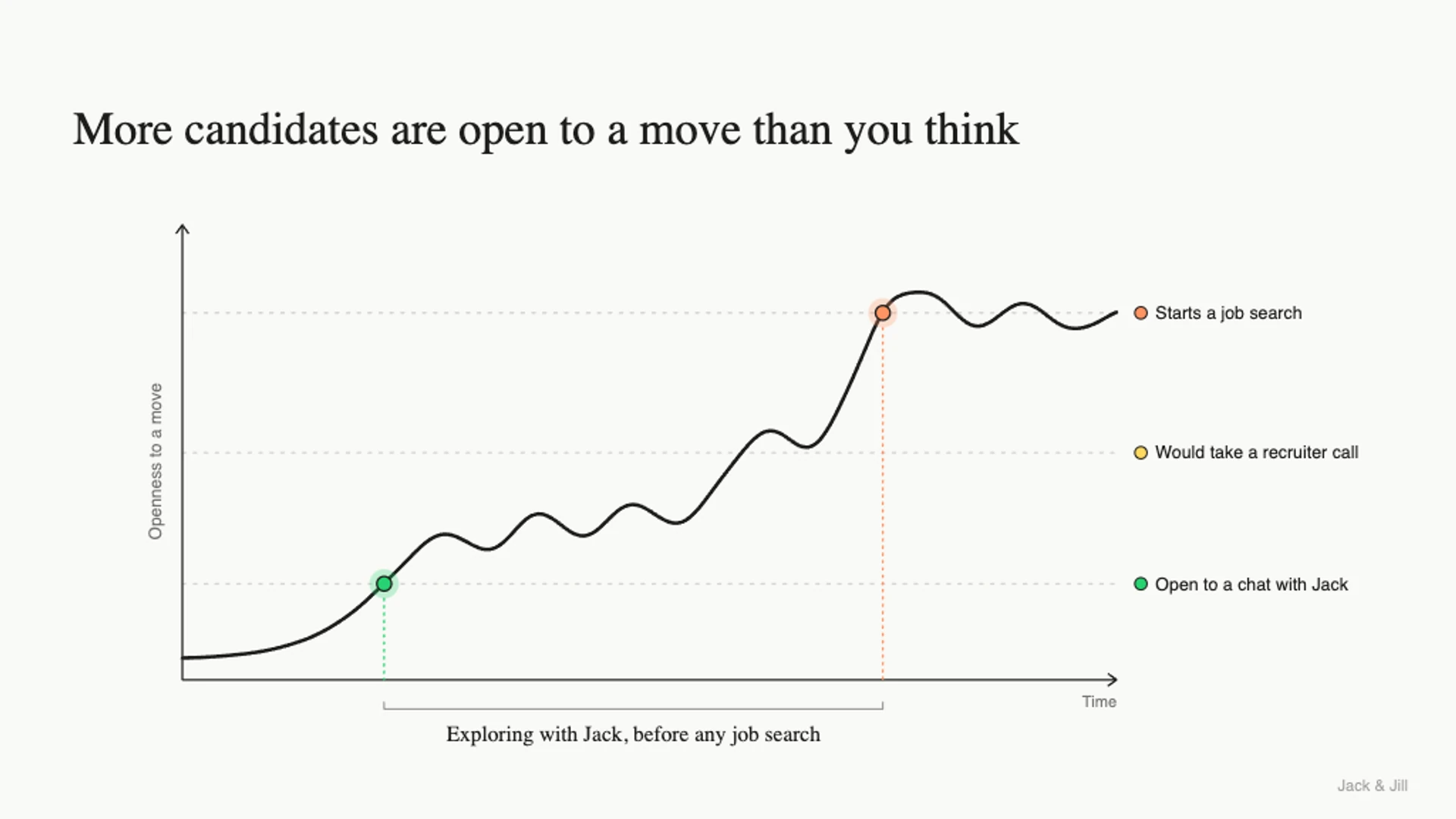
Someone actively searching gets help finding their next role. Someone happy where they are can hear about an exceptional opportunity without spending their evenings trying to find it.
Only one in five professionals using Jack is actively applying, yet nine in ten are open to the right opportunity. For employers, the alpha lies in reaching that broader pool through an agent who can recognise which opportunities are worth bringing to each candidate.
A match has to work in both directions
Jill, Jack & Jill’s AI hiring agent for companies, learns what your team needs: the skills and experience required, what the person will own, and what the opportunity offers.
Jack considers the opportunity from the candidate’s side, using his understanding of their goals and preferences. Their search brief stays between them and Jack.
A candidate might have exactly the experience you need but want more ownership than your role offers. Another might have relevant skills and find your company’s stage, mission and way of working particularly compelling. A worthwhile introduction needs both sides to see a fit.
When an employer requests an introduction, Jack explains the opportunity to the candidate in terms that matter to them. The candidate decides whether to meet.
What this means for hiring with Jill
Better candidates. Jack makes exploring worthwhile for exceptional professionals across the market, including people conventional sourcing struggles to engage. Jill draws from that broader pool, rather than relying on who happens to be searching or willing to answer a cold message.
Better information. Jill builds a detailed understanding of your company and hiring needs. Jack understands what the candidate wants next. Each represents their own side, so introductions are grounded in more than a match between a job description and a LinkedIn profile.
Better reach. More than half of introduction requests on Jack & Jill receive a positive response, more than five times the 9.4% interested rate in Gem’s 2026 Email Outreach Benchmarks Report. Warm introductions turn more approaches into conversations, giving hiring teams more opportunities to find the right person and fewer unanswered messages to chase.
Ben