Jack & Jill · A report on startup hiring, November 2026
The State of Startup Hiring 2026
What professionals want, and what the teams hiring them look for. Drawn from 400,000+ candidates speaking to Jack, thousands of talent teams speaking to Jill, millions of job ads, and interviews with talent leaders at leading startups.
Data from April to November 2026.
Why we’re publishing this
Jack & Jill understands both sides of hiring. Jack has in-depth conversations with candidates about what they really want, and Jill works with the teams hiring them. No one else has this view of both sides of the market, so we’re sharing what we find openly, to help candidates and talent teams alike represent themselves well.
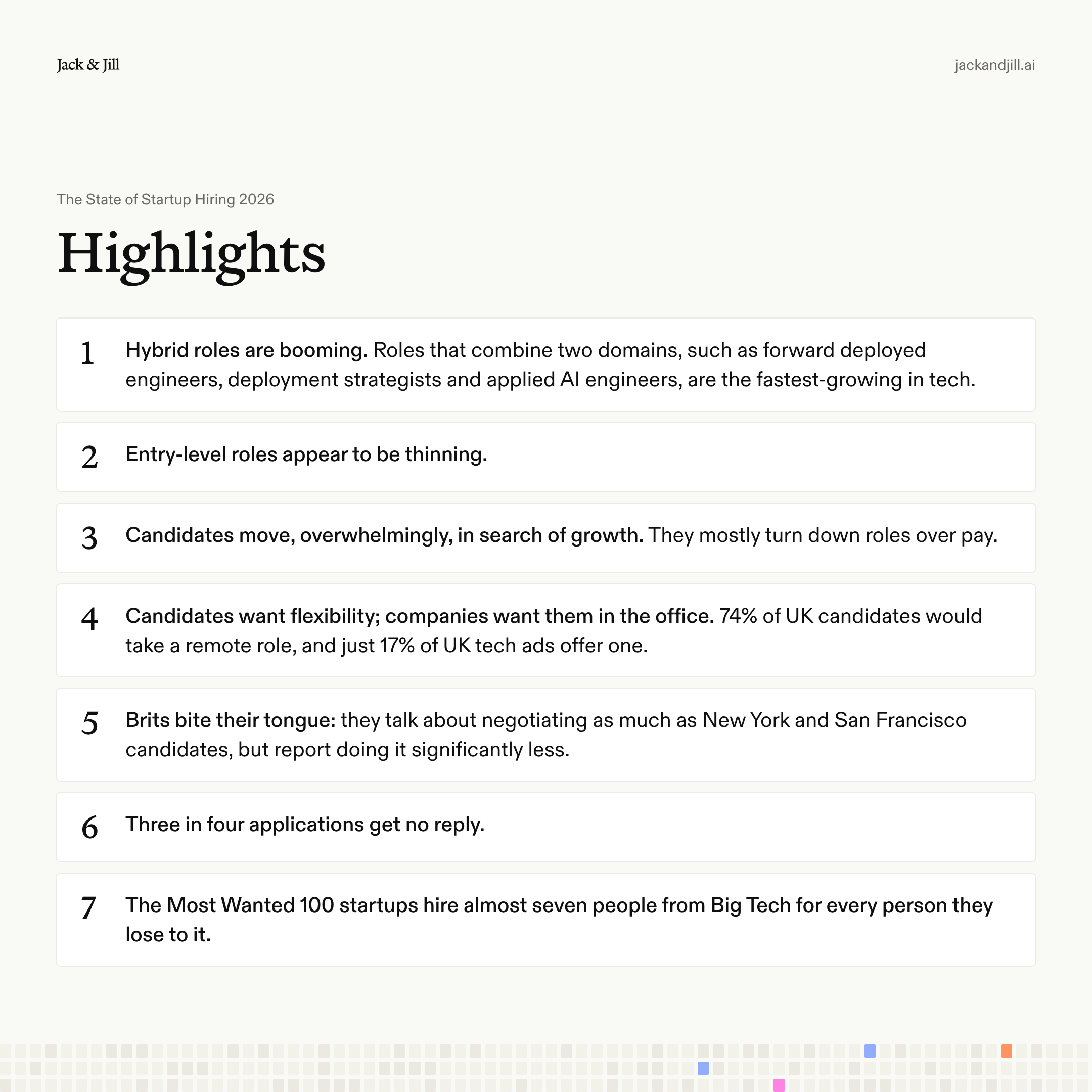
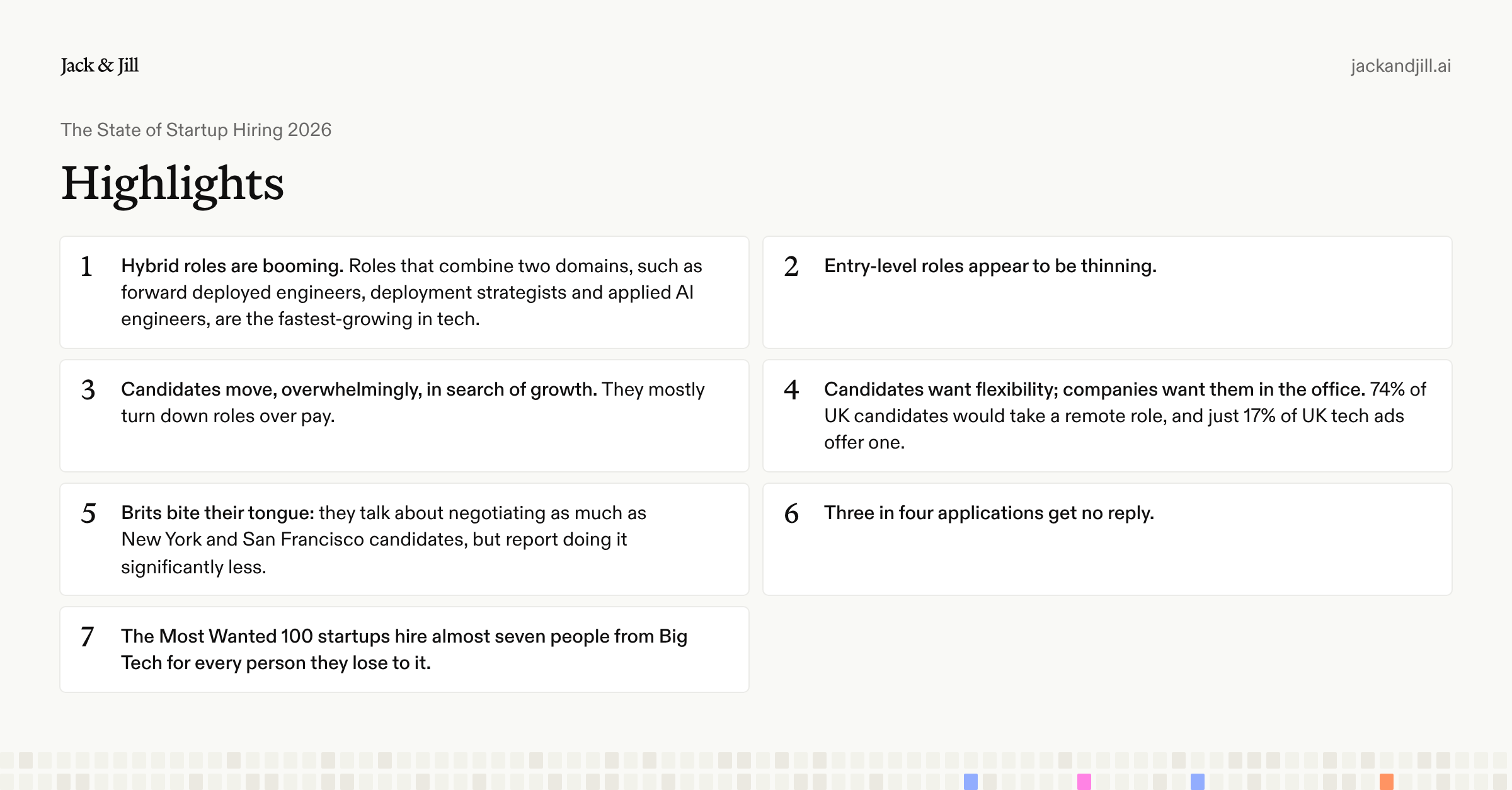
Hybrid roles are booming. Roles that combine two domains, such as forward deployed engineers, deployment strategists and applied AI engineers, are the fastest-growing in tech. Read more
2
Entry-level roles appear to be thinning. Read more
3
Candidates move, overwhelmingly, in search of growth. They mostly turn down roles over pay. Read more
4
Candidates want flexibility; companies want them in the office. 74% of UK candidates would take a remote role, and just 17% of UK tech ads offer one. Read more
5
Brits bite their tongue: they talk about negotiating as much as New York and San Francisco candidates, but report doing it significantly less. Read more
6
Three in four applications get no reply. Read more
7
The Most Wanted 100 startups hire almost seven people from Big Tech for every person they lose to it. Read more
Share and cite this report
Every chart is free to use with credit. Download any chart as a square or landscape image from the icons in its corner, or get them all at once.
Sharing on social? Tag Jack & Jill on LinkedIn and X.
For articles and reports
Jack & Jill, The State of Startup Hiring 2026 (November 2026), jackandjill.ai
Part 1
Hear from candidates
Headline numbers, from candidates speaking to Jack
29%
of new joiners want to leave their job because they’ve stopped growing or grown bored
That’s 2.5 times as many as say they’re leaving for more pay (11.5%).
77.5%
of applications have no reply or update after 90 days
Fewer than 1 in 20 lead to an interview.
86%
of candidates who negotiated got more from the employer
When candidates ask for more, employers usually give something. Based on negotiations where we know the outcome.
1 in 4
new joiners want to build with AI
Fewer than 1 in 300 say they fear it will take their job (25.6% against 0.3%).
A hard market showing some signs of easing
Job hunting is hard, and harder when nobody writes back. Things appear a little less desperate than in spring, although graduate and entry-level roles seem to be at a low across Jill roles and the broader market.
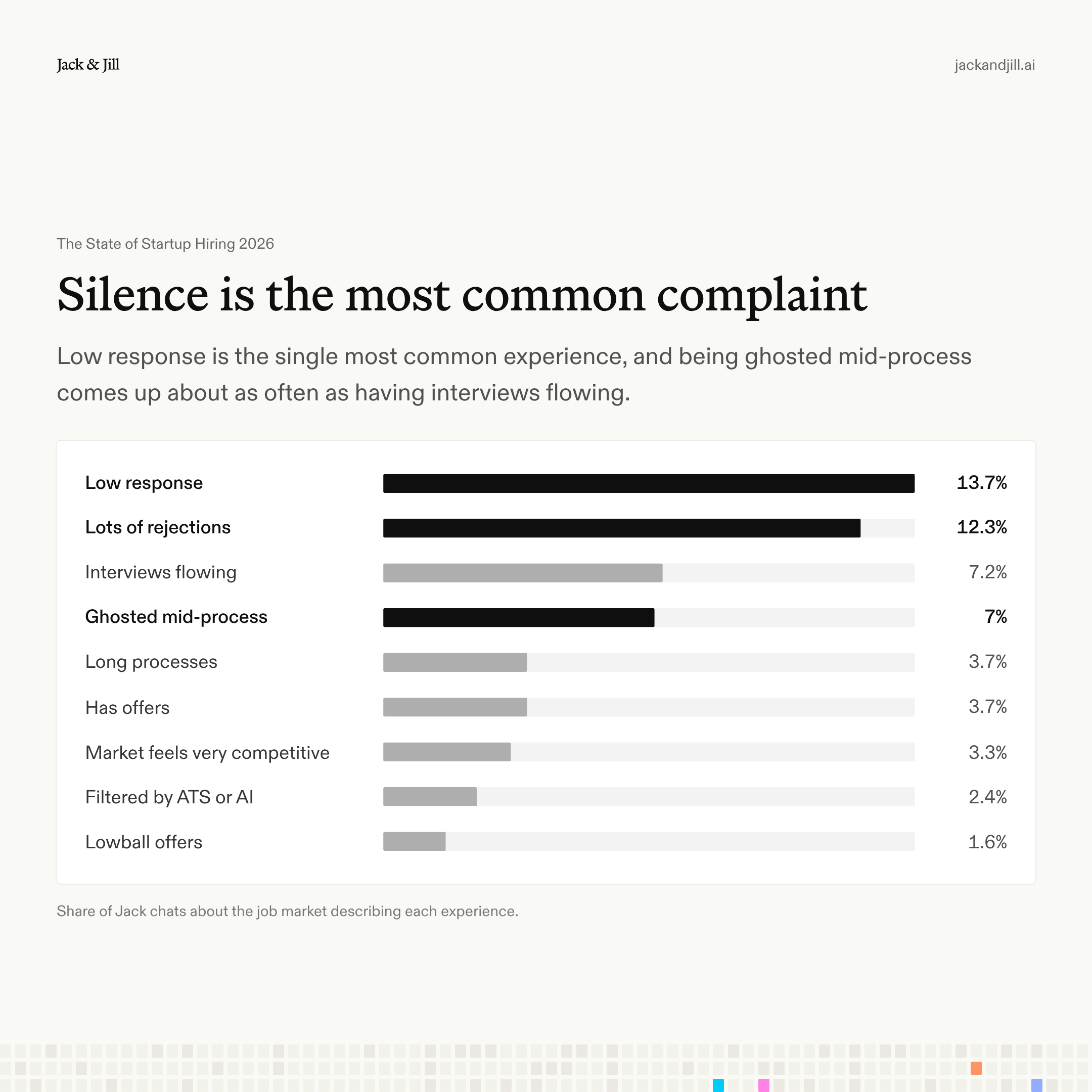
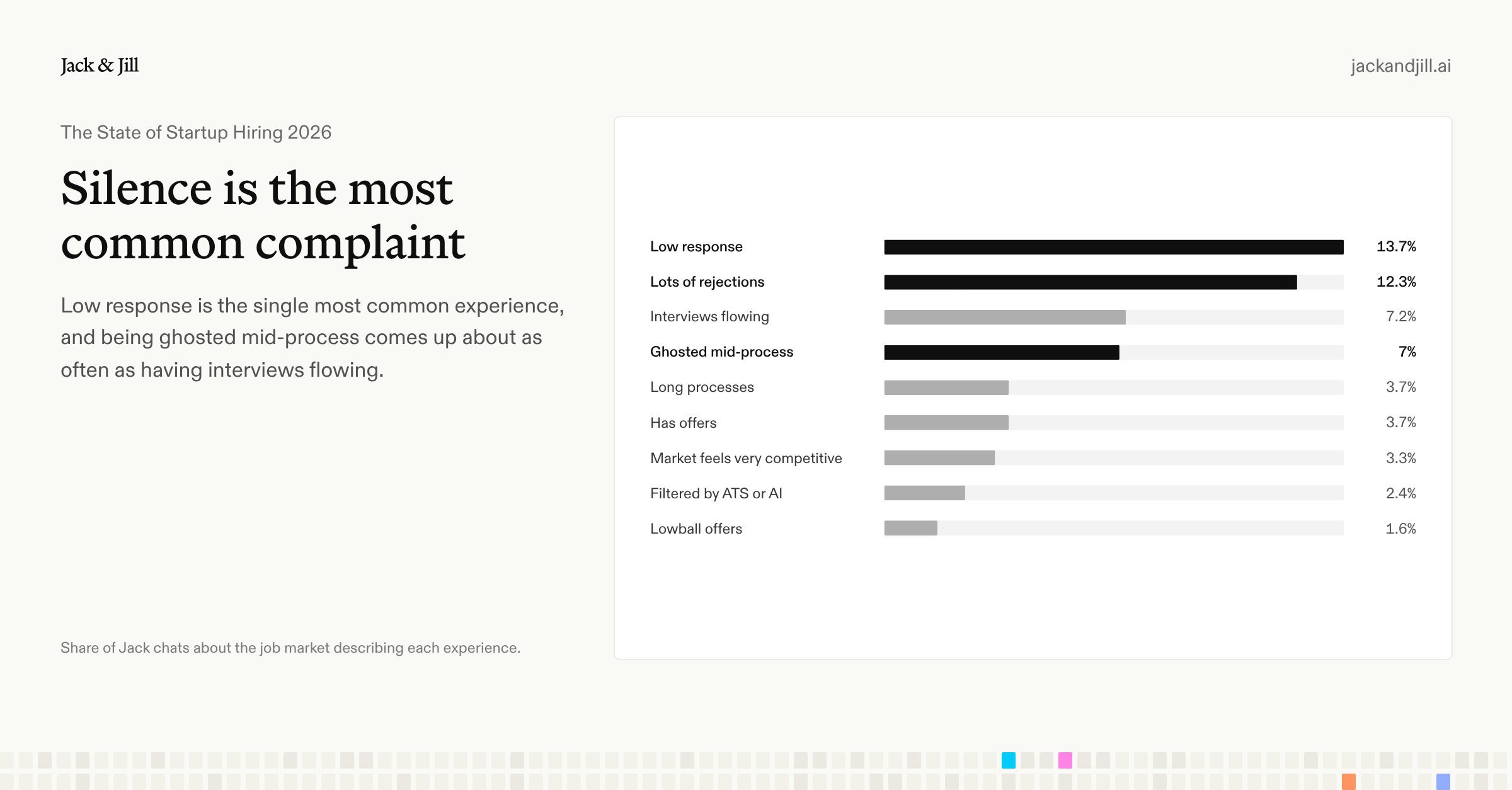
Silence is the most common complaint
Low response is the single most common experience, and being ghosted mid-process comes up about as often as having interviews flowing.
Low response13.7%
Lots of rejections12.3%
Interviews flowing7.2%
Ghosted mid-process7%
Long processes3.7%
Has offers3.7%
Market feels very competitive3.3%
Filtered by ATS or AI2.4%
Lowball offers1.6%
Share of Jack chats about the job market describing each experience.
How has it changed since spring?
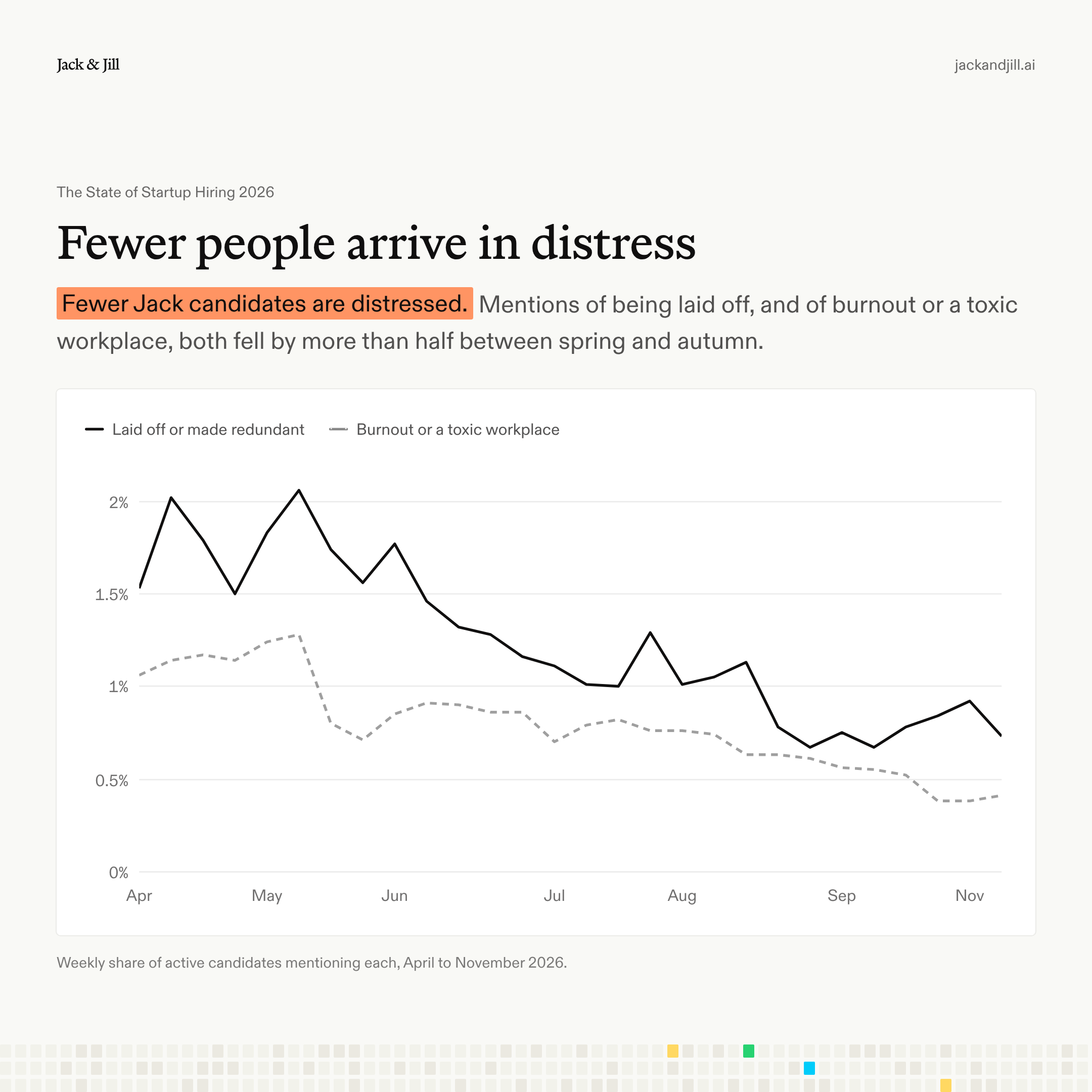
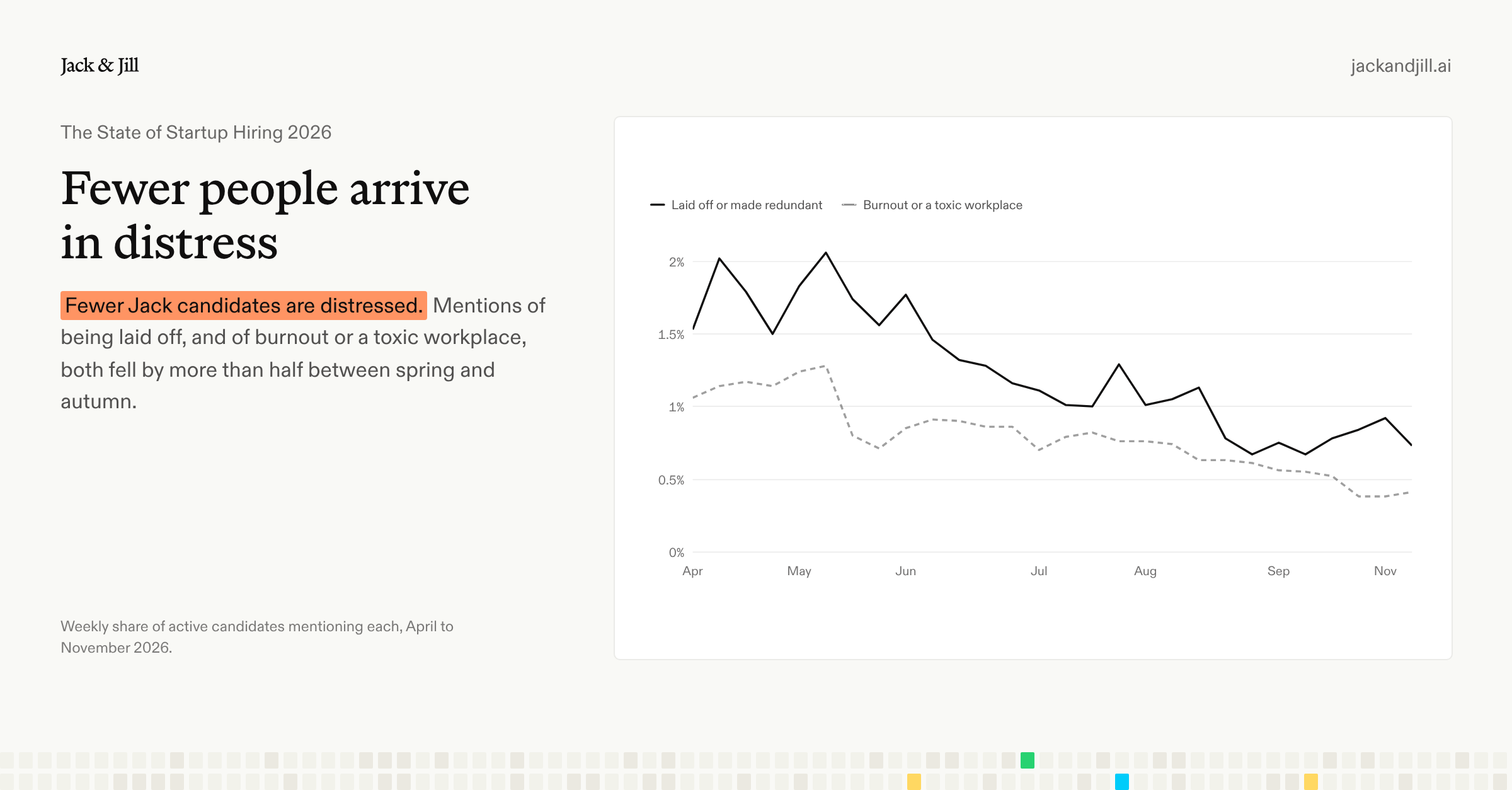
Fewer people arrive in distress
Fewer Jack candidates are distressed than in spring. Mentions of being laid off, and of burnout or a toxic workplace, both fell by more than half.
Laid off or made redundantBurnout or a toxic workplace
0%
0.5%
1%
1.5%
2%
AprMayJunJulAugSepNov
Weekly share of active candidates mentioning each, April to November 2026.
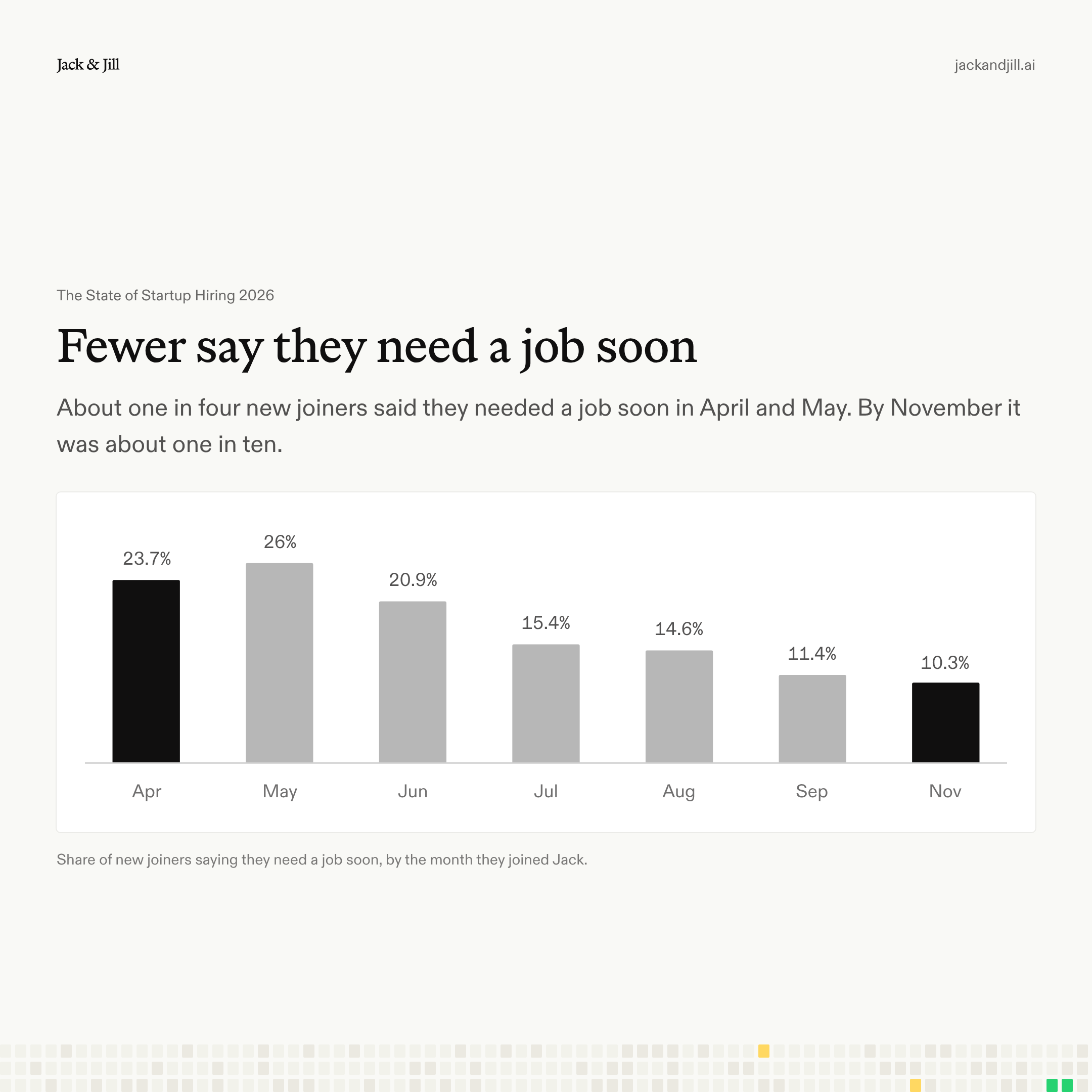
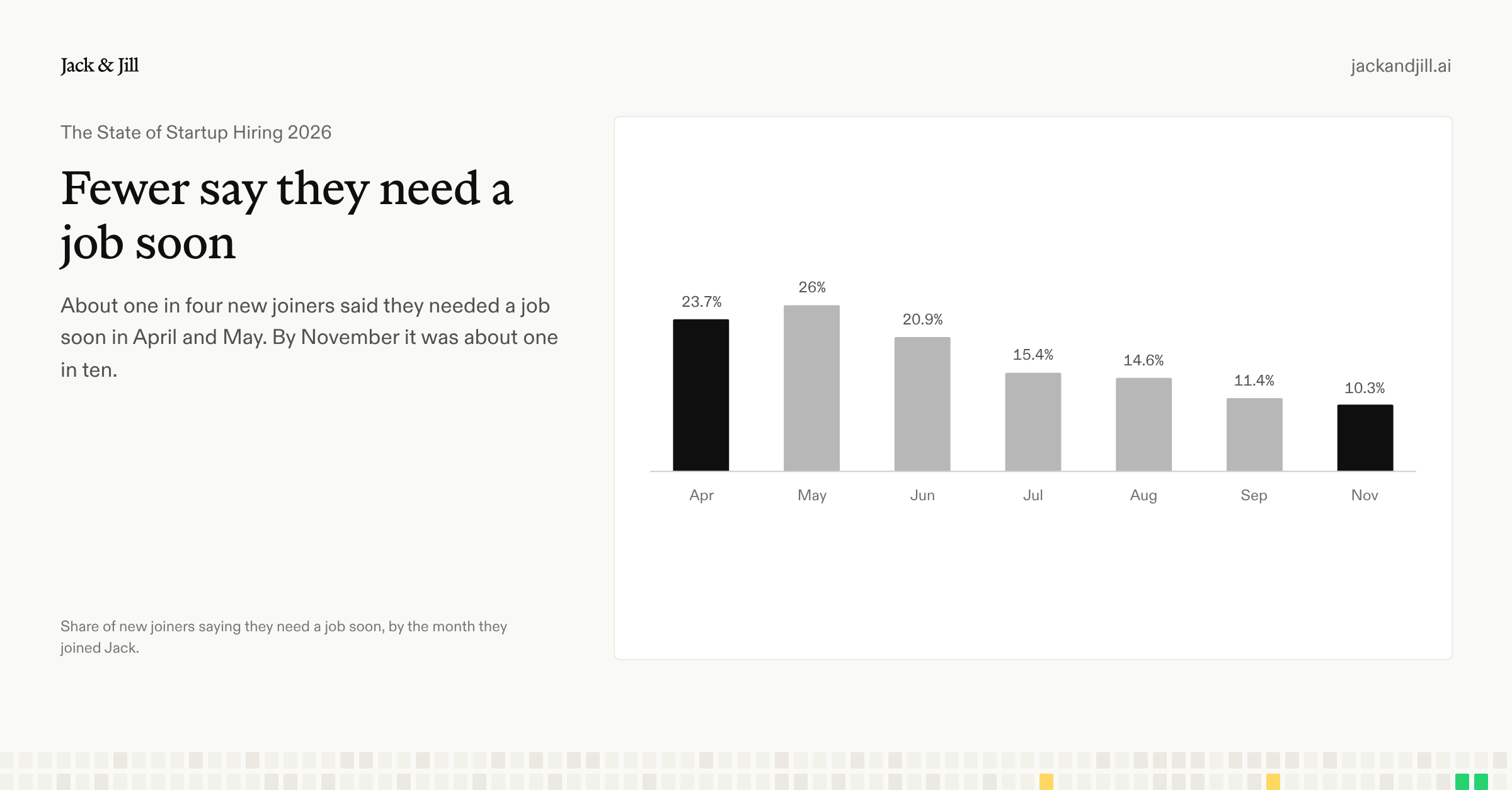
Fewer say they need a job soon
About one in four new joiners said they needed a job soon in April and May. By November it was about one in ten.
23.7%
26%
20.9%
15.4%
14.6%
11.4%
10.3%
AprMayJunJulAugSepNov
Share of new joiners saying they need a job soon, by the month they joined Jack.
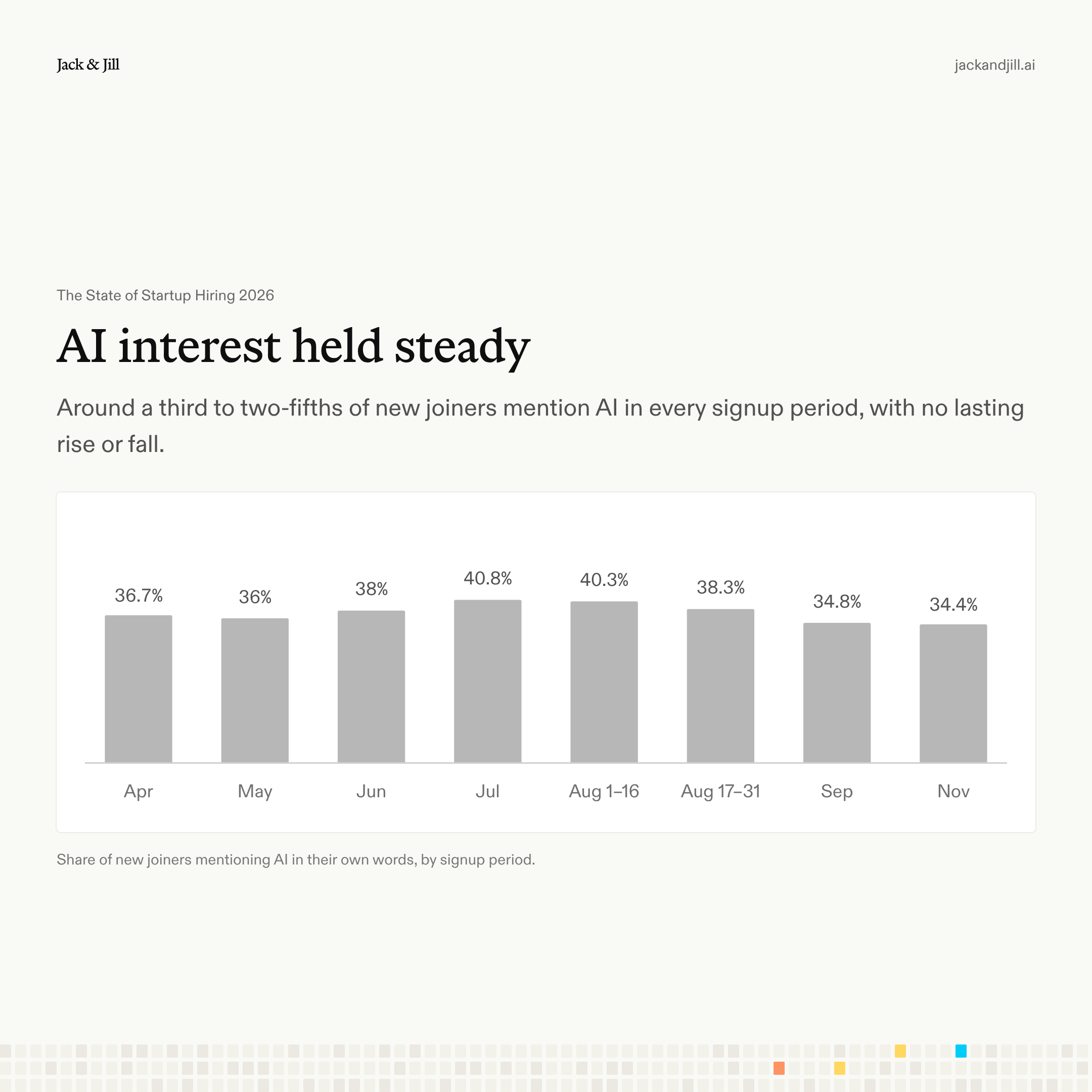
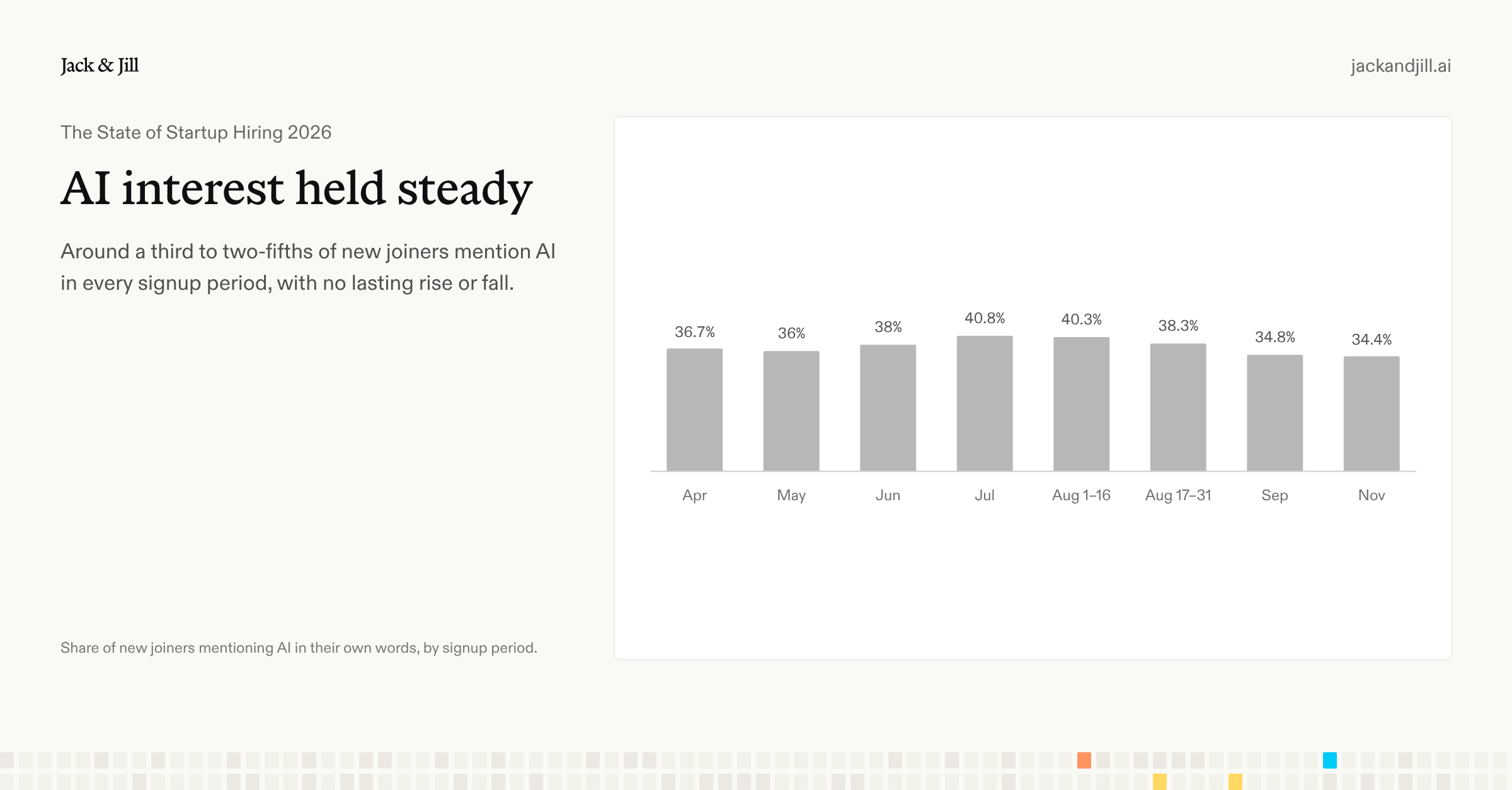
AI interest held steady
Around a third to two-fifths of new joiners mention AI in every signup period, with no lasting rise or fall.
36.7%
36%
38%
40.8%
40.3%
38.3%
34.8%
34.4%
AprMayJunJulAug 1–16Aug 17–31SepNov
Share of new joiners mentioning AI in their own words, by signup period.
Medium confidence How much to trust this section
Two separate measures tell the same story in every region: how often candidates mention being laid off or burnt out, and how many new joiners say they need a job soon. Some of the change may come from who joins Jack rather than the market itself, so read this as a signal.
Most applications go unanswered
Three in four applications get no reply at all. Rejections usually arrive within a month.
77.5%
of applications have no reply or update after 90 days
Tracked by Jack users on their job board.
4 to 1
at least four applications go quiet for every explicit no
Even counting every unexplained archive as a rejection.
1 in 20
applications lead to an interview
In line with other published per-application rates.
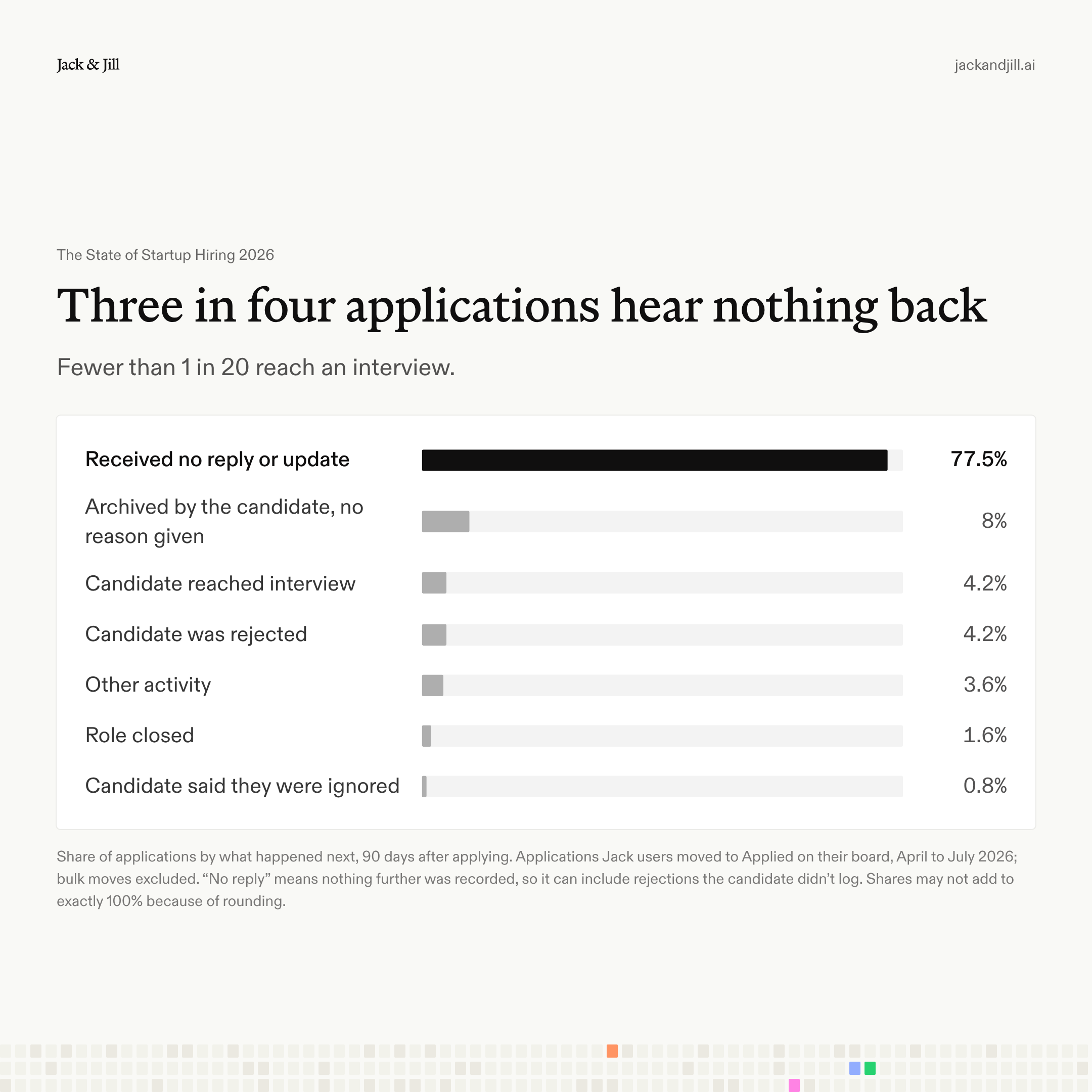
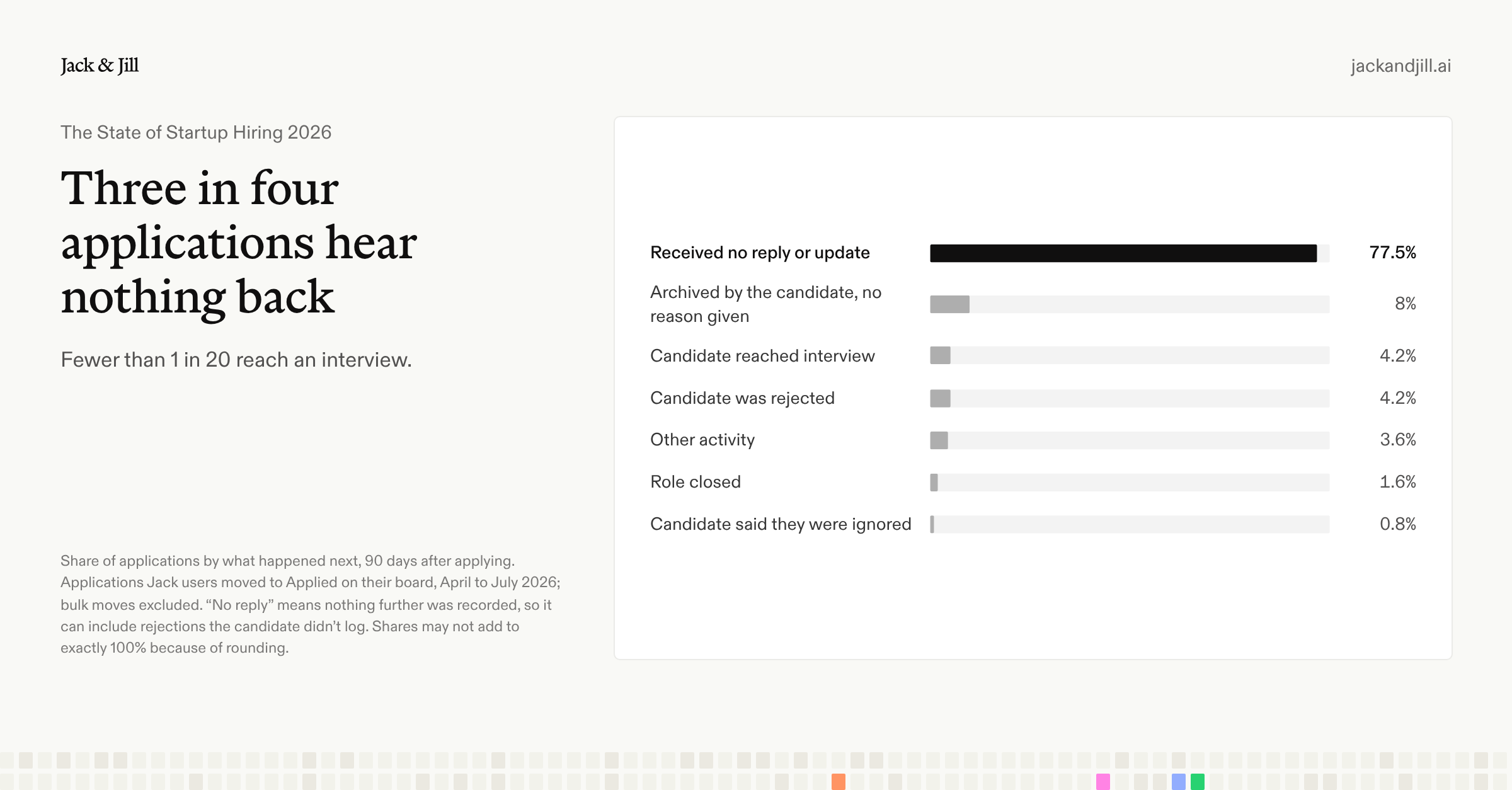
Three in four applications hear nothing back
Fewer than 1 in 20 reach an interview.
Received no reply or update77.5%
Archived by the candidate, no reason given8%
Candidate reached interview4.2%
Candidate was rejected4.2%
Other activity3.6%
Role closed1.6%
Candidate said they were ignored0.8%
Share of applications by what happened next, 90 days after applying. Applications Jack users moved to Applied on their board, April to July 2026; bulk moves excluded. “No reply” means nothing further was recorded, so it can include rejections the candidate didn’t log. Shares may not add to exactly 100% because of rounding.
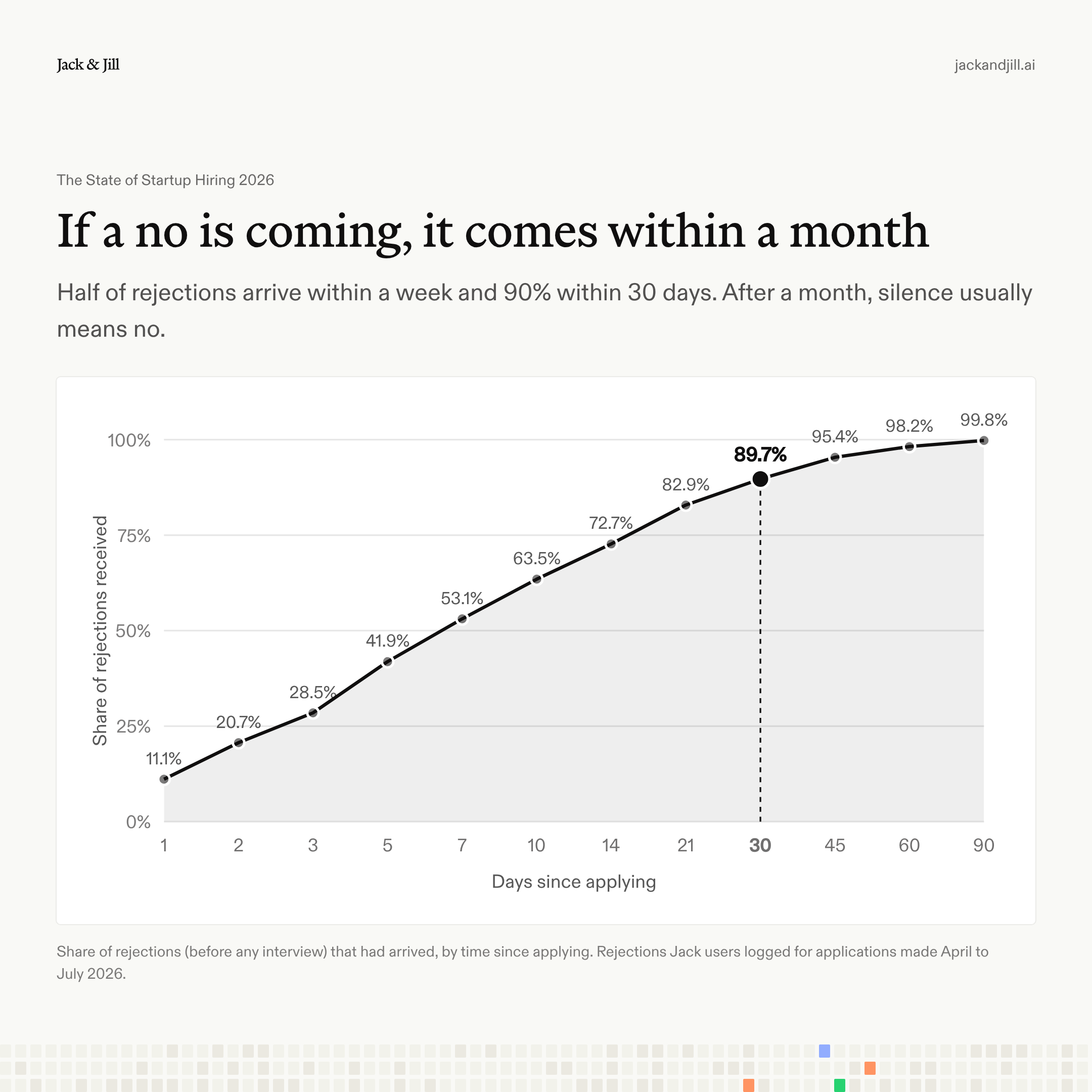
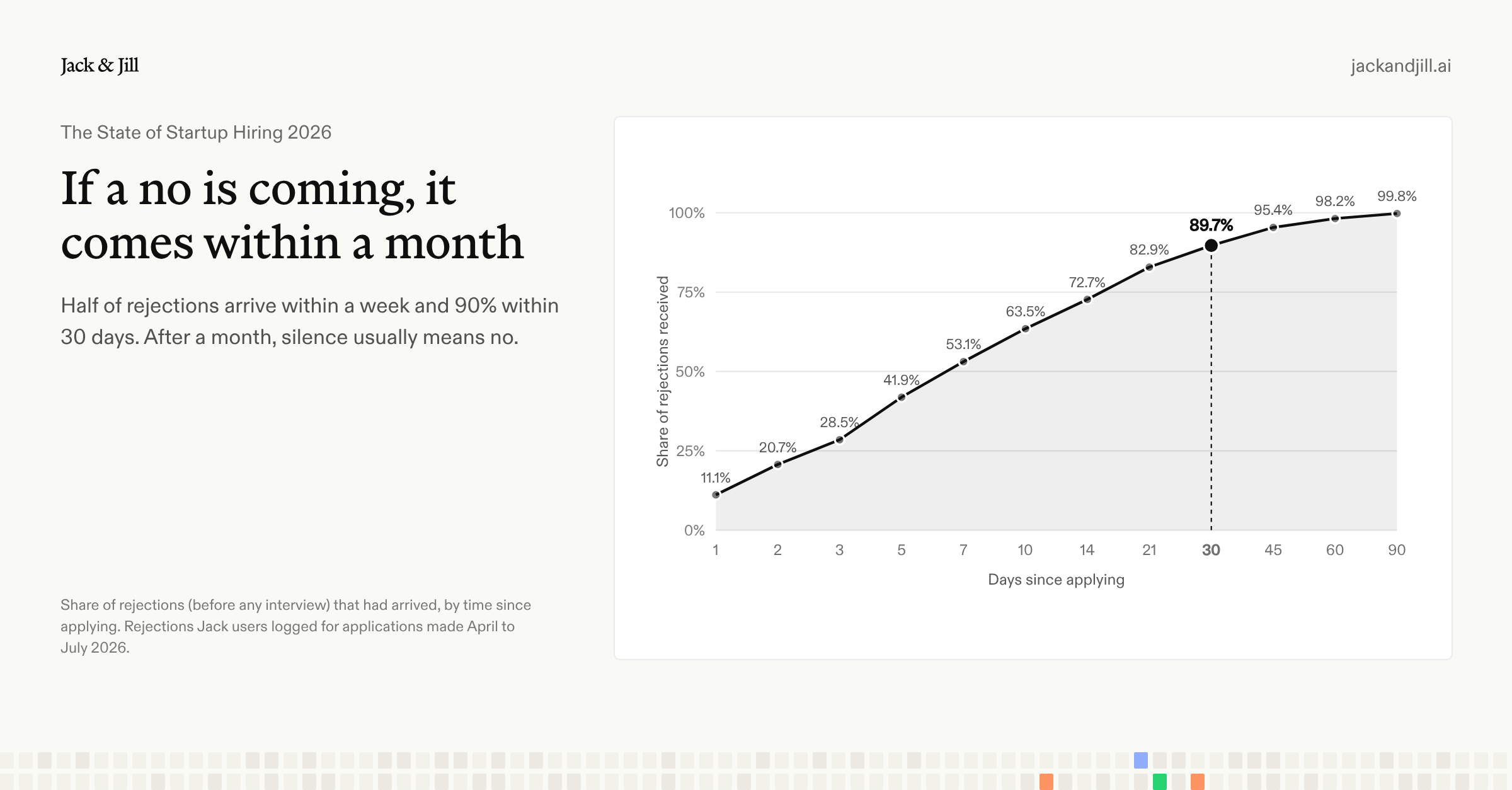
If a no is coming, it comes within a month
Half of rejections arrive within a week and 90% within 30 days. After a month, silence usually means no.
Share of rejections (before any interview) that had arrived, by time since applying. Rejections Jack users logged for applications made April to July 2026.
Careers pages can be misleading.
Job ads offer an imperfect picture of who’s actually hiring. Roles can sit on careers pages for months or be repeatedly reposted. An older ad might still represent a real opening, but candidates have little way of knowing whether a company is hiring urgently, taking its time or no longer looking.
And the roles advertised are only part of the picture. Some companies keep openings off their careers pages to avoid a flood of low-quality applications. It’s hard to quantify how common this is, but it’s something we hear frequently from Jill customers.
Candidates are left trying to work out which advertised roles are still open, which opportunities aren’t advertised at all, and which companies would welcome a conversation.
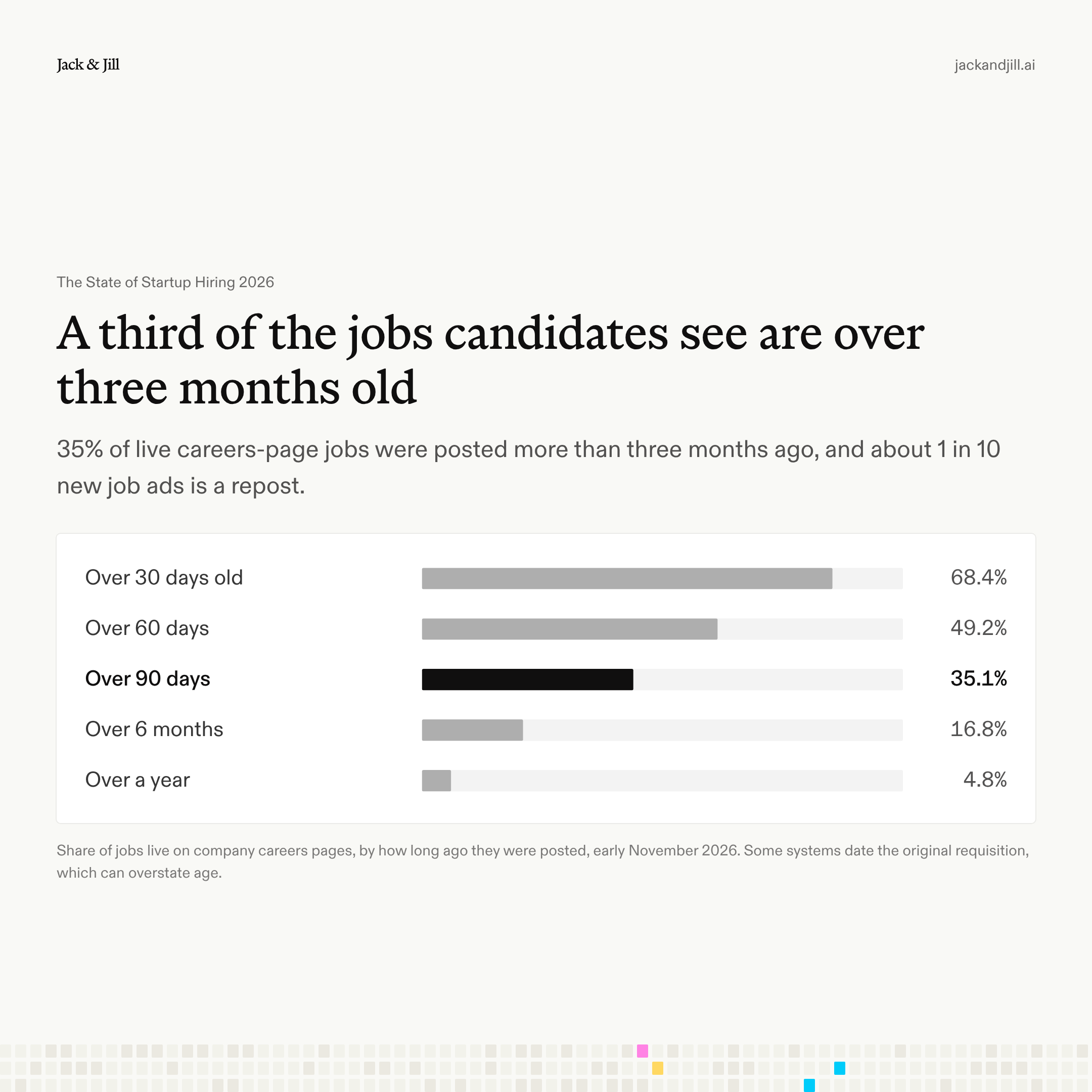
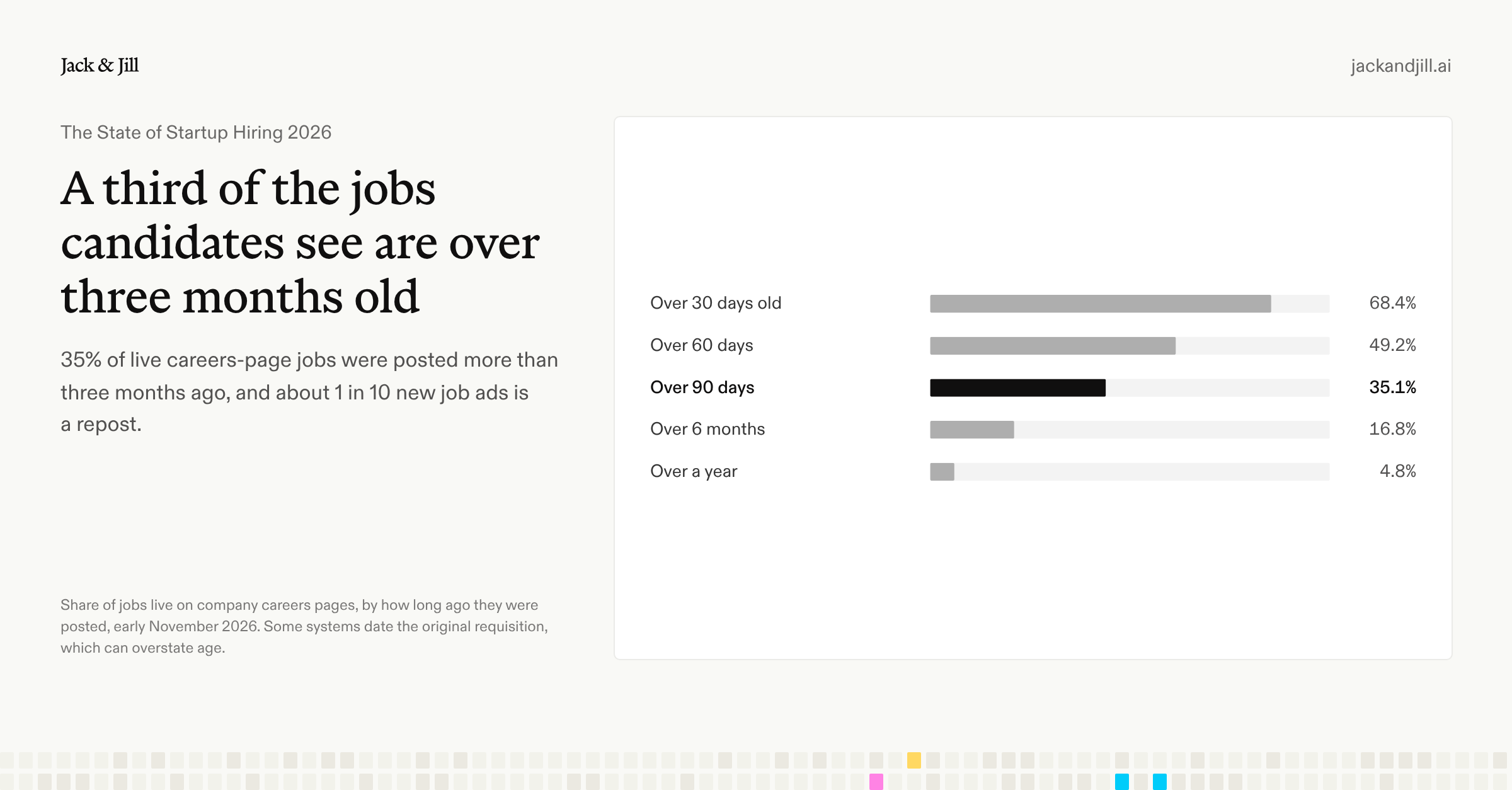
A third of the jobs candidates see are over three months old
35% of live careers-page jobs were posted more than three months ago, and about 1 in 10 new job ads is a repost.
Over 30 days old68.4%
Over 60 days49.2%
Over 90 days35.1%
Over 6 months16.8%
Over a year4.8%
Share of jobs live on company careers pages, by how long ago they were posted, early November 2026. Some systems date the original requisition, which can overstate age.
What candidates want from their next move
People want to keep learning, build things with AI and see their own kitchen at least two days a week. A handful of startups get most of the attention.
Why do they move?
People leave when the job stops teaching them anything, and they go wherever they’ll learn and own more. Equity, often treated as a startup’s trump card, is named by just 10.3%.
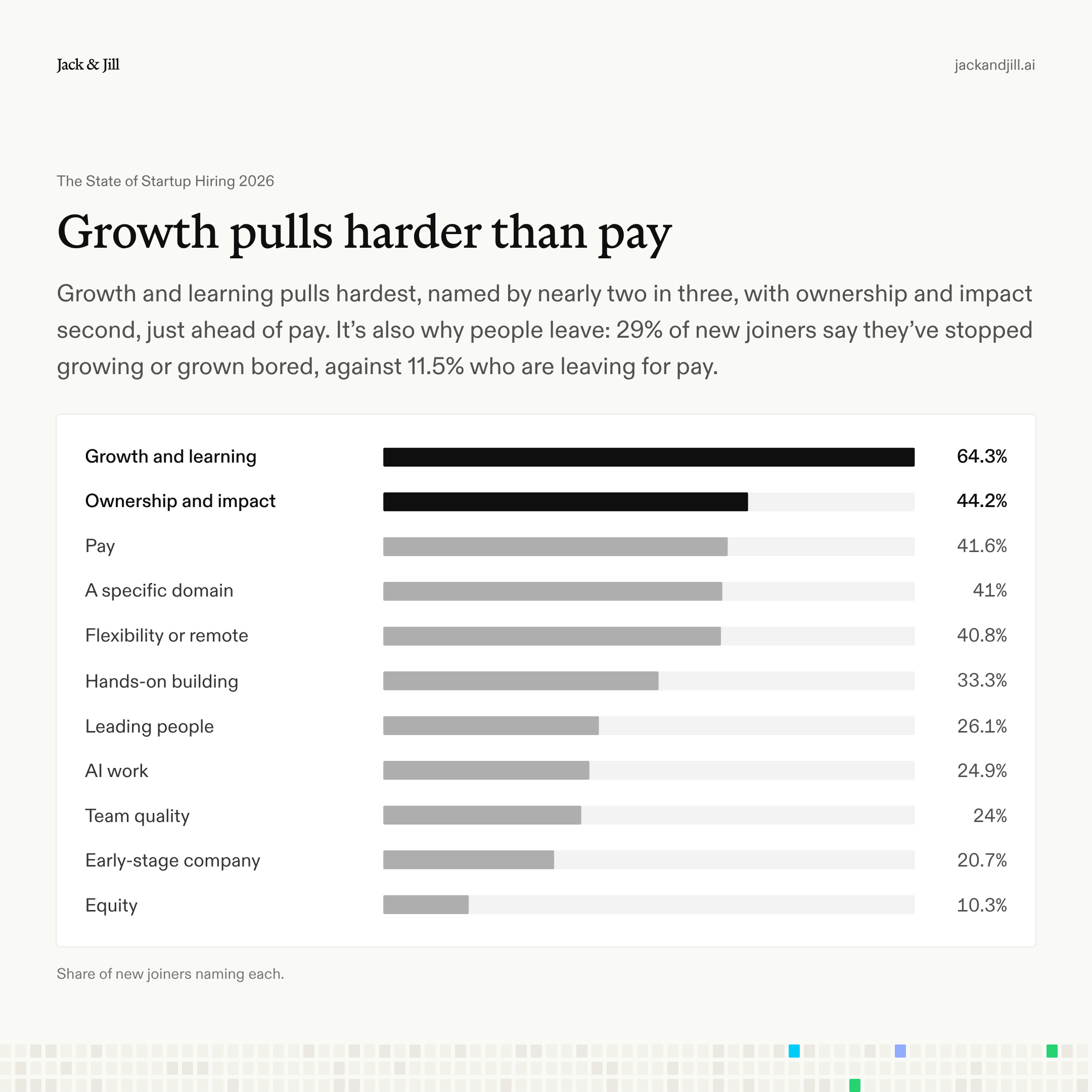
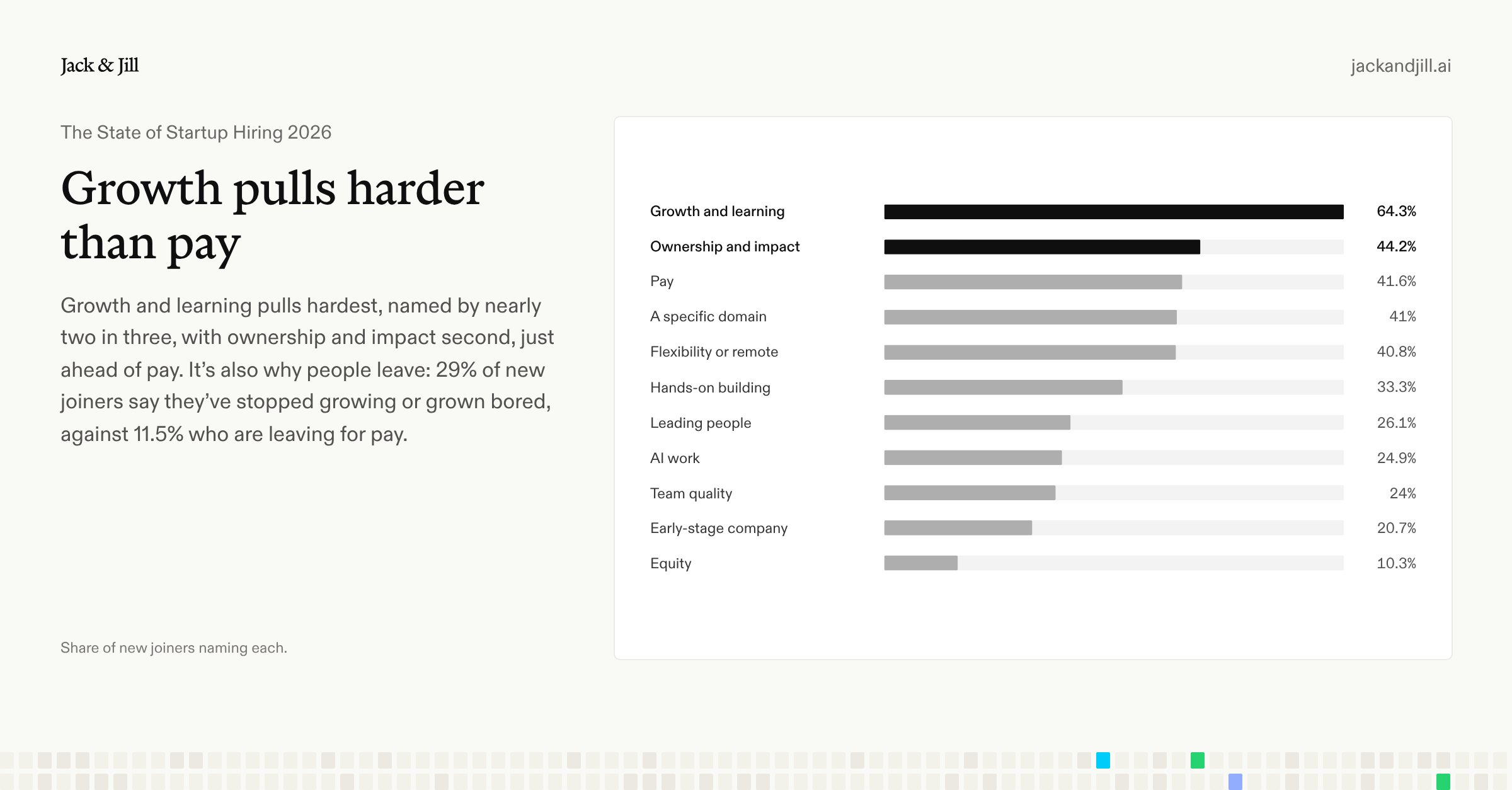
Growth pulls harder than pay
Growth and learning pulls hardest, named by nearly two in three, with ownership and impact second, just ahead of pay. It’s also why people leave: 29% of new joiners say they’ve stopped growing or grown bored, against 11.5% who are leaving for pay.
Growth and learning64.3%
Ownership and impact44.2%
Pay41.6%
A specific domain41%
Flexibility or remote40.8%
Hands-on building33.3%
Leading people26.1%
AI work24.9%
Team quality24%
Early-stage company20.7%
Equity10.3%
Share of new joiners naming each.
Who wants to switch careers?
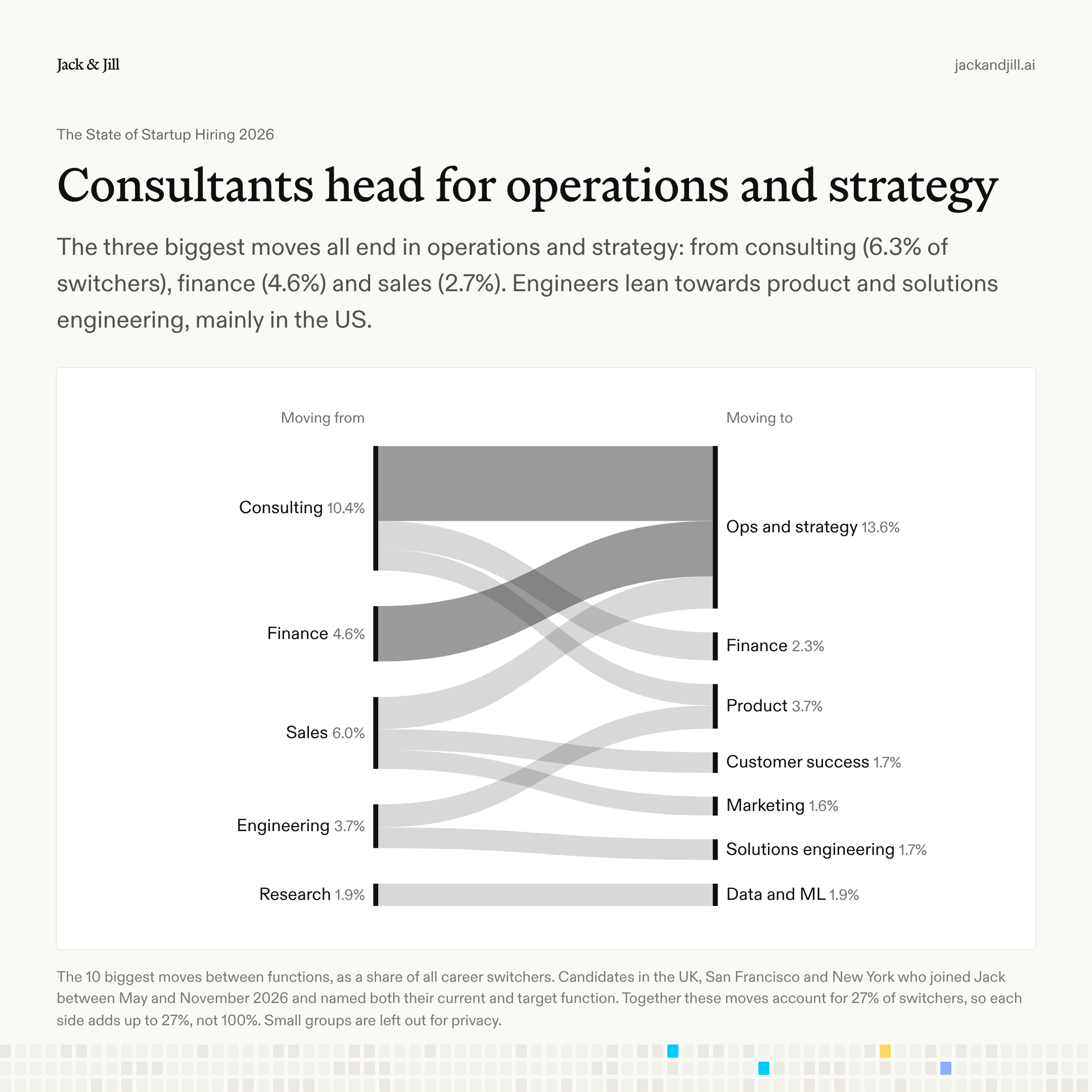
About 1 in 7 candidates (14.8%) want to move into a different function. The single biggest move is consulting to operations and strategy.
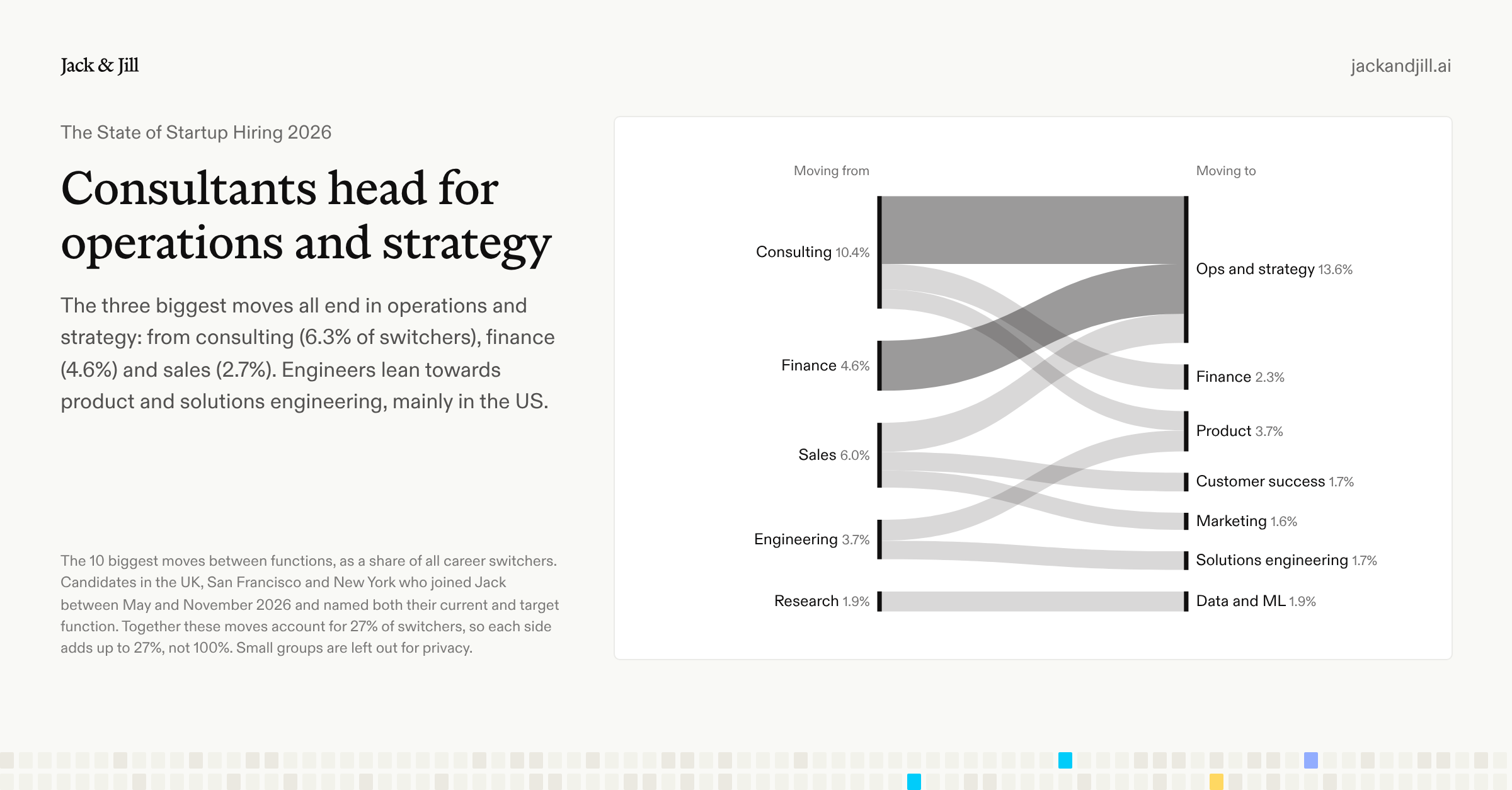
Consultants head for operations and strategy
The three biggest moves all end in operations and strategy: from consulting (6.3% of switchers), finance (4.6%) and sales (2.7%). Engineers lean towards product and solutions engineering, mainly in the US.
The 10 biggest moves between functions, as a share of all career switchers. Candidates in the UK, San Francisco and New York who joined Jack between May and November 2026 and named both their current and target function. Together these moves account for 27% of switchers, so each side adds up to 27%, not 100%. Small groups are left out for privacy.
Counting everyone who wants in against everyone who wants out, product gains the most (a net gain equal to 10% of switchers), followed by operations and strategy (9%) and data and ML (4%). Consulting loses the most (11%), then research (7%) and engineering (4%).
Who wants to be a forward deployed engineer?
FDE is the fastest-growing title in tech (see How demand is shifting). The people chasing it are mostly engineers moving closer to customers.
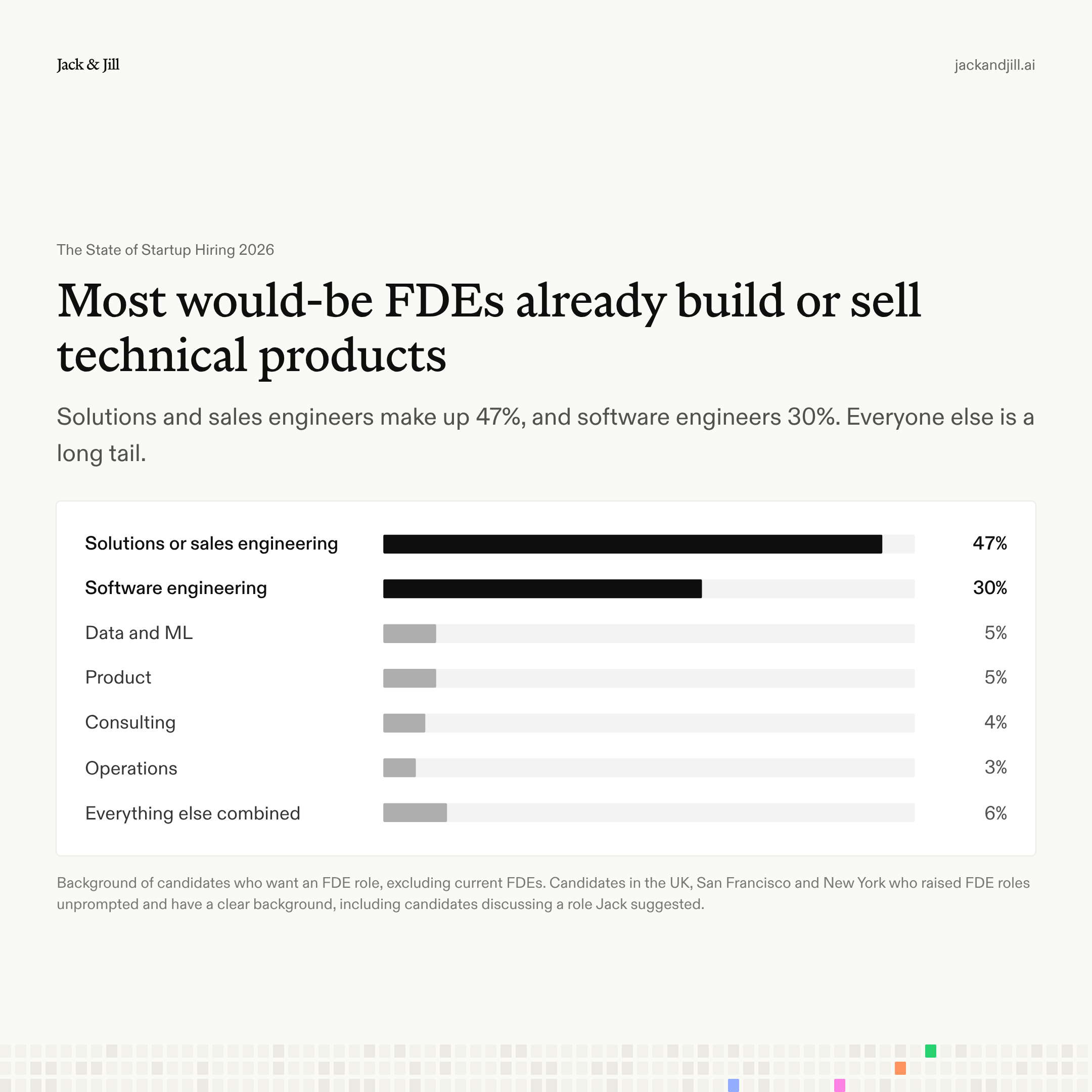
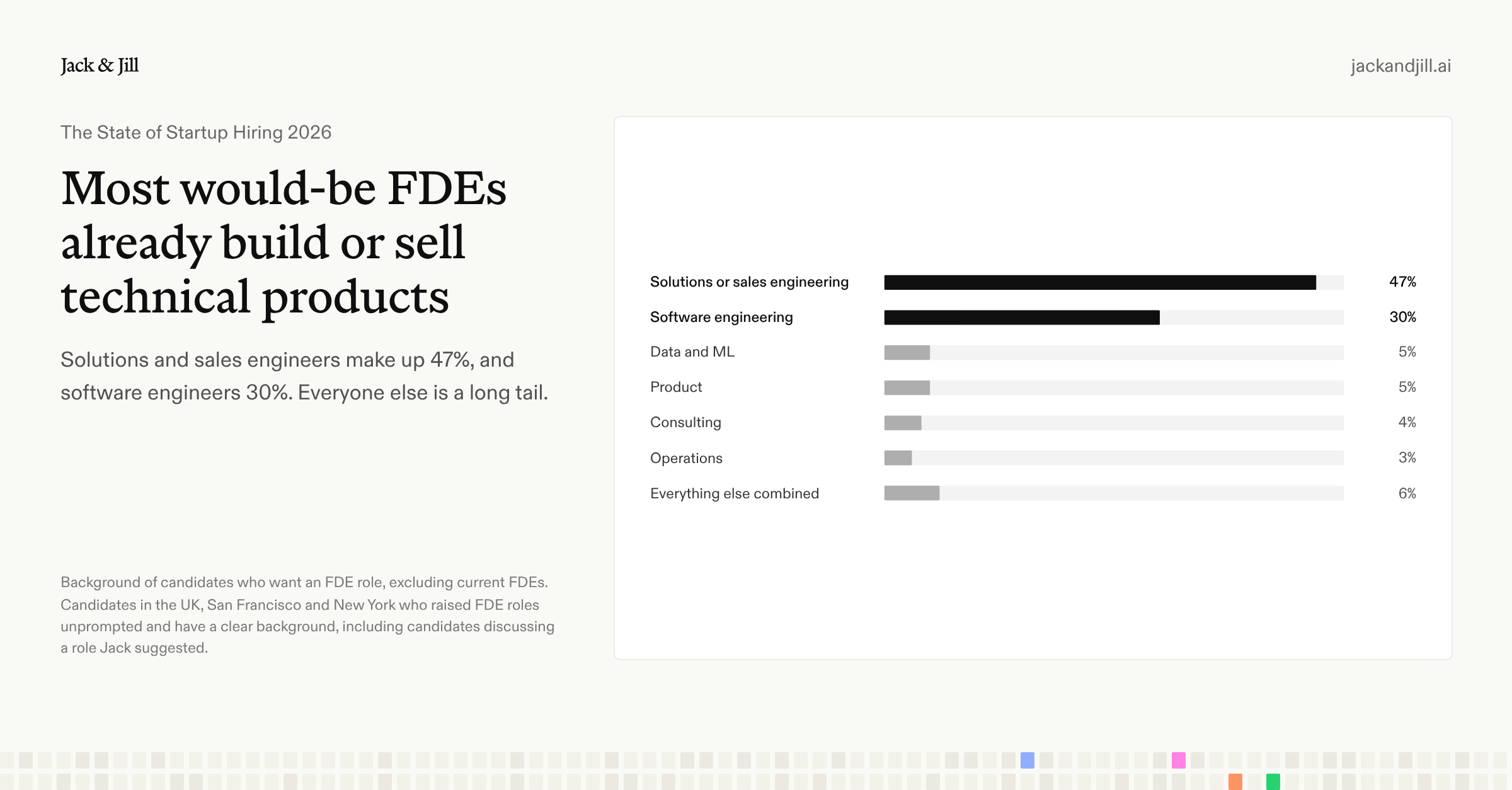
Most would-be FDEs already build or sell technical products
Solutions and sales engineers make up 47%, and software engineers 30%. Everyone else is a long tail.
Solutions or sales engineering47%
Software engineering30%
Data and ML5%
Product5%
Consulting4%
Operations3%
Everything else combined6%
Background of candidates who want an FDE role, excluding current FDEs. Candidates in the UK, San Francisco and New York who raised FDE roles unprompted and have a clear background, including candidates discussing a role Jack suggested.
Most are drawn by the mix of technical and customer work, which 79% mention (no surprise, since that’s the job), and about half by the chance to work in AI. Pay matters less, coming up for 13%. The most common concern (still only mentioned by 6%) is not being technical enough for the role.
What do candidates think about AI?
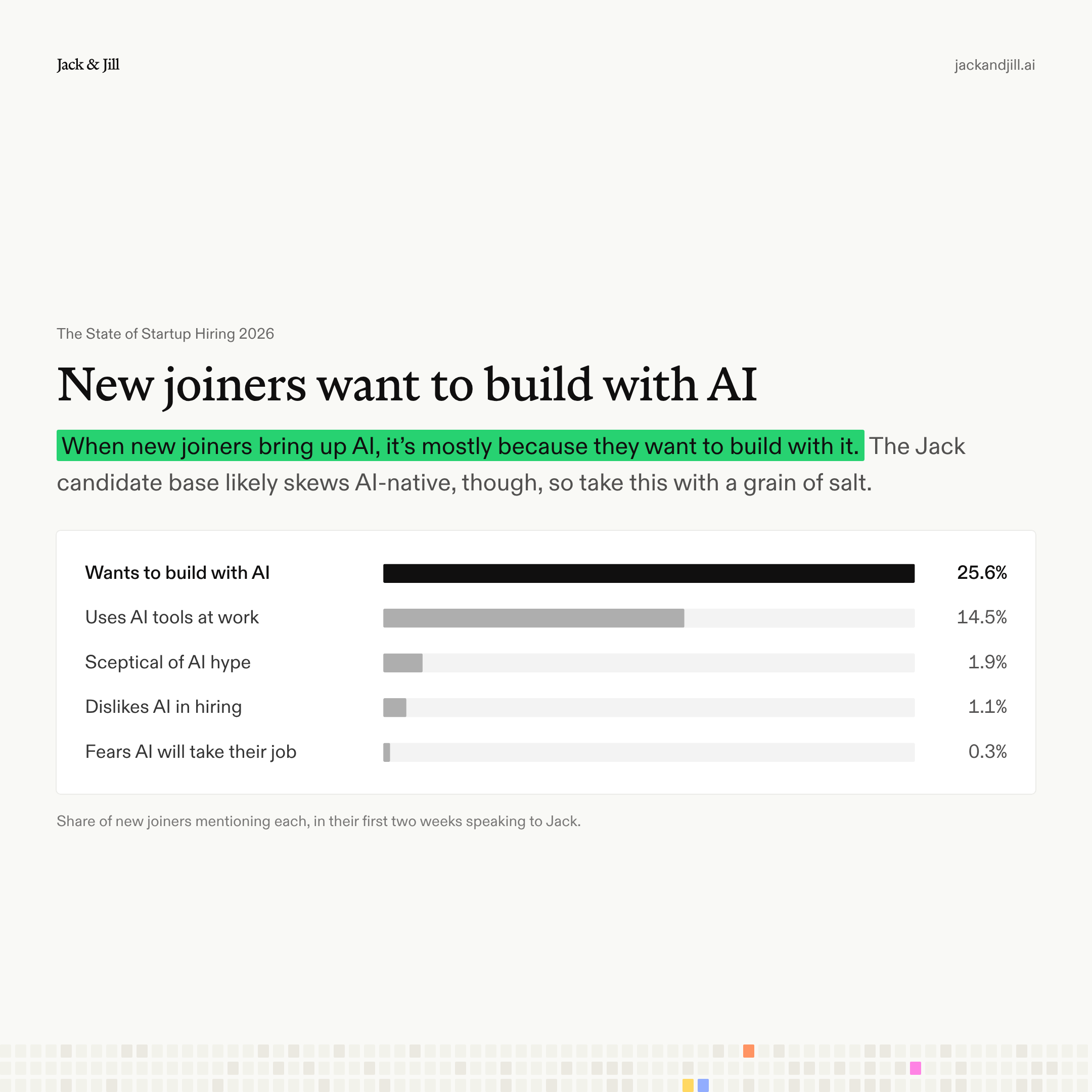
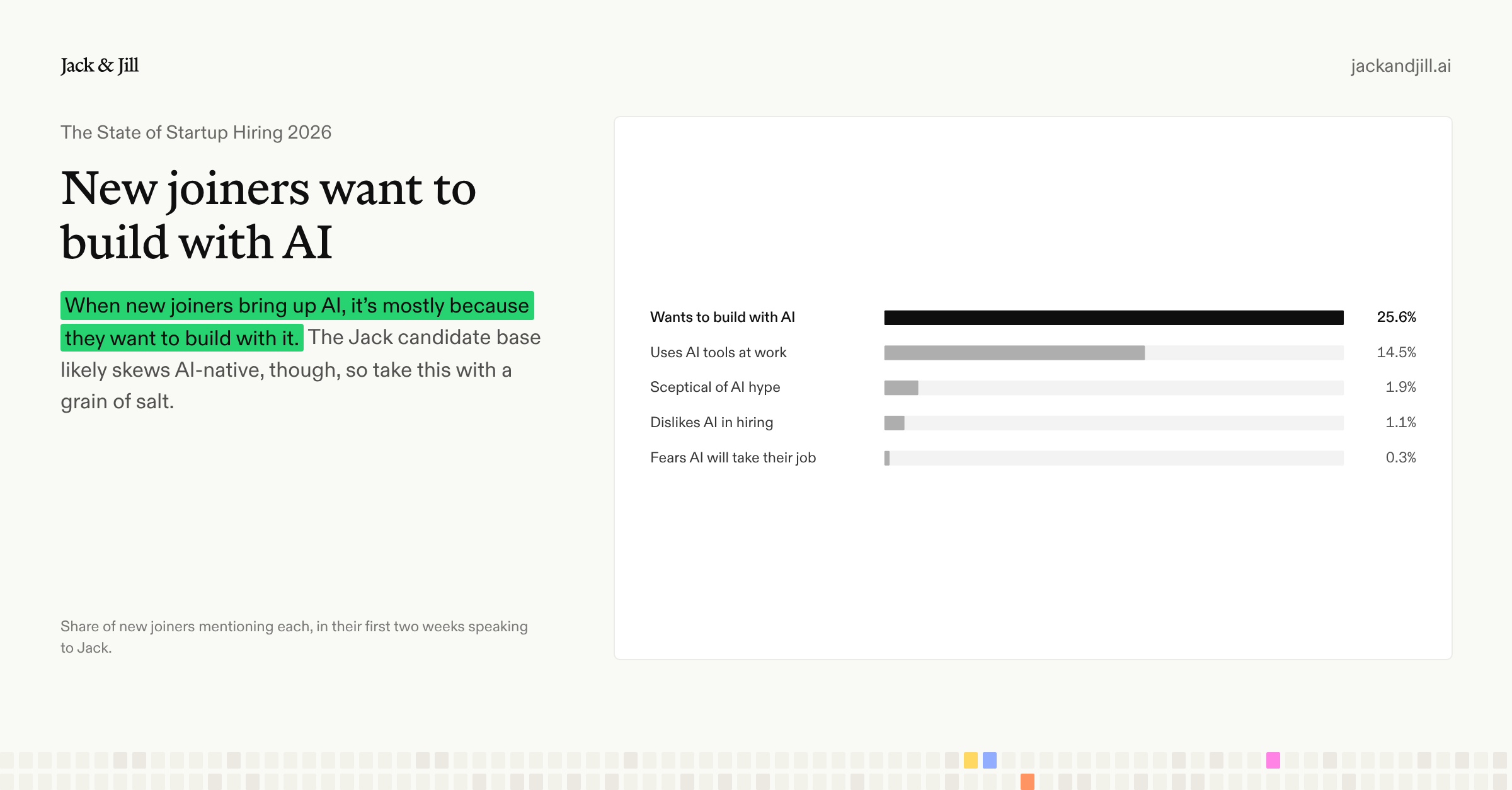
New joiners want to build with AI
When new joiners bring up AI, it’s mostly because they want to build with it. The Jack candidate base likely skews AI-native, though, so take this with a grain of salt.
Wants to build with AI25.6%
Uses AI tools at work14.5%
Sceptical of AI hype1.9%
Dislikes AI in hiring1.1%
Fears AI will take their job0.3%
Share of new joiners mentioning each, in their first two weeks speaking to Jack.
Where do they want to work?
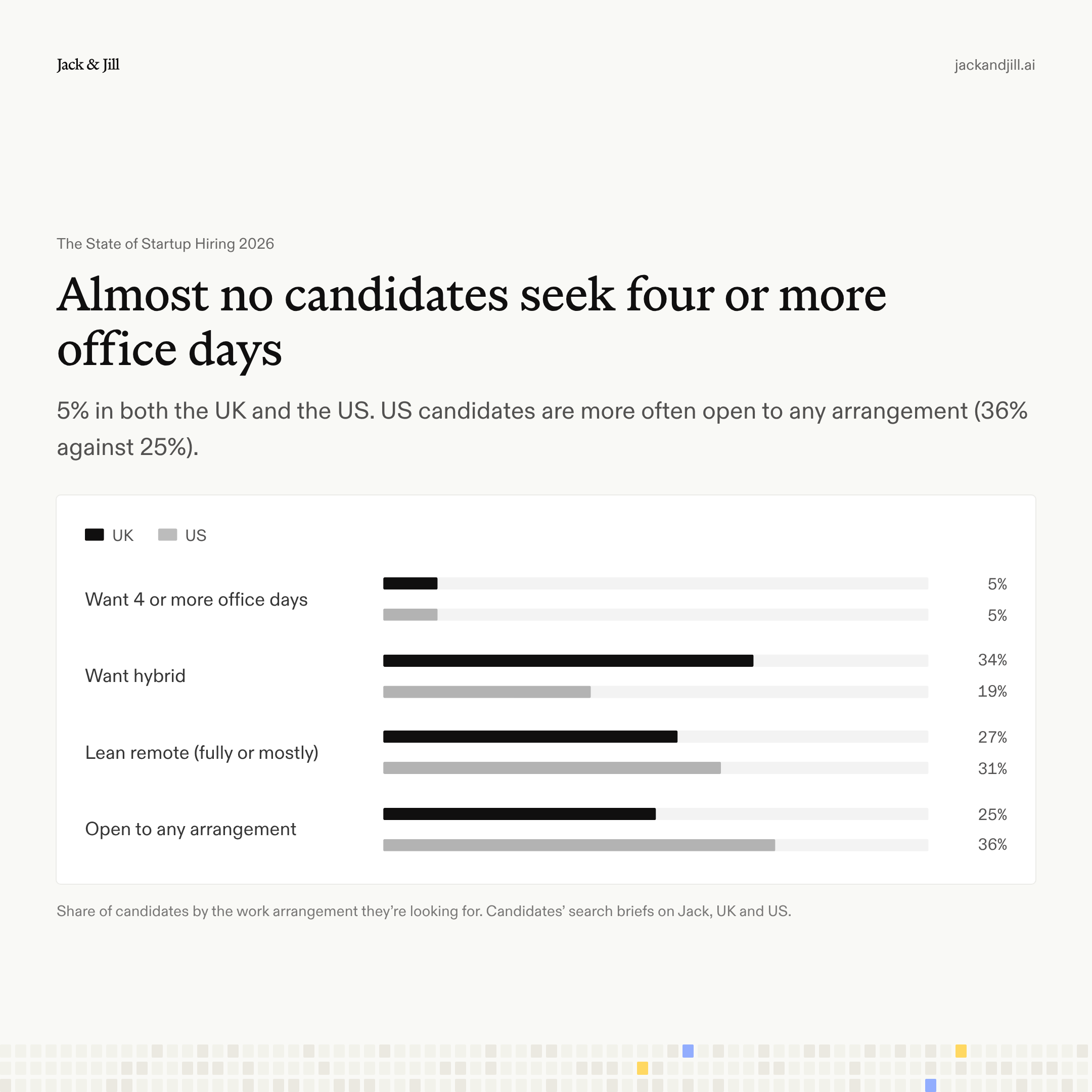
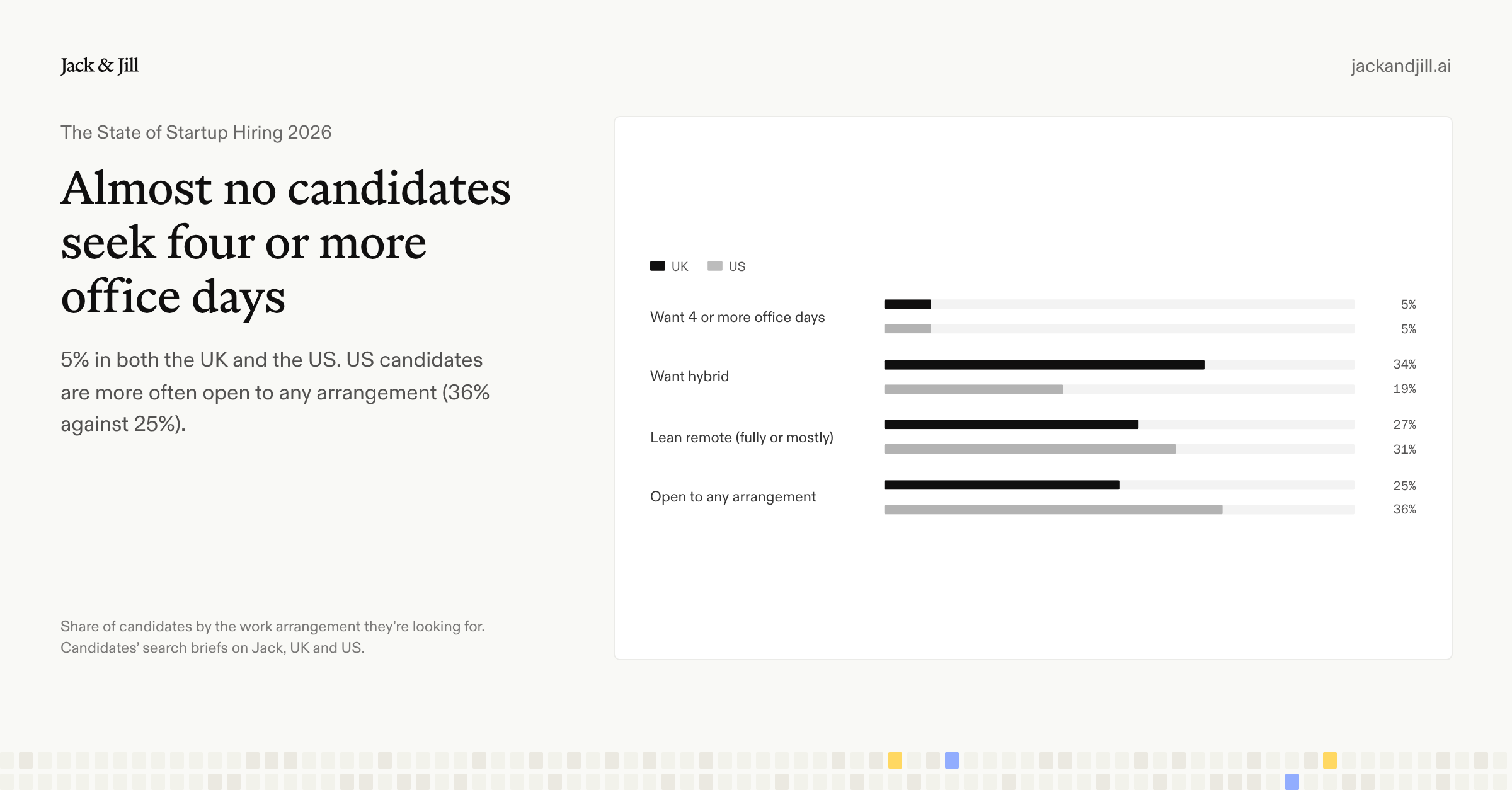
Only 5% of candidates in the UK and the US seek four or more office days. New York and San Francisco candidates are more flexible: more are open to anything, and more would move cities for the right role.
5%
of candidates seek four or more office days
The same in the UK and the US.
36%
of US candidates are open to any arrangement
Against 25% in the UK.
1 in 3
US candidates would relocate for a role
Against 22% in the UK.
Almost no candidates seek four or more office days
5% in both the UK and the US. US candidates are more often open to any arrangement (36% against 25%).
UKUS
Want 4 or more office days
5%
5%
Want hybrid
34%
19%
Lean remote (fully or mostly)
27%
31%
Open to any arrangement
25%
36%
Share of candidates by the work arrangement they’re looking for. Candidates’ search briefs on Jack, UK and US.
Most would flex. About 70% in the UK and the US see their preference as negotiable, and half say they’d compromise for the right role, company or pay. When New York and San Francisco candidates won’t compromise, it’s usually because they want a fully remote role.
Which startups do candidates most want to work for?
Our Most Wanted ranking, published at the end of October 2026, ranks the top startups by Jack candidate interest. Specifically, we counted how many different candidates saved one of a company’s roles or told Jack they’d like to work there in the last 90 days. Each person counts once per company. Frontier AI labs are left out, so the list stays on startups and scale-ups.
“Faculty has the scrappiness of a startup with the structure and processes of a more established company, which is important for innovating in regulated industries.”
“The challenge of making AI reliable is an enormously important problem, and Prolific’s model appeals to me from both a practical and ethical perspective.”
Growth opportunities normally start the conversation, and money usually ends it. Once there’s an offer, most people who negotiate win something, and British notice periods make everyone wait.
Why do they say no?
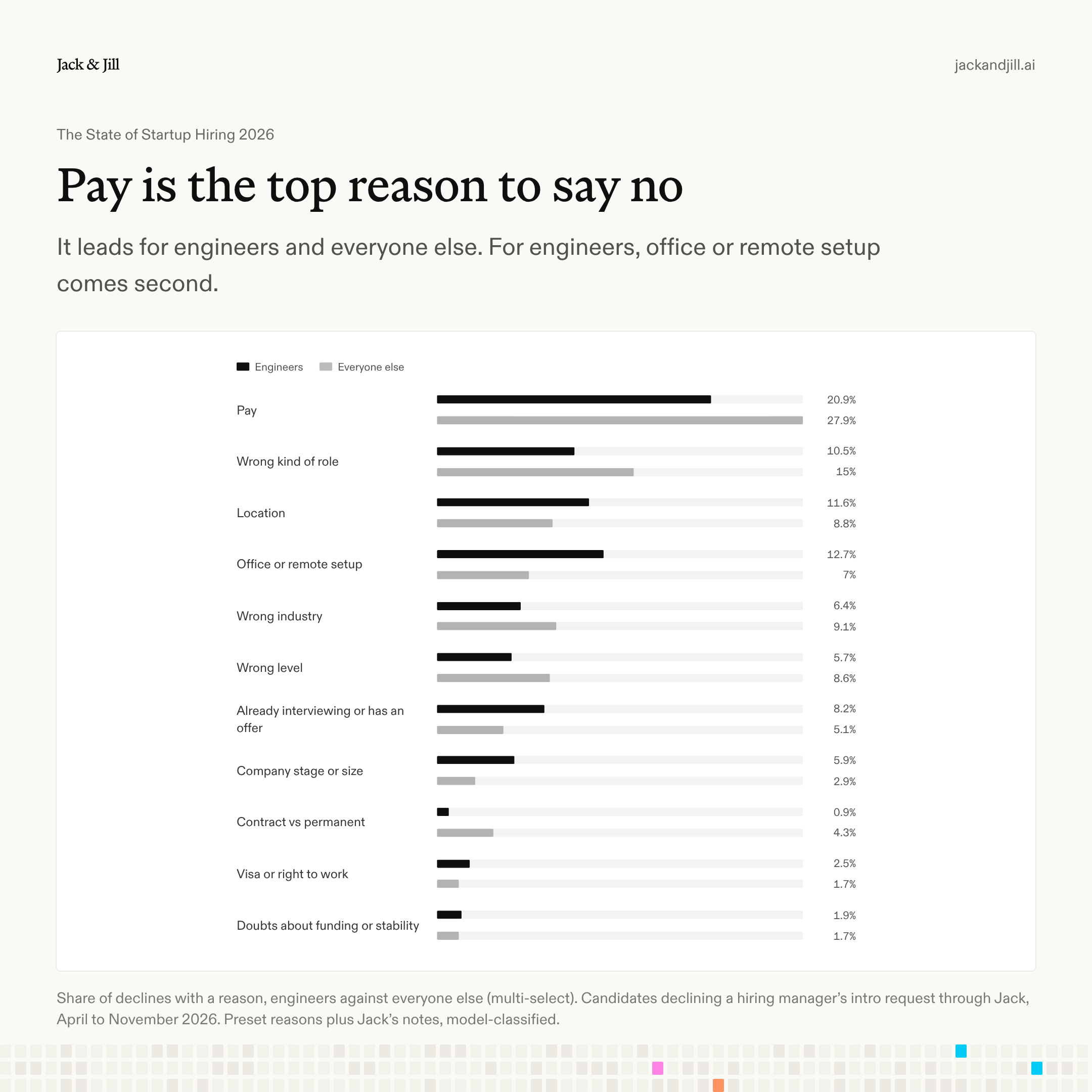
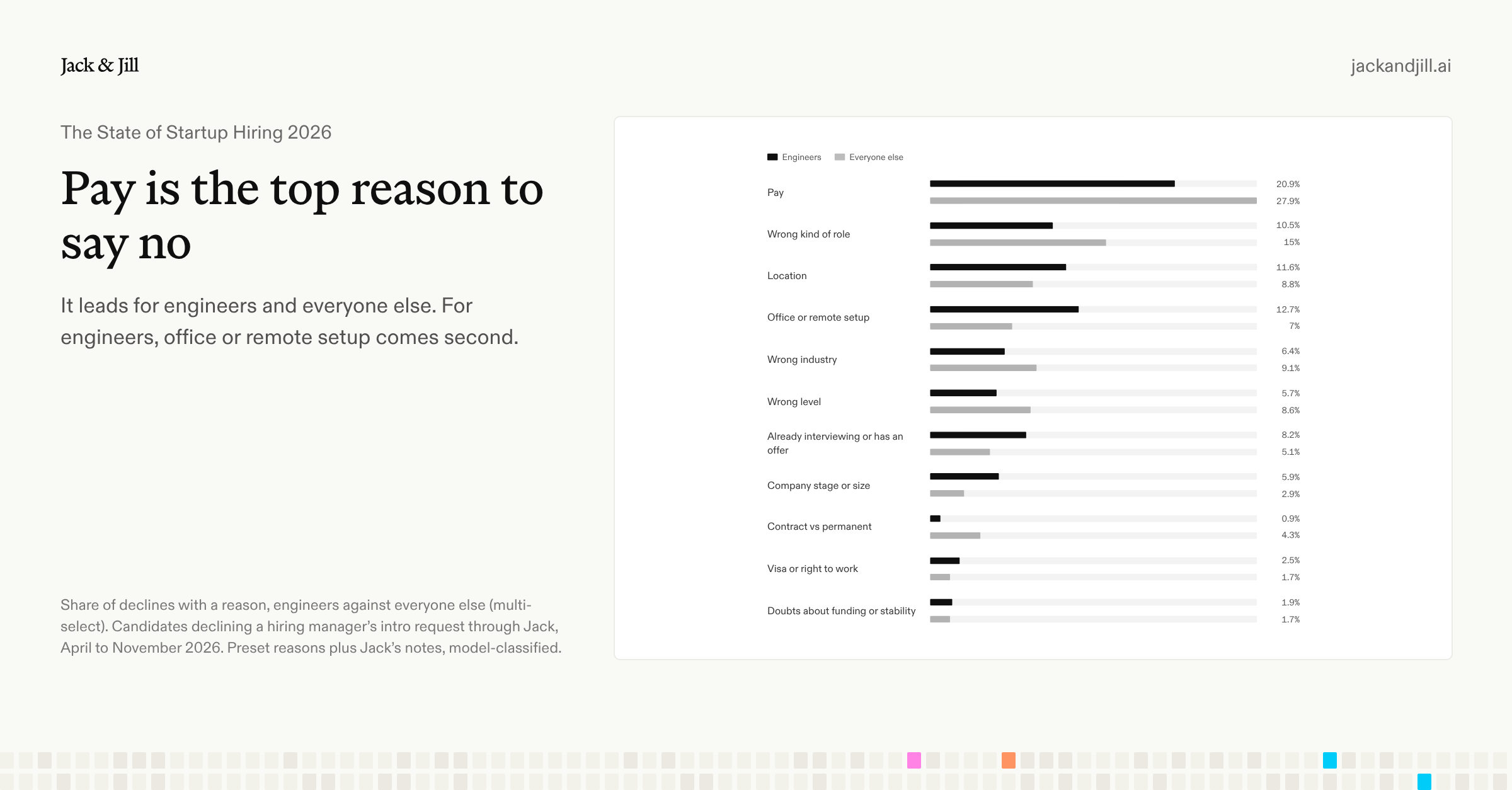
Pay comes up in about a quarter of declines, in the UK (25.5%) and the US (23.6%) alike. The vast majority of candidates are open to startup risk: doubts about funding or stability come in under 2% everywhere.
Pay is the top reason to say no
It leads for engineers and everyone else. For engineers, office or remote setup comes second.
EngineersEveryone else
Pay
20.9%
27.9%
Wrong kind of role
10.5%
15%
Location
11.6%
8.8%
Office or remote setup
12.7%
7%
Wrong industry
6.4%
9.1%
Wrong level
5.7%
8.6%
Already interviewing or has an offer
8.2%
5.1%
Company stage or size
5.9%
2.9%
Contract vs permanent
0.9%
4.3%
Visa or right to work
2.5%
1.7%
Doubts about funding or stability
1.9%
1.7%
Share of declines with a reason, engineers against everyone else (multi-select). Candidates declining a hiring manager’s intro request through Jack, April to November 2026. Preset reasons plus Jack’s notes, model-classified.
What happens once there’s an offer?
Asking for more usually works. Starting quickly is harder in the UK, where 45% of candidates have a notice period of two months or more.
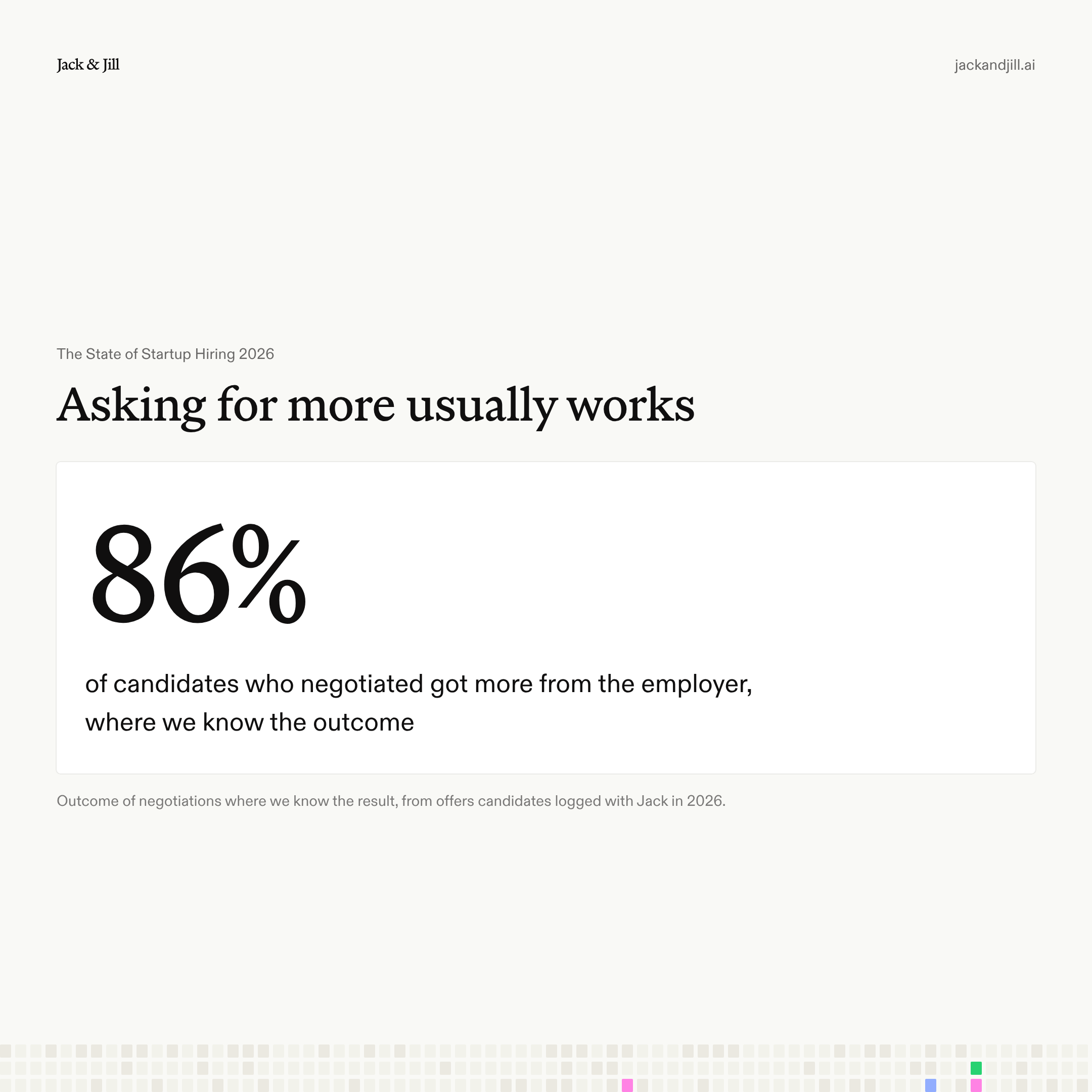
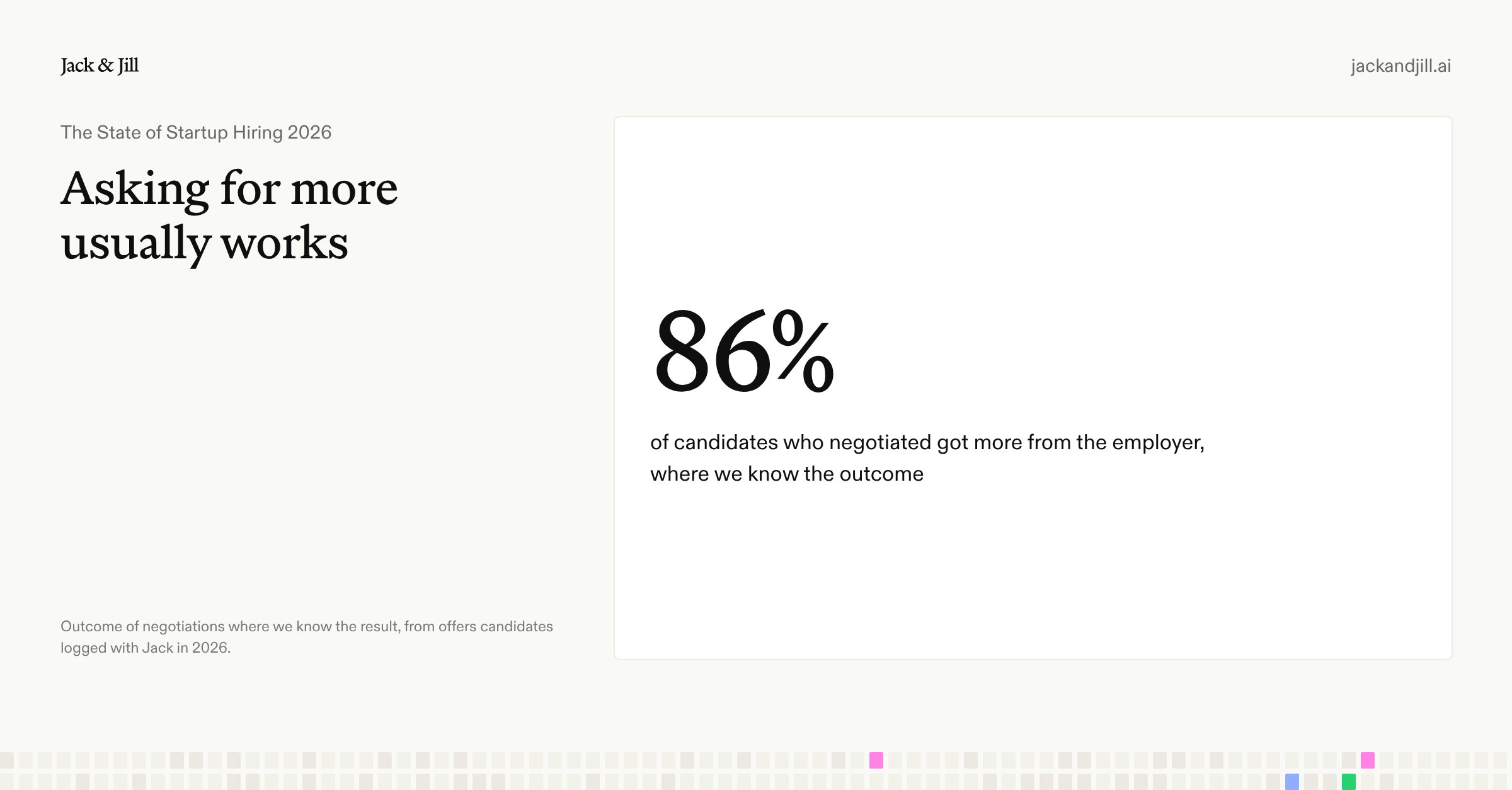
Asking for more usually works
86%
of candidates who negotiated got more from the employer, where we know the outcome
Outcome of negotiations where we know the result, from offers candidates logged with Jack in 2026.
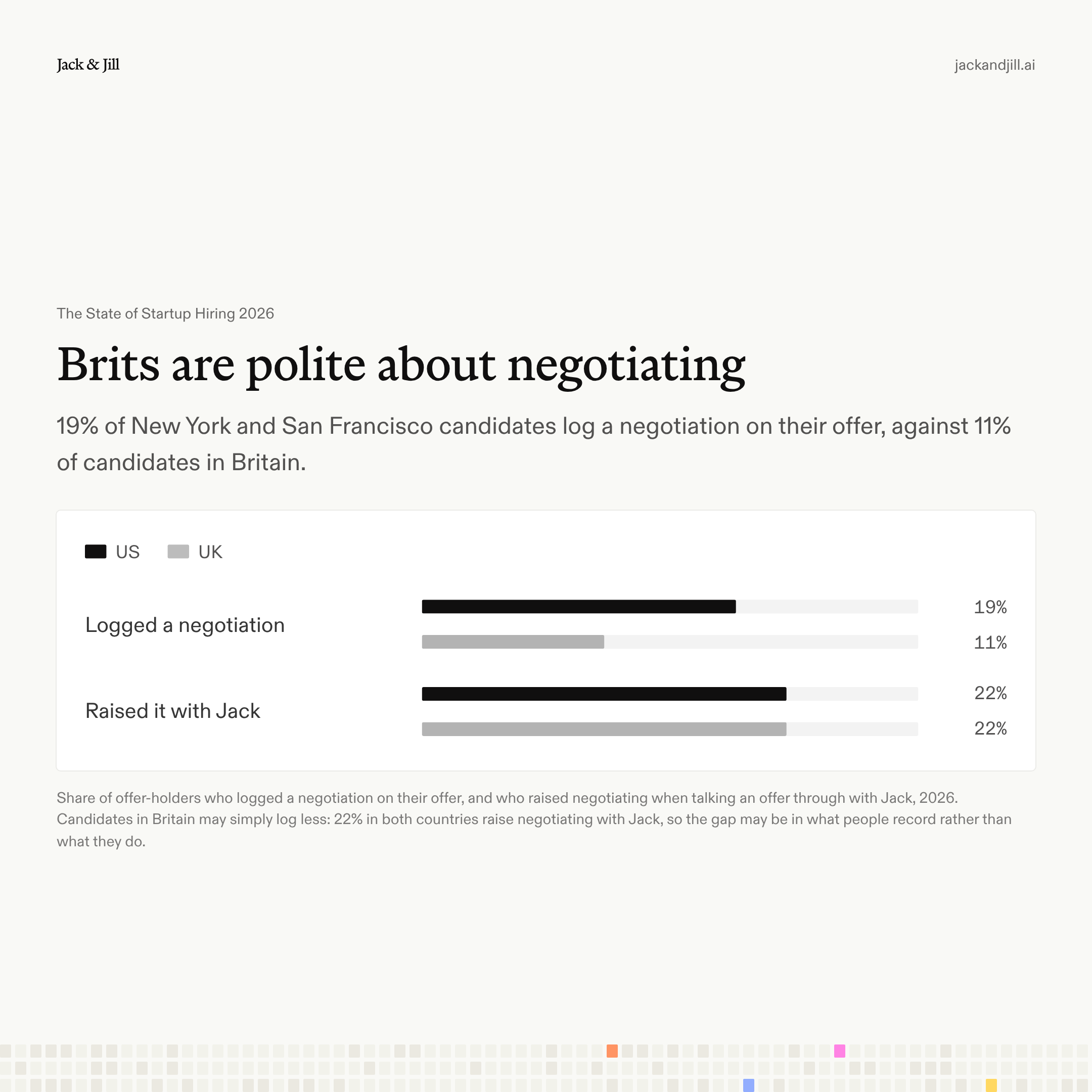
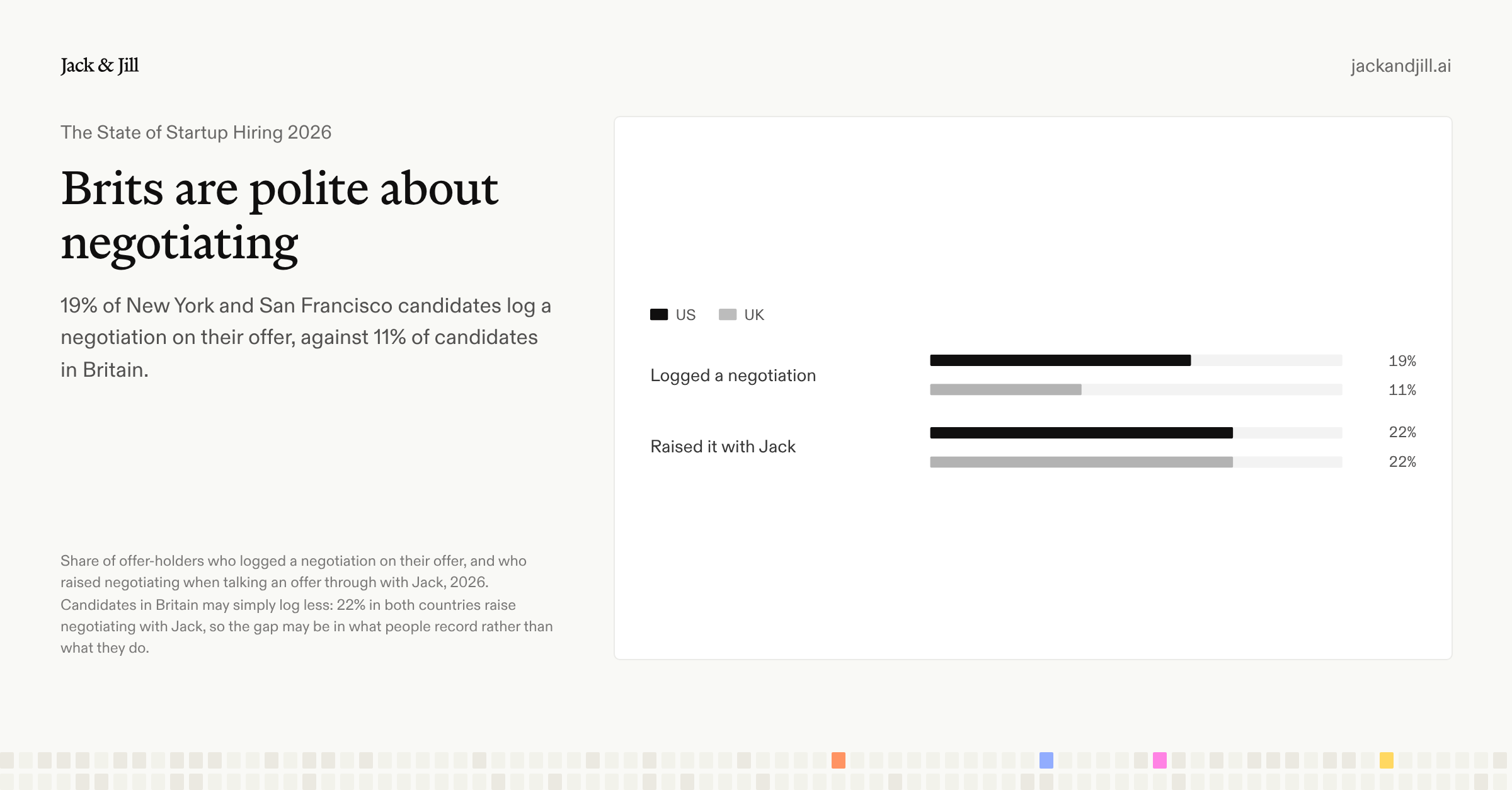
Brits are polite about negotiating
19% of New York and San Francisco candidates log a negotiation on their offer, against 11% of candidates in Britain.
USUK
Logged a negotiation
19%
11%
Raised it with Jack
22%
22%
Share of offer-holders who logged a negotiation on their offer, and who raised negotiating when talking an offer through with Jack, 2026. Candidates in Britain may simply log less: 22% in both countries raise negotiating with Jack, so the gap may be in what people record rather than what they do.
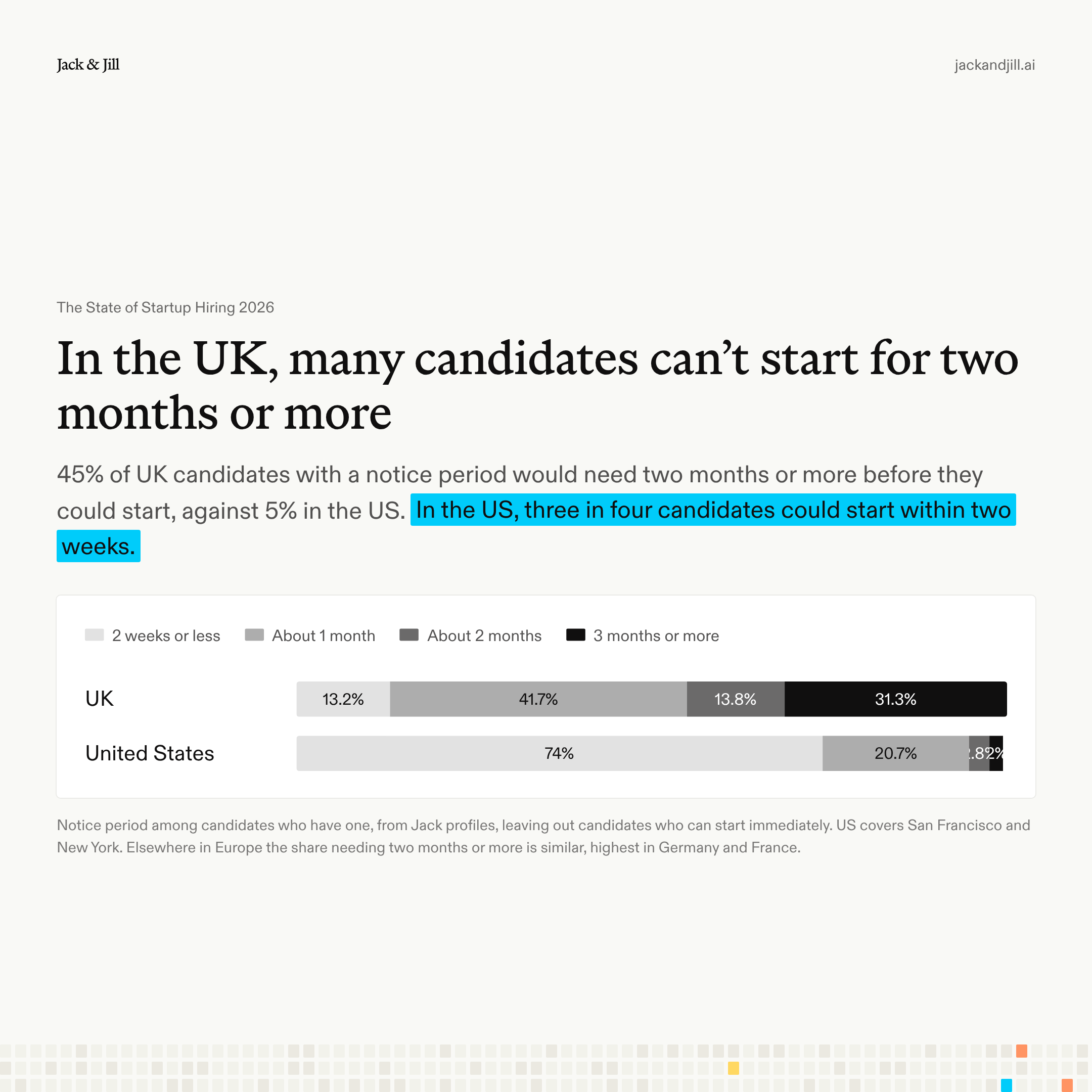
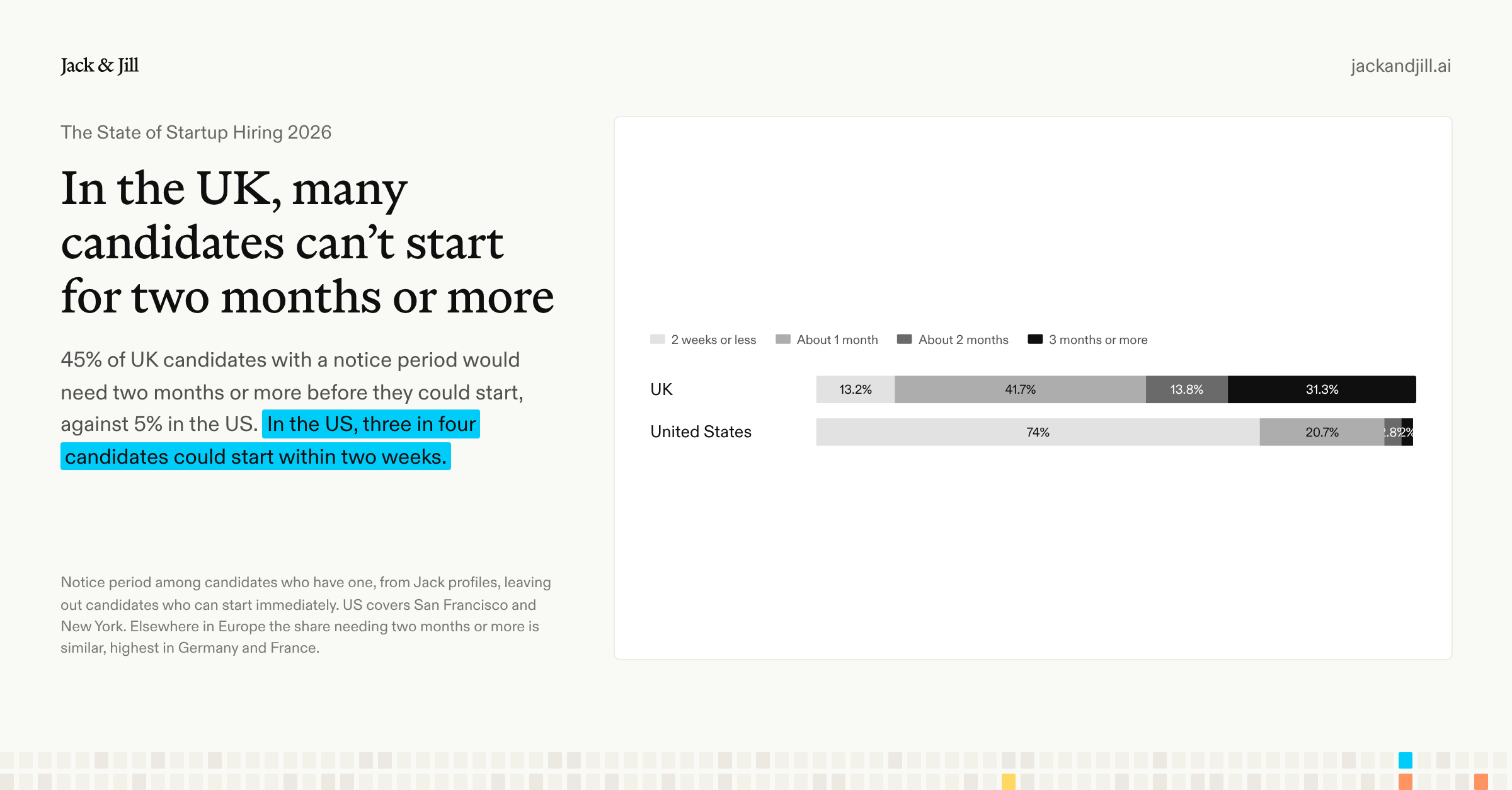
In the UK, many candidates can’t start for two months or more
45% of UK candidates with a notice period would need two months or more before they could start, against 5% in the US. In the US, three in four candidates could start within two weeks.
2 weeks or lessAbout 1 monthAbout 2 months3 months or more
UK
13.2%41.7%13.8%31.3%
United States
74%20.7%2.8%2%
Notice period among candidates who have one, from Jack profiles, leaving out candidates who can start immediately. US covers San Francisco and New York. Elsewhere in Europe the share needing two months or more is similar, highest in Germany and France.
What candidates would change about hiring
Candidates’ wishes are small, specific and cheap to grant: say what it pays, say what the role really is, and reply.
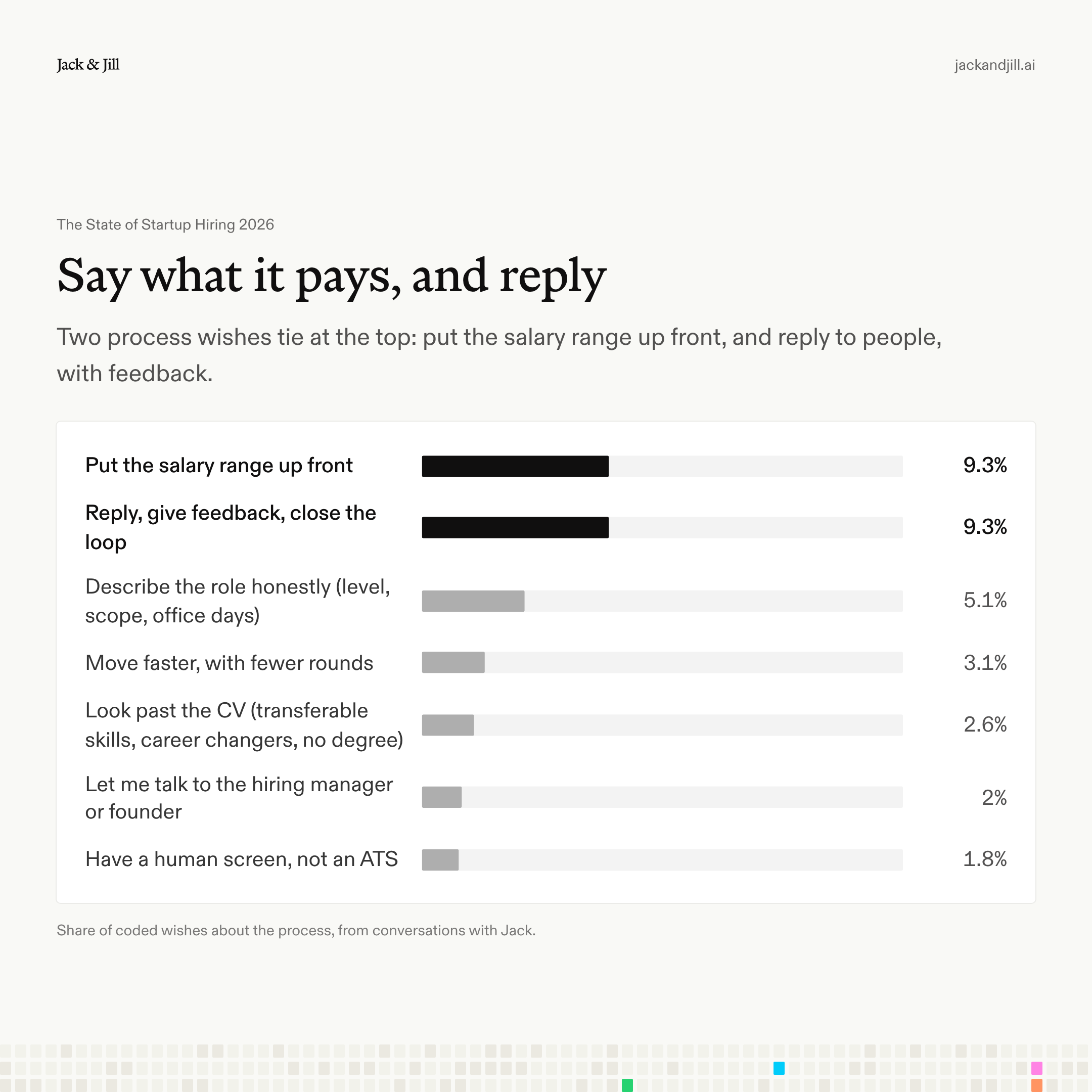
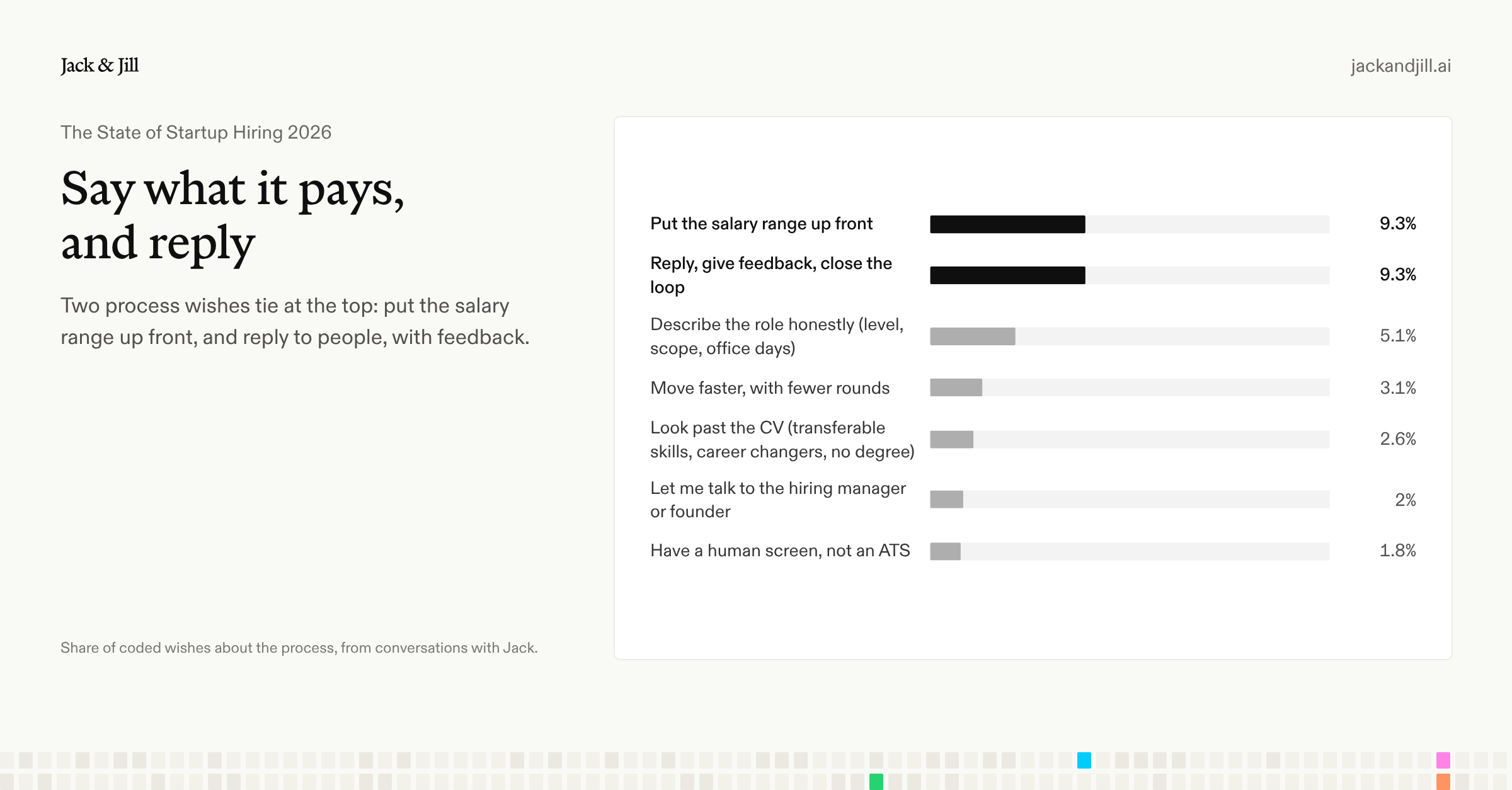
Say what it pays, and reply
Two process wishes tie at the top: put the salary range up front, and reply to people, with feedback.
Put the salary range up front9.3%
Reply, give feedback, close the loop9.3%
Describe the role honestly (level, scope, office days)5.1%
Move faster, with fewer rounds3.1%
Look past the CV (transferable skills, career changers, no degree)2.6%
Let me talk to the hiring manager or founder2%
Have a human screen, not an ATS1.8%
Share of coded wishes about the process, from conversations with Jack.
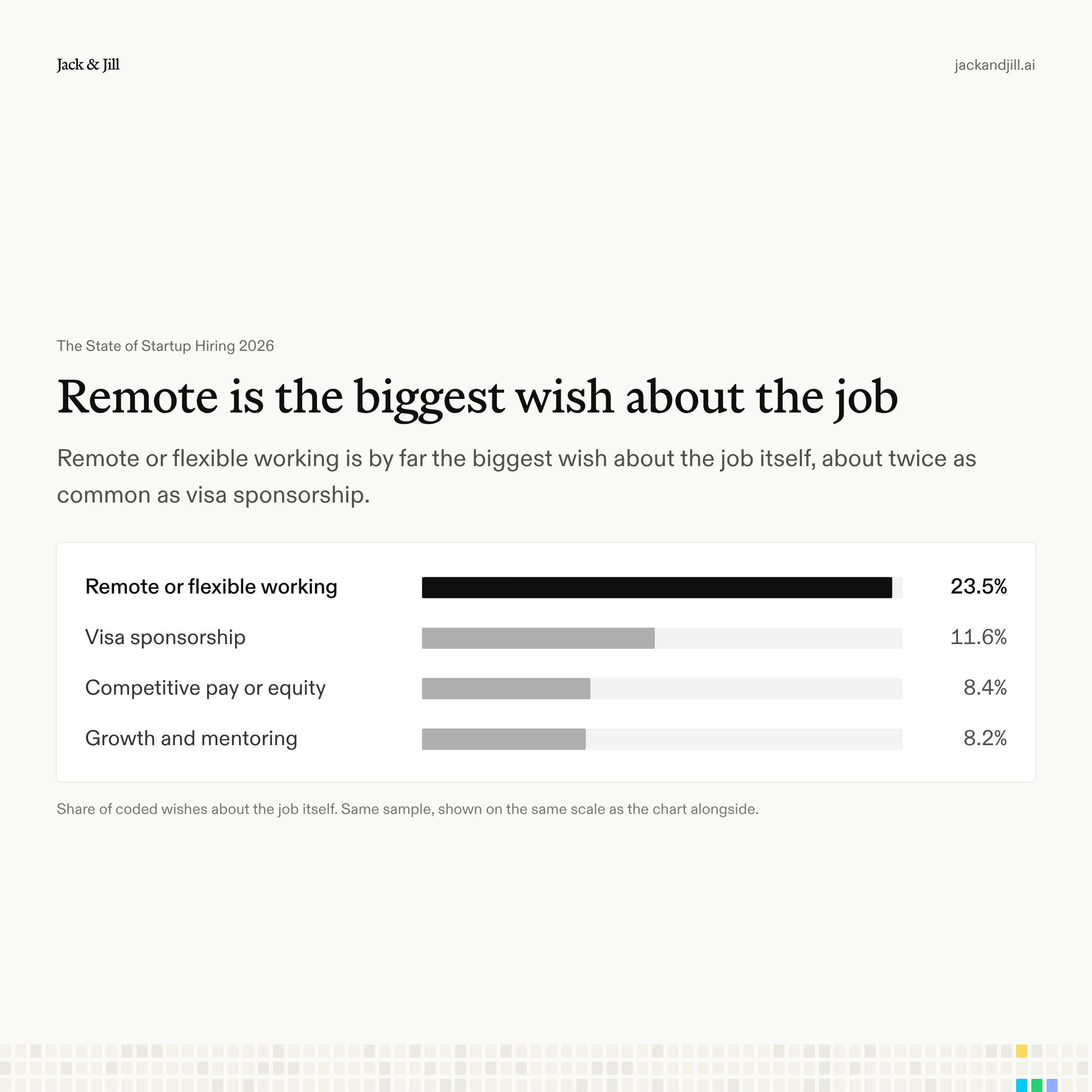
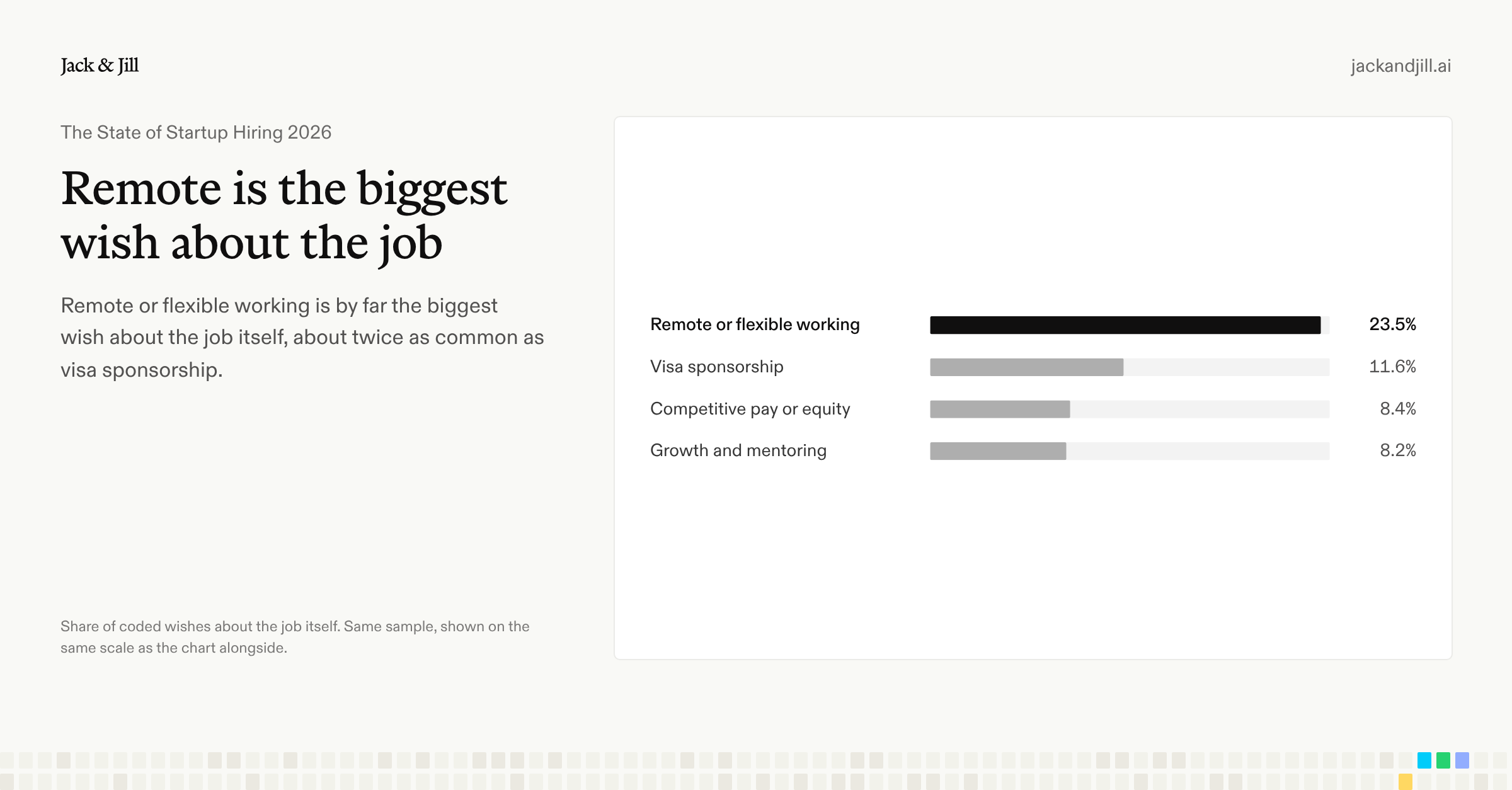
Remote is the biggest wish about the job
Remote or flexible working is by far the biggest wish about the job itself, about twice as common as visa sponsorship.
Remote or flexible working23.5%
Visa sponsorship11.6%
Competitive pay or equity8.4%
Growth and mentoring8.2%
Share of coded wishes about the job itself. Same sample, shown on the same scale as the chart alongside.
For candidates
Thinking about your next move?
Jack gets to know you, finds the roles you’d never think to look for, and introduces you directly when there’s a fit.
This part draws on Jill’s work with talent teams: thousands of roles, April to November 2026, with the reasons hiring managers gave when they passed on candidates. Alongside the data, talent leaders at startups and scale-ups shared what they look for and how their hiring is changing. We’re grateful for their time!
9 in 10
roles ask for someone who takes ownership
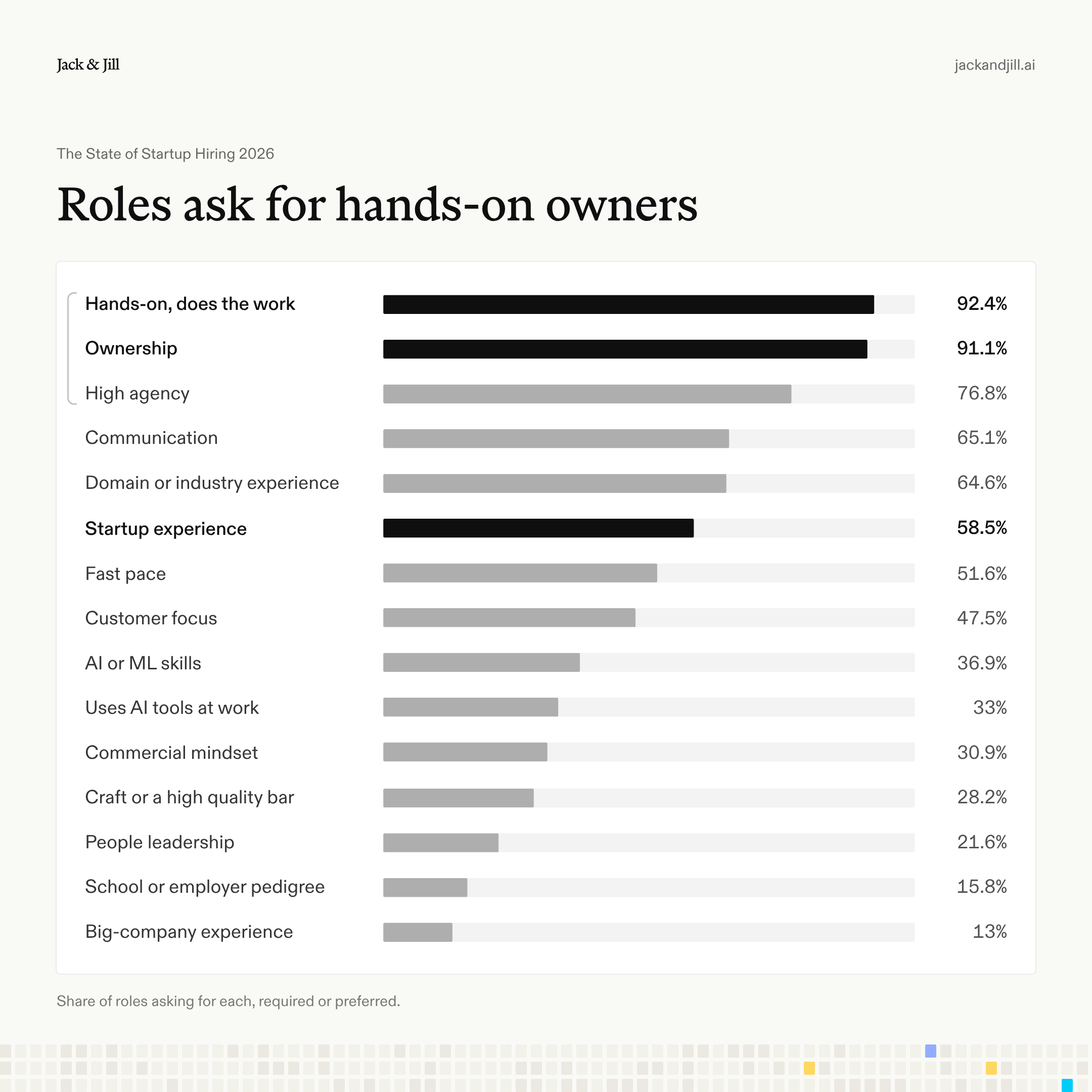
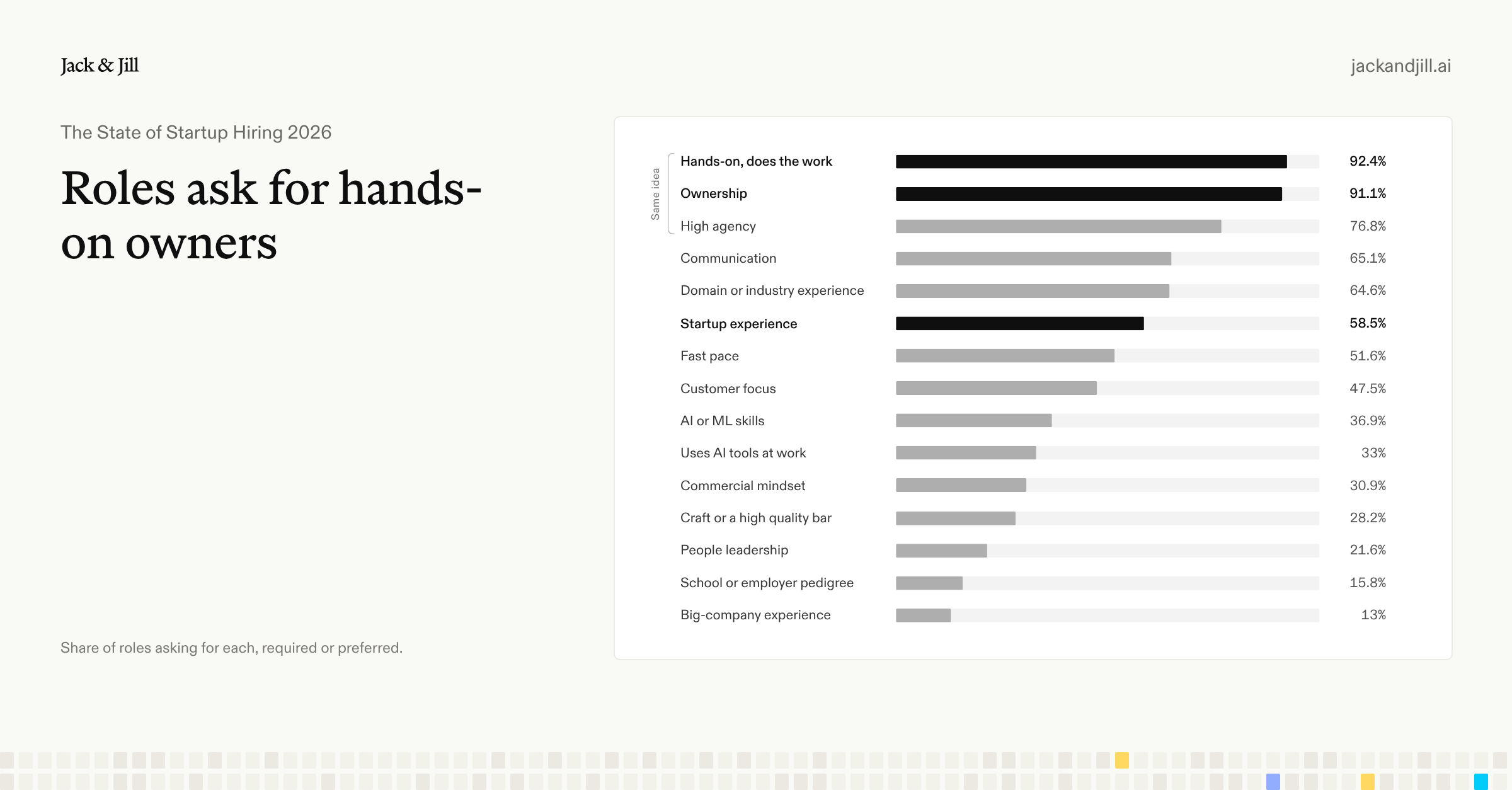
The top three asks, by some margin, describe the same traits: hands-on (92%), ownership (91%) and high agency (77%).
1 in 3
roles ask candidates to use AI tools at work, against 1 in 7 new joiners who say they already do
33% of roles ask for it and 24% require it. 14.5% of new joiners speaking to Jack say they use AI tools at work. Jack’s candidates likely skew AI-native, so the real gap across the wider workforce may be bigger.
17%
of UK tech job ads offer remote work. Three in four UK candidates would take a remote role.
74% of UK candidates would accept a remote role.
What they ask for
Above all, talent teams want people who take ownership and act without being told. They also look for relevant experience, ideally at a startup, and, more and more, people who are comfortable with AI.
Roles ask for hands-on owners
Same idea
Hands-on, does the work92.4%
Ownership91.1%
High agency76.8%
Communication65.1%
Domain or industry experience64.6%
Startup experience58.5%
Fast pace51.6%
Customer focus47.5%
AI or ML skills36.9%
Uses AI tools at work33%
Commercial mindset30.9%
Craft or a high quality bar28.2%
People leadership21.6%
School or employer pedigree15.8%
Big-company experience13%
Share of roles asking for each, required or preferred.
How many roles ask for AI literacy?
33% of roles ask candidates to use AI tools at work, and 37% ask for AI or ML skills: building with AI, not just using it. Hiring managers write it into the spec more often than they mention it to Jill: it comes up in their own words in 11% of their chats with Jill.
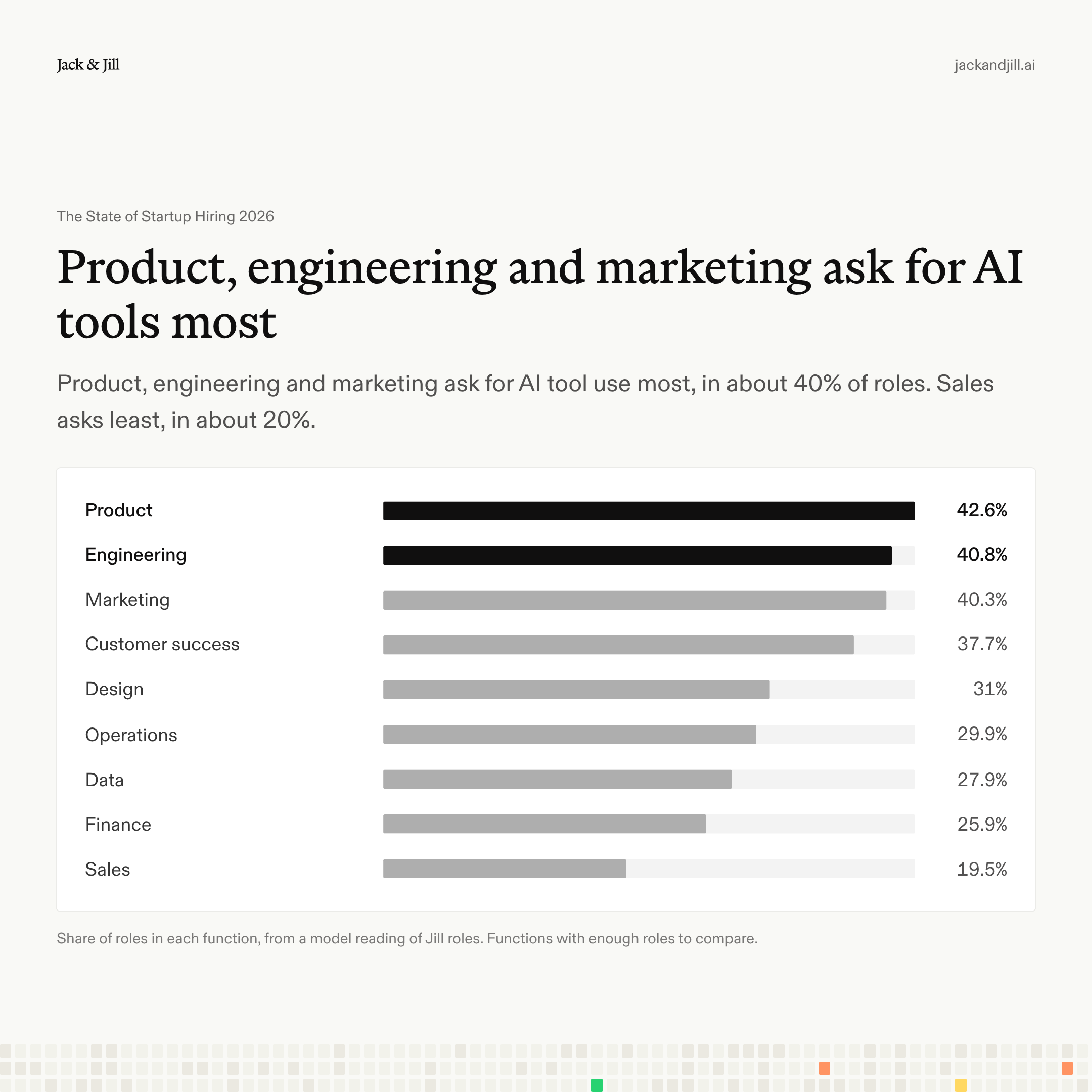
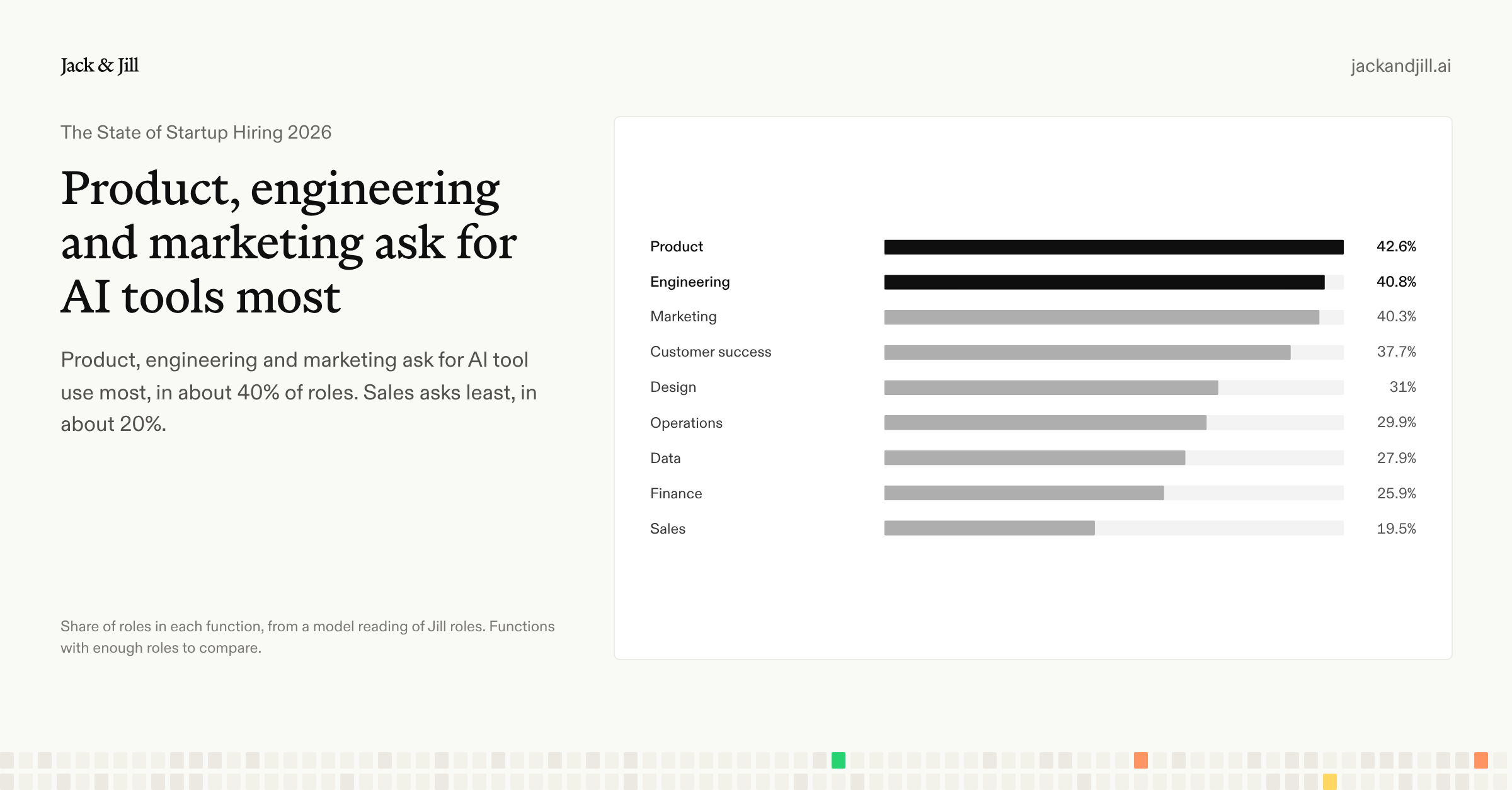
Product, engineering and marketing ask for AI tools most
Product, engineering and marketing ask for AI tool use most, in about 40% of roles. Sales asks least, in about 20%.
Product42.6%
Engineering40.8%
Marketing40.3%
Customer success37.7%
Design31%
Operations29.9%
Data27.9%
Finance25.9%
Sales19.5%
Share of roles in each function, from a model reading of Jill roles. Functions with enough roles to compare.
How demand is shifting
Engineering still makes up the largest share of new Jill roles, but sales is catching up. Fewer roles appear to be opening at entry level, and more are hybrids that blend two domains.
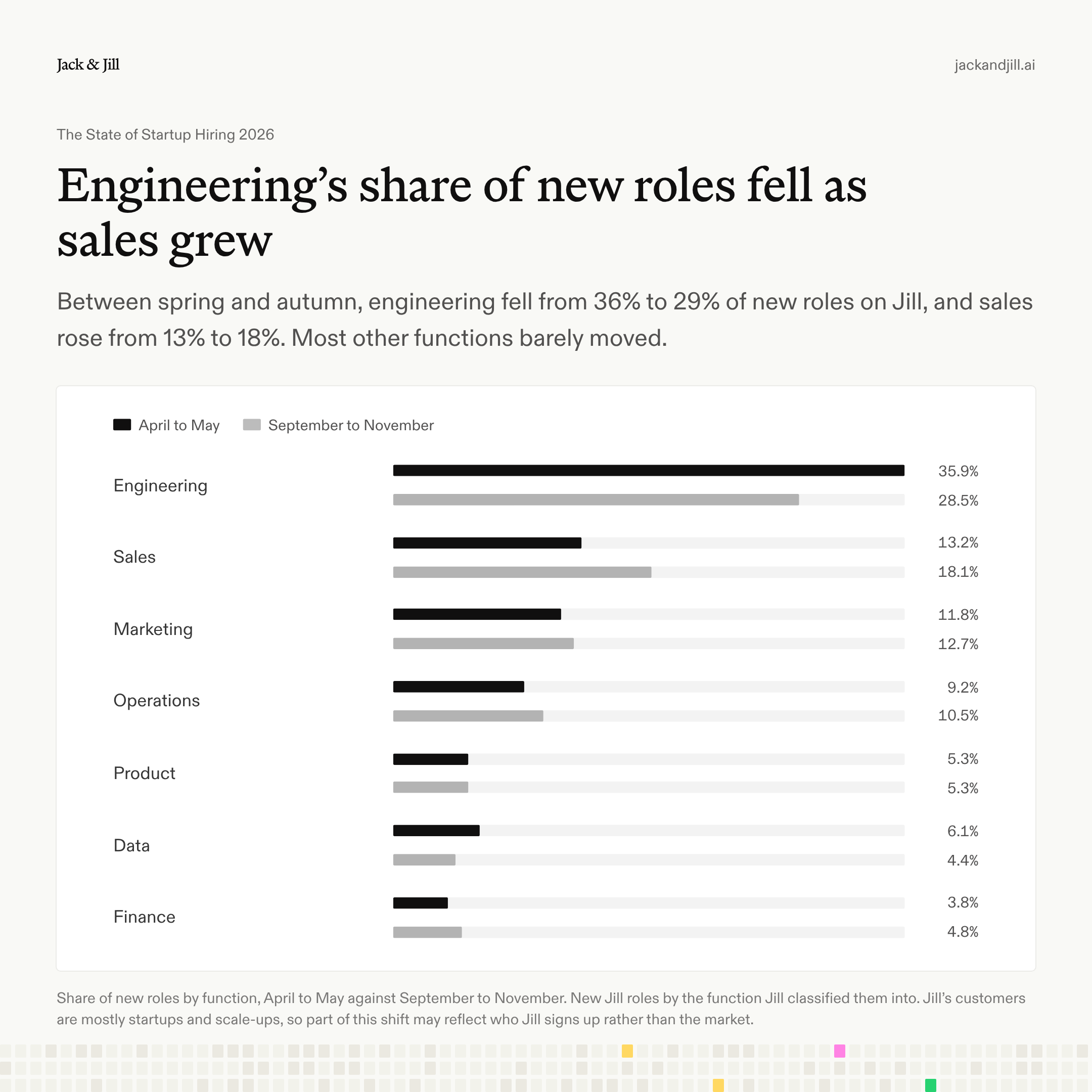
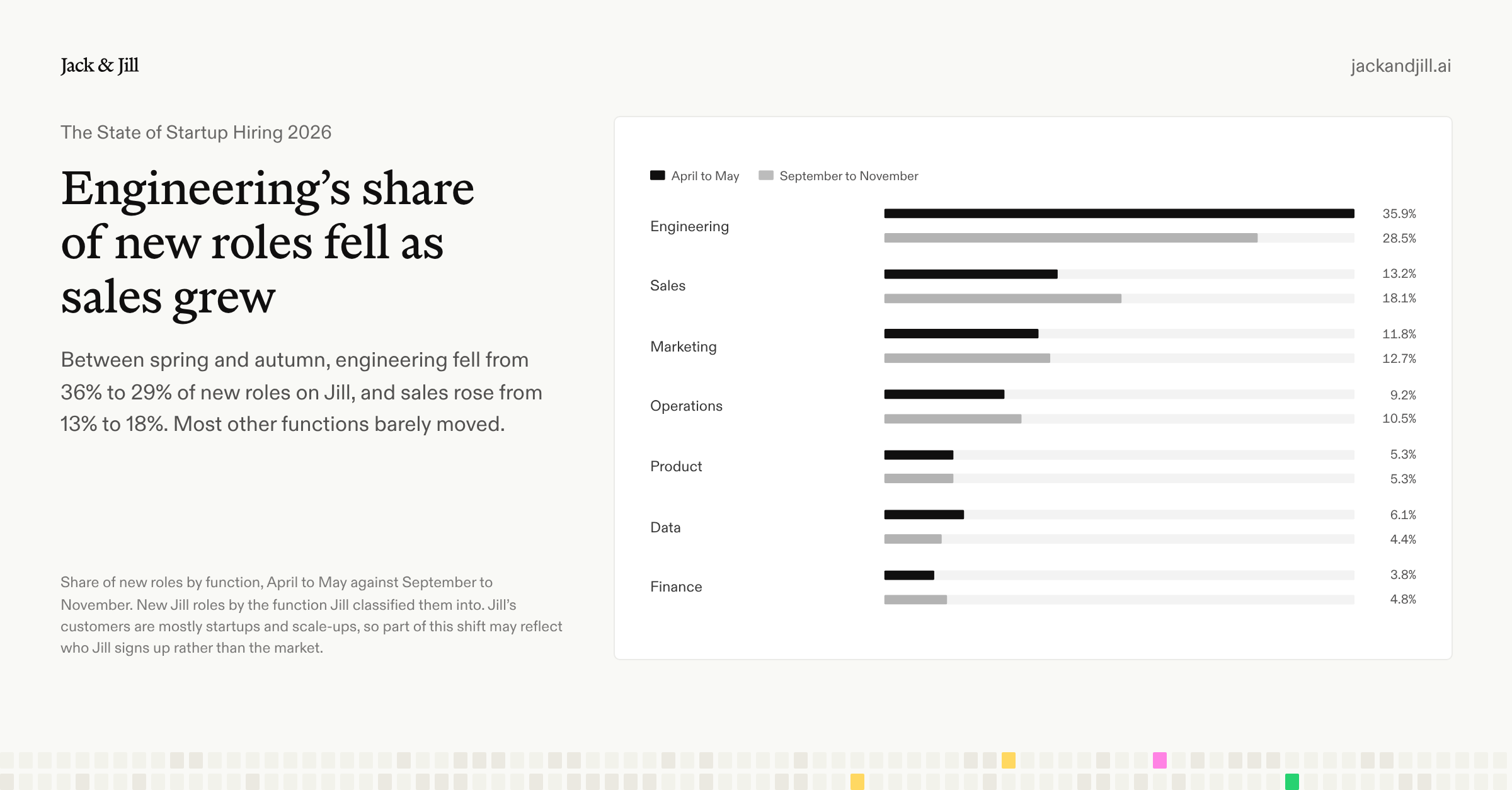
Engineering’s share of new roles fell as sales grew
Between spring and autumn, engineering fell from 36% to 29% of new roles on Jill, and sales rose from 13% to 18%. Most other functions barely moved.
April to MaySeptember to November
Engineering
35.9%
28.5%
Sales
13.2%
18.1%
Marketing
11.8%
12.7%
Operations
9.2%
10.5%
Product
5.3%
5.3%
Data
6.1%
4.4%
Finance
3.8%
4.8%
Share of new roles by function, April to May against September to November. New Jill roles by the function Jill classified them into. Jill’s customers are mostly startups and scale-ups, so part of this shift may reflect who Jill signs up rather than the market.
Is the junior market shrinking?
Fewer roles appear to be opening at entry level, among Jill roles and across the wider market, where graduate and intern schemes have shrunk most.
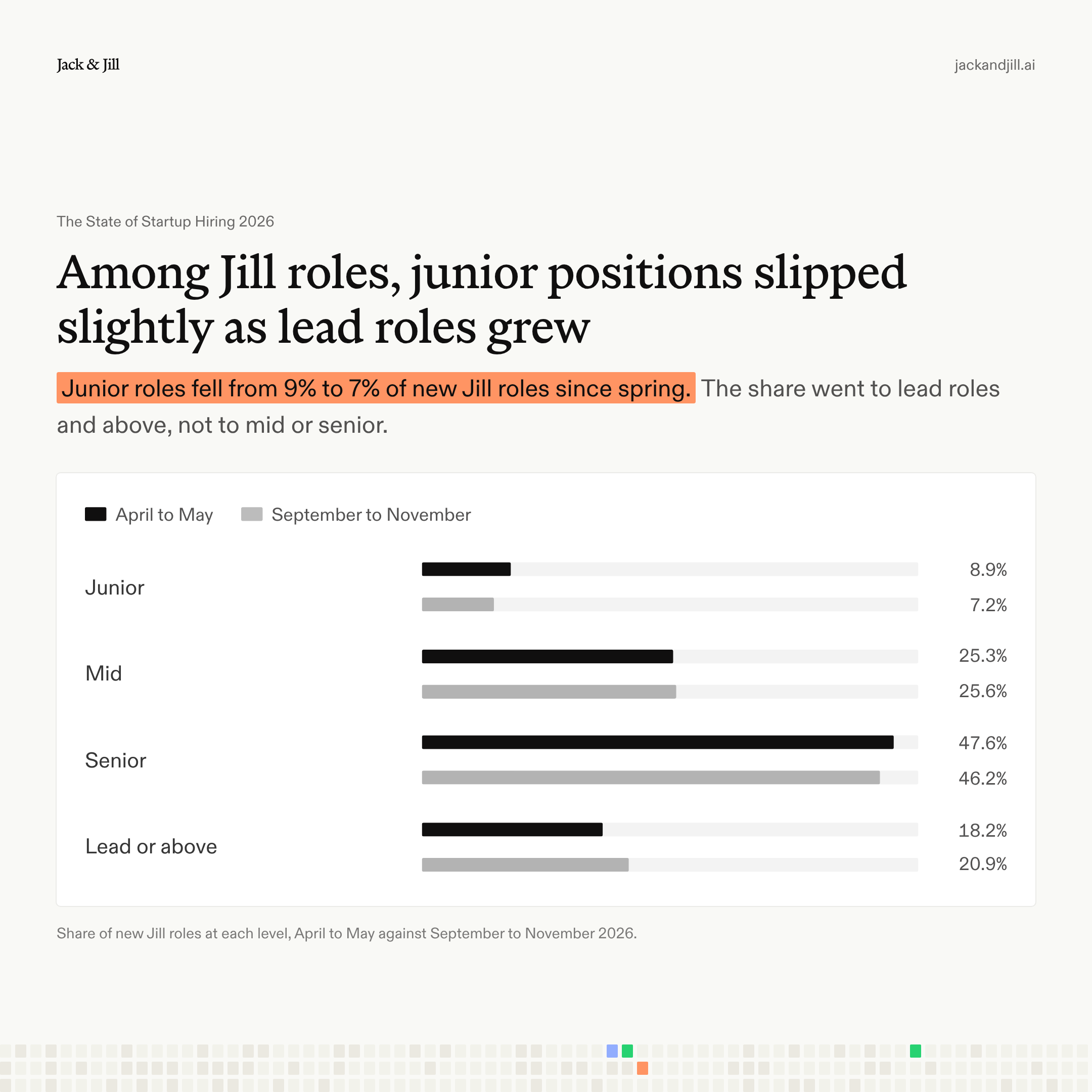
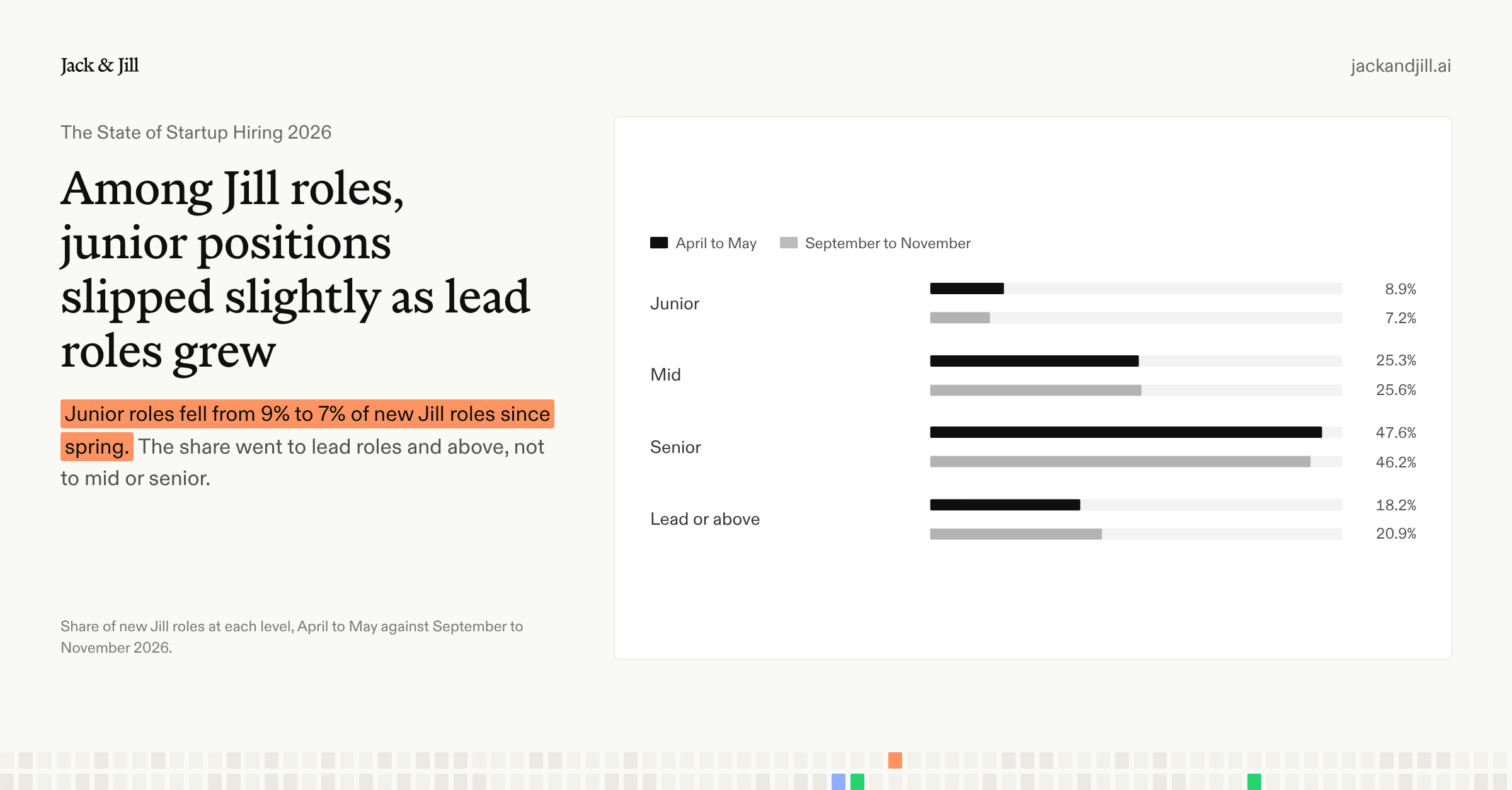
Among Jill roles, junior positions slipped slightly as lead roles grew
Junior roles fell from 9% to 7% of new Jill roles since spring. The share went to lead roles and above, not to mid or senior.
April to MaySeptember to November
Junior
8.9%
7.2%
Mid
25.3%
25.6%
Senior
47.6%
46.2%
Lead or above
18.2%
20.9%
Share of new Jill roles at each level, April to May against September to November 2026.
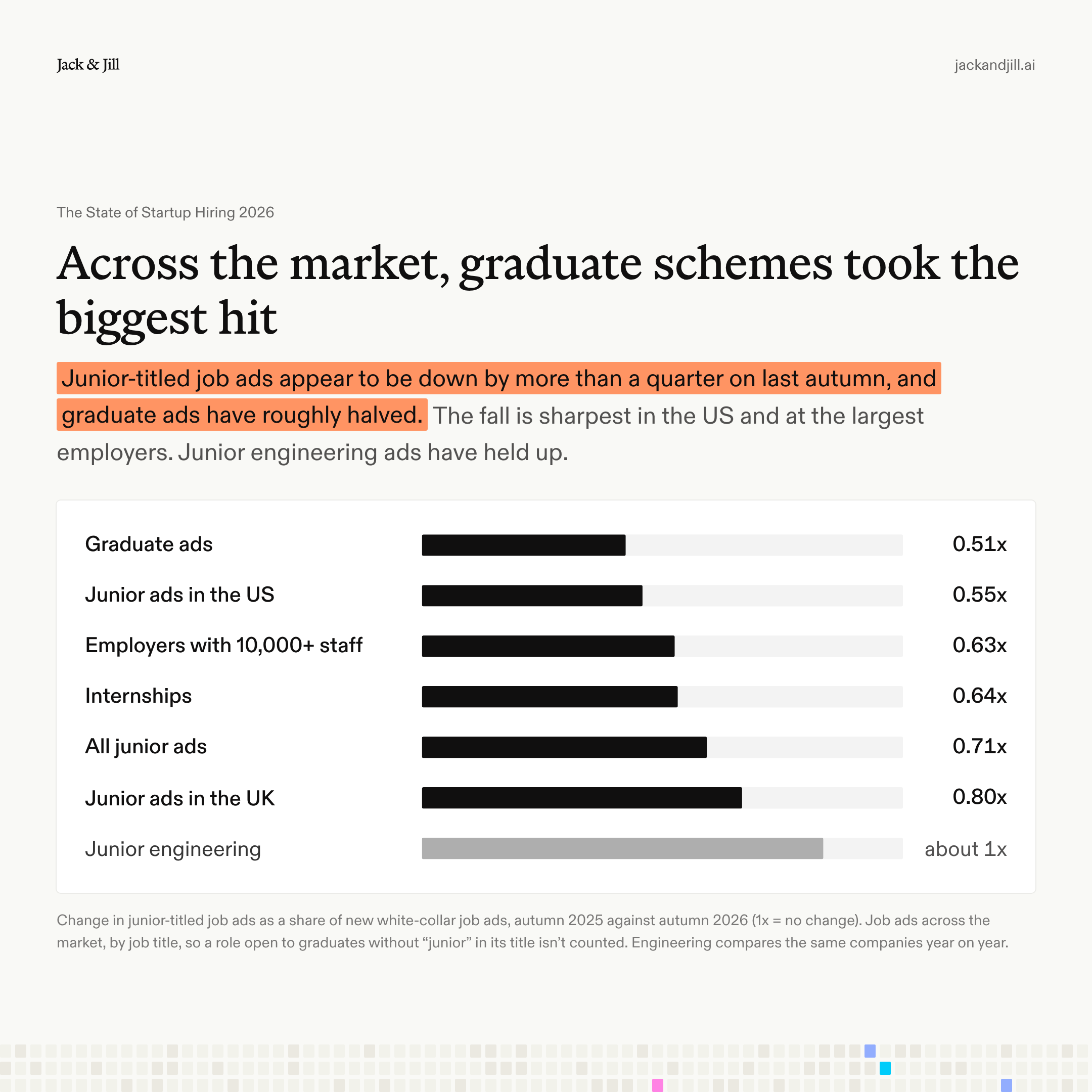
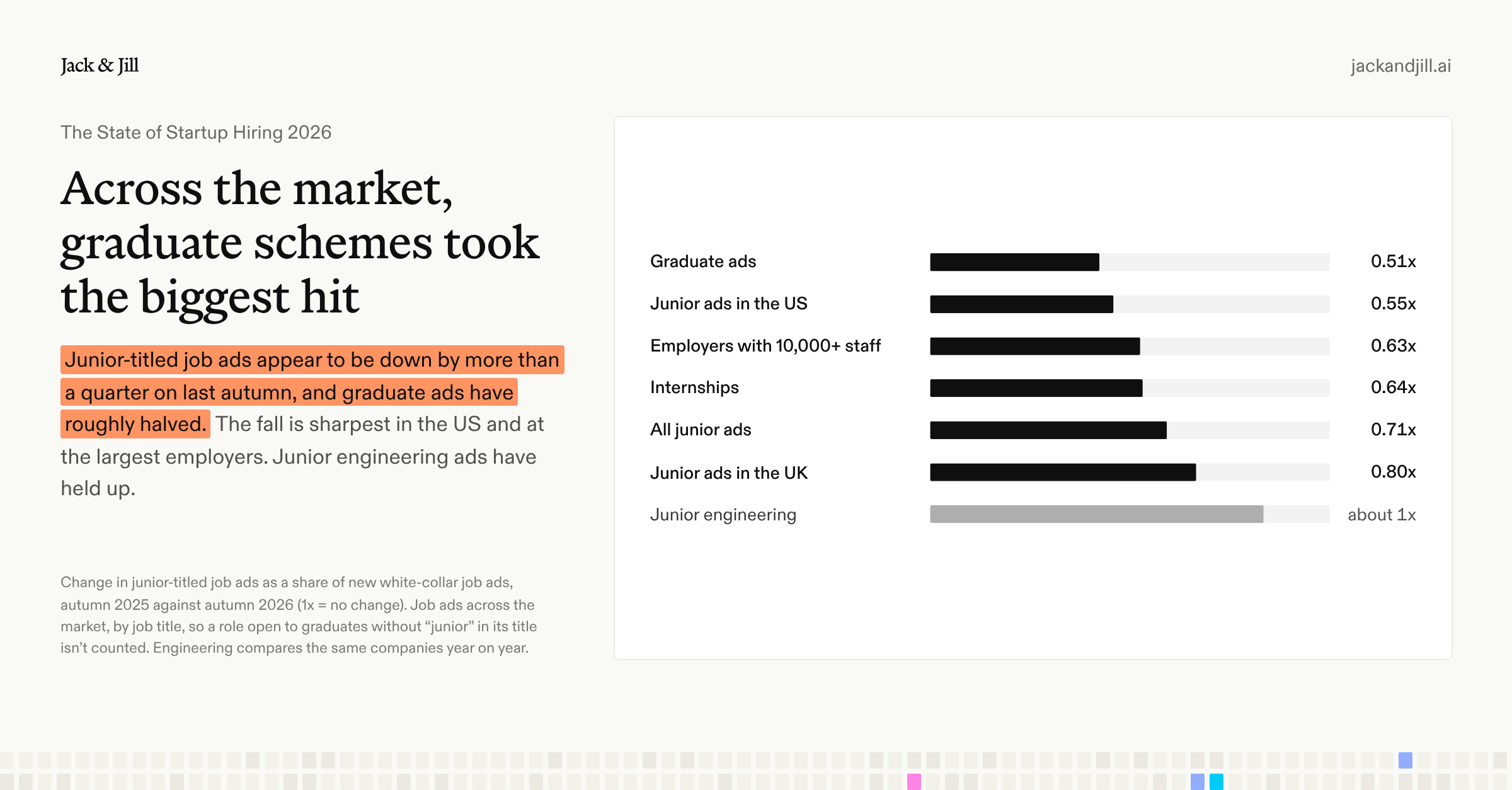
Across the market, graduate schemes took the biggest hit
Junior-titled job ads appear to be down by more than a quarter on last autumn, and graduate ads have roughly halved. The fall is sharpest in the US and at the largest employers. Junior engineering ads have held up.
Graduate ads0.51x
Junior ads in the US0.55x
Employers with 10,000+ staff0.63x
Internships0.64x
All junior ads0.71x
Junior ads in the UK0.80x
Junior engineeringabout 1x
Change in junior-titled job ads as a share of new white-collar job ads, autumn 2025 against autumn 2026 (1x = no change). Job ads across the market, by job title, so a role open to graduates without “junior” in its title isn’t counted. Engineering compares the same companies year on year.
Starting out? Jack can help you find roles that never get advertised:Talk to Jack
Hybrid roles take centre stage
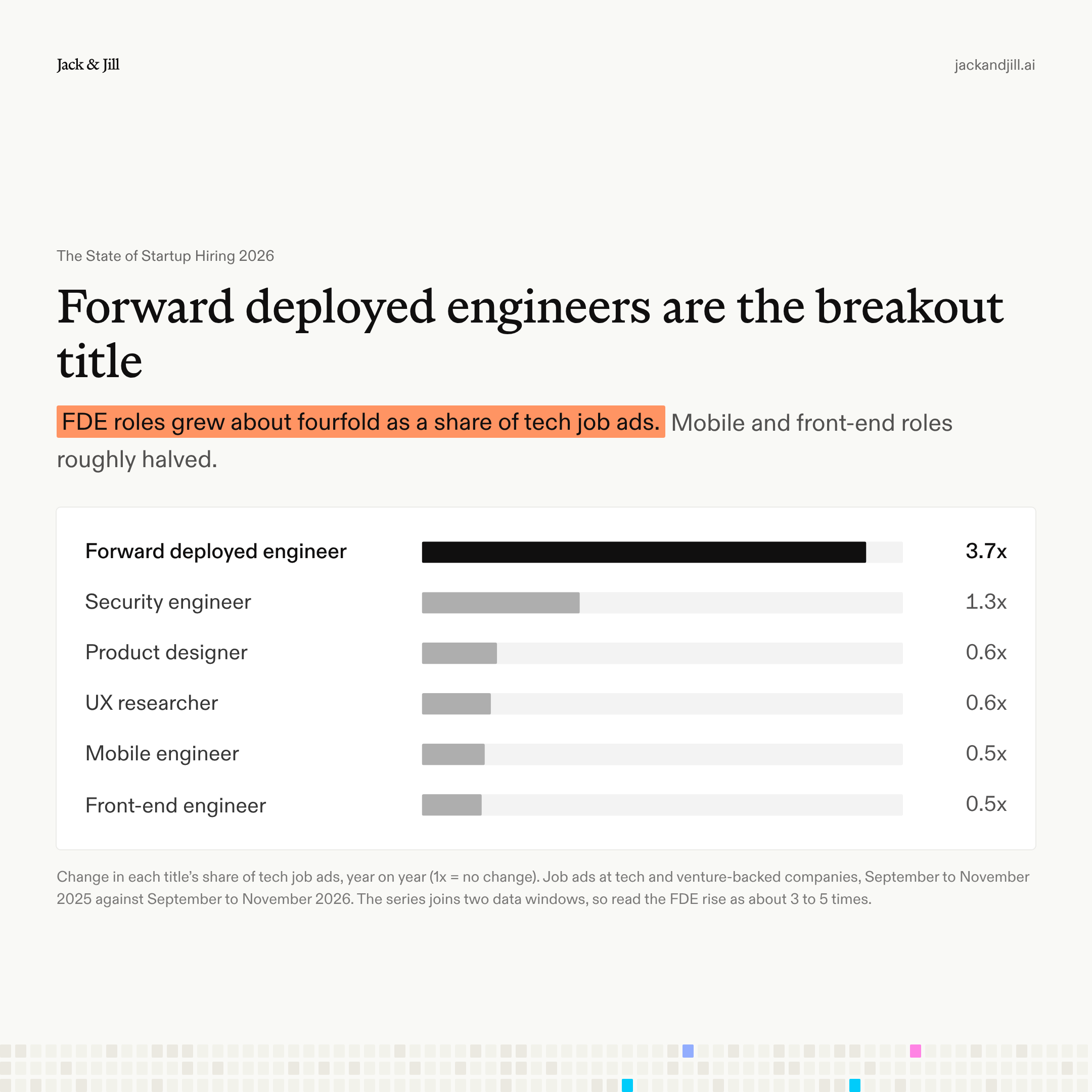
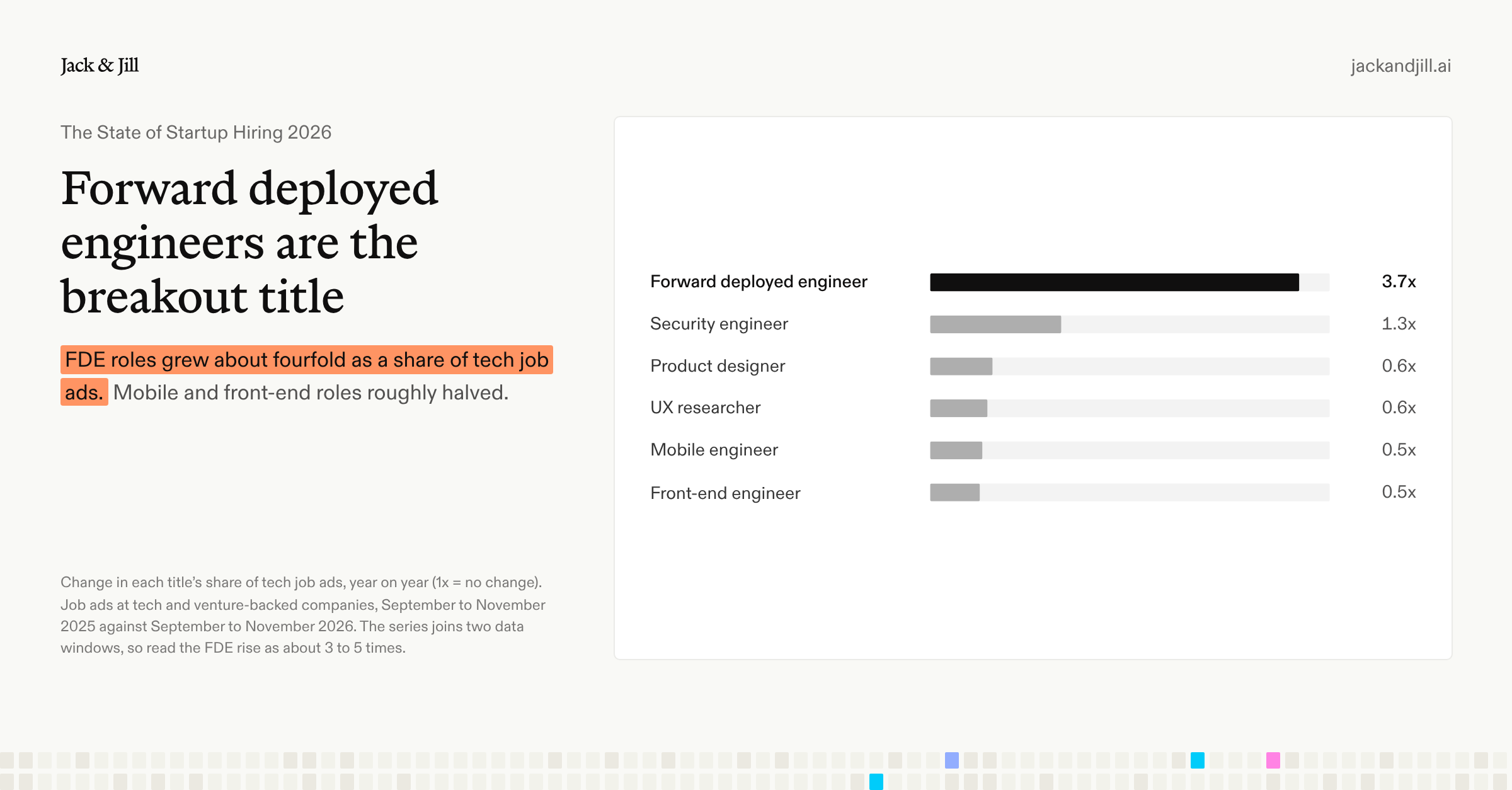
Forward deployed engineer (FDE) roles have roughly quadrupled as a share of tech job ads in a year, in the UK as much as the US. The growth is particularly in hybrid roles at the intersection of customer work and engineering.
Change in each title’s share of tech job ads, year on year (1x = no change). Job ads at tech and venture-backed companies, September to November 2025 against September to November 2026. The series joins two data windows, so read the FDE rise as about 3 to 5 times.
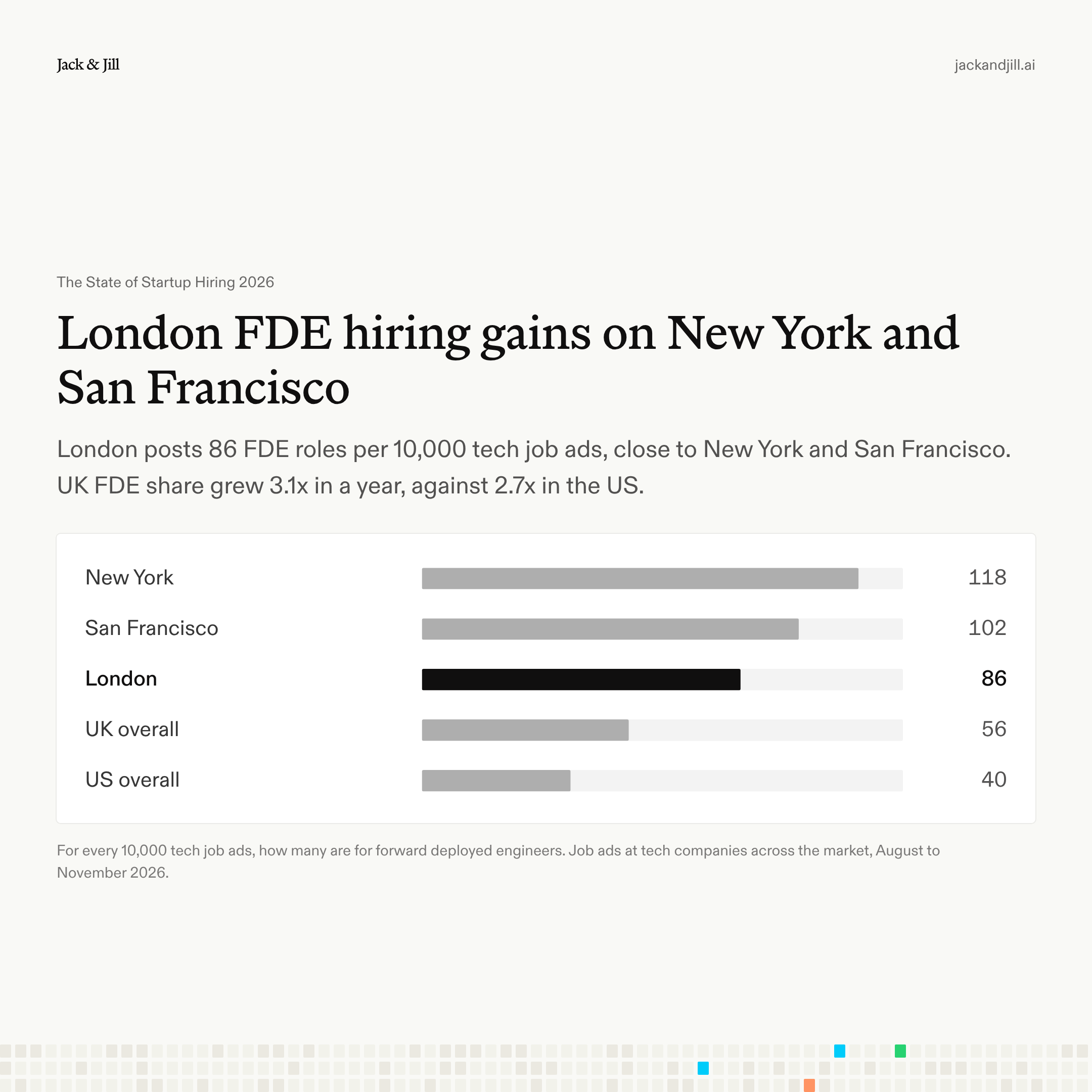
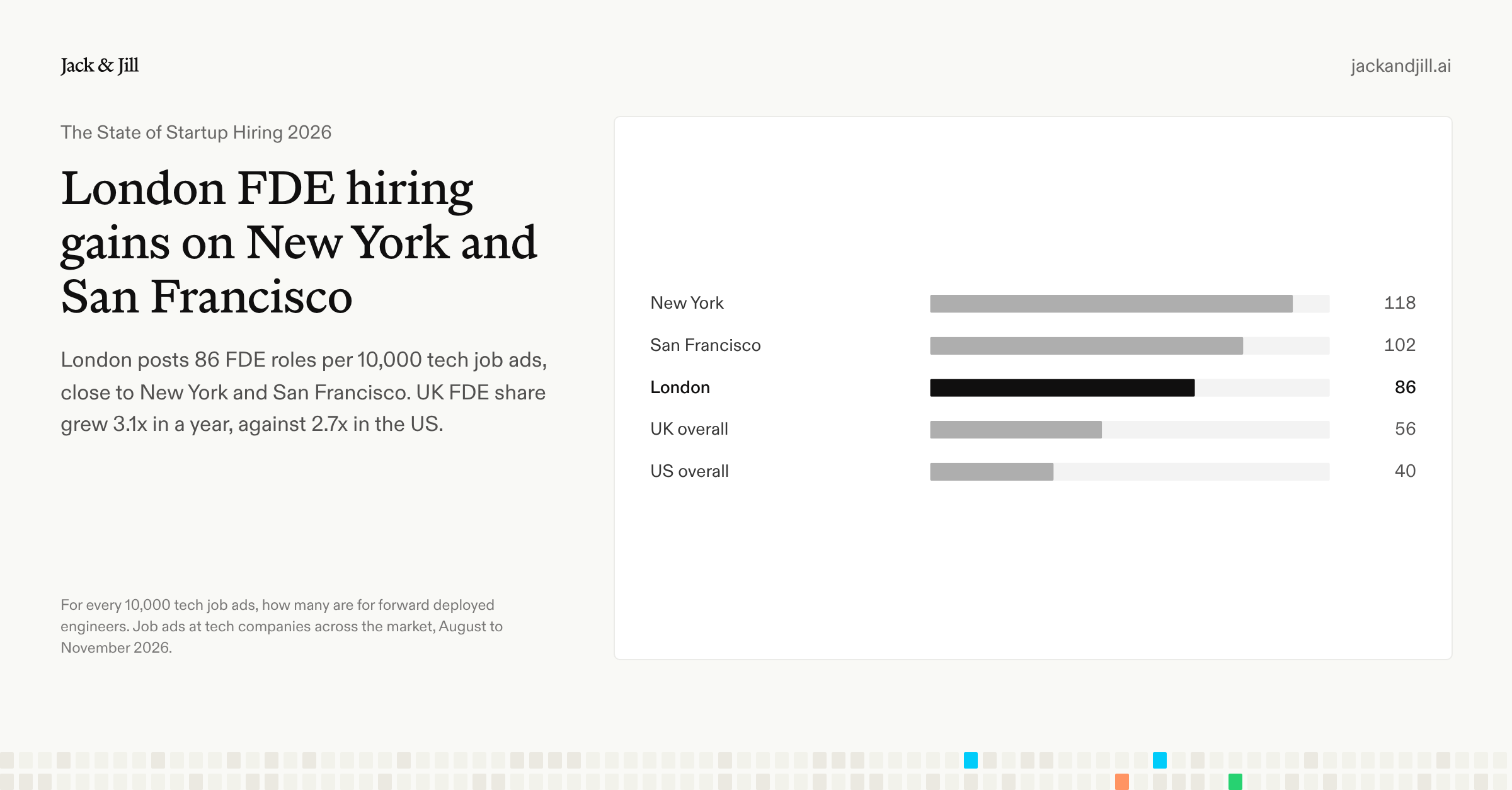
London FDE hiring gains on New York and San Francisco
London posts 86 FDE roles per 10,000 tech job ads, close to New York and San Francisco. UK FDE share grew 3.1x in a year, against 2.7x in the US.
New York118
San Francisco102
London86
UK overall56
US overall40
For every 10,000 tech job ads, how many are for forward deployed engineers. Job ads at tech companies across the market, August to November 2026.
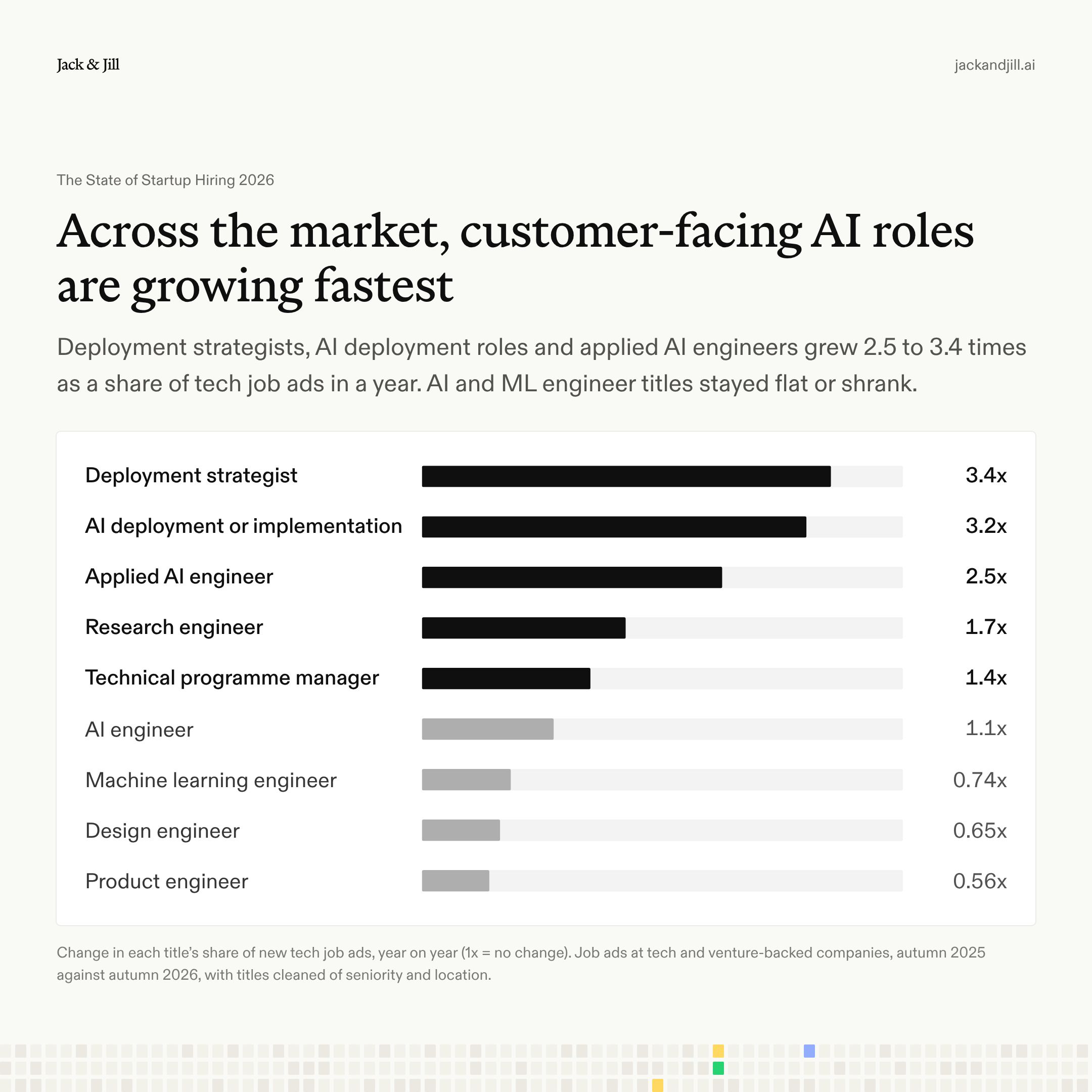
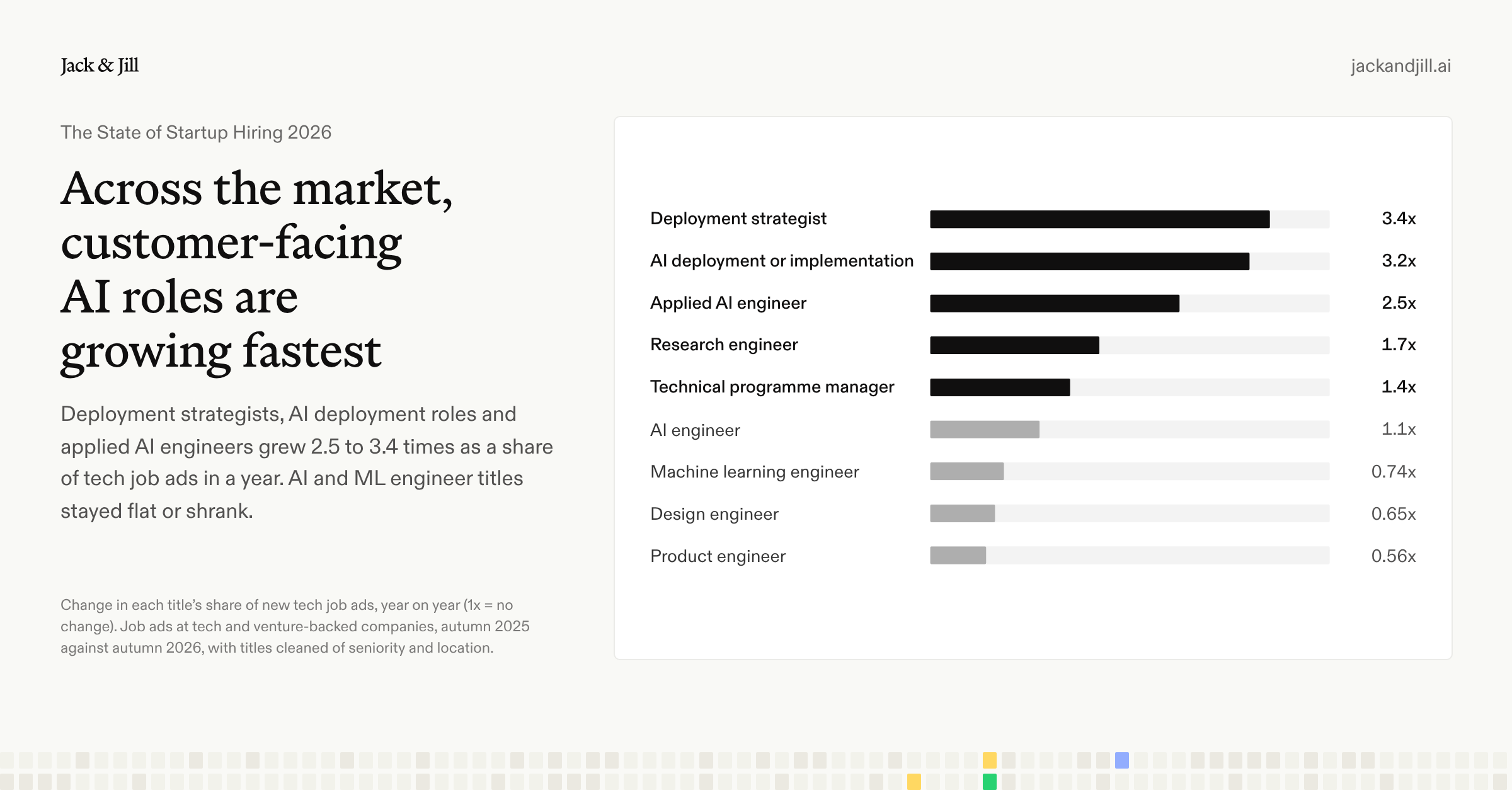
Across the market, customer-facing AI roles are growing fastest
Deployment strategists, AI deployment roles and applied AI engineers grew 2.5 to 3.4 times as a share of tech job ads in a year. AI and ML engineer titles stayed flat or shrank.
Deployment strategist3.4x
AI deployment or implementation3.2x
Applied AI engineer2.5x
Research engineer1.7x
Technical programme manager1.4x
AI engineer1.1x
Machine learning engineer0.74x
Design engineer0.65x
Product engineer0.56x
Change in each title’s share of new tech job ads, year on year (1x = no change). Job ads at tech and venture-backed companies, autumn 2025 against autumn 2026, with titles cleaned of seniority and location.
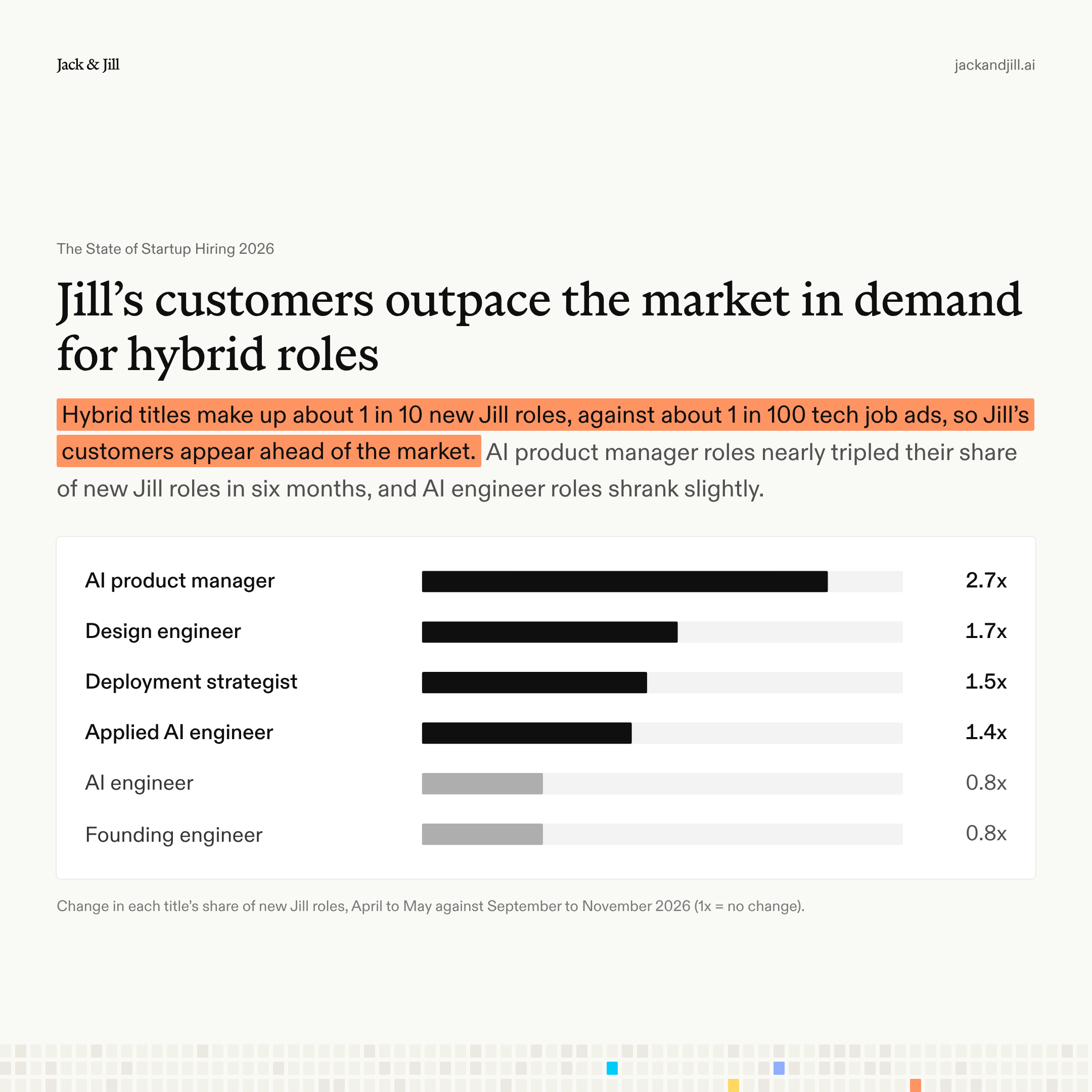
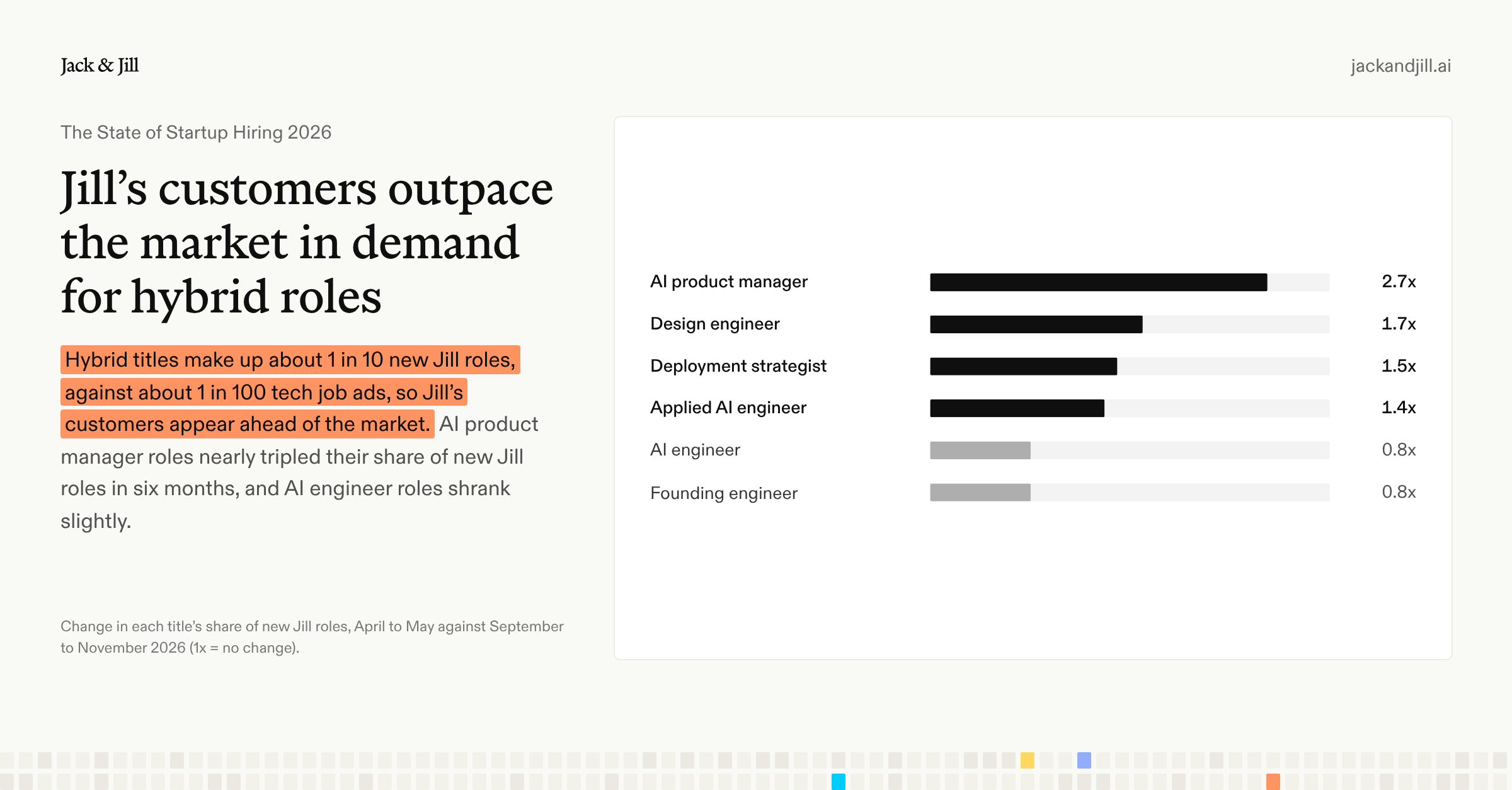
Jill’s customers outpace the market in demand for hybrid roles
Hybrid titles make up about 1 in 10 new Jill roles, against about 1 in 100 tech job ads, so Jill’s customers appear ahead of the market. AI product manager roles nearly tripled their share of new Jill roles in six months, and AI engineer roles shrank slightly.
Change in each title’s share of new Jill roles, April to May against September to November 2026 (1x = no change).
Office, hybrid or remote
The office is where roles and candidates disagree most. Candidates want to work from home; companies seek to pull them in.
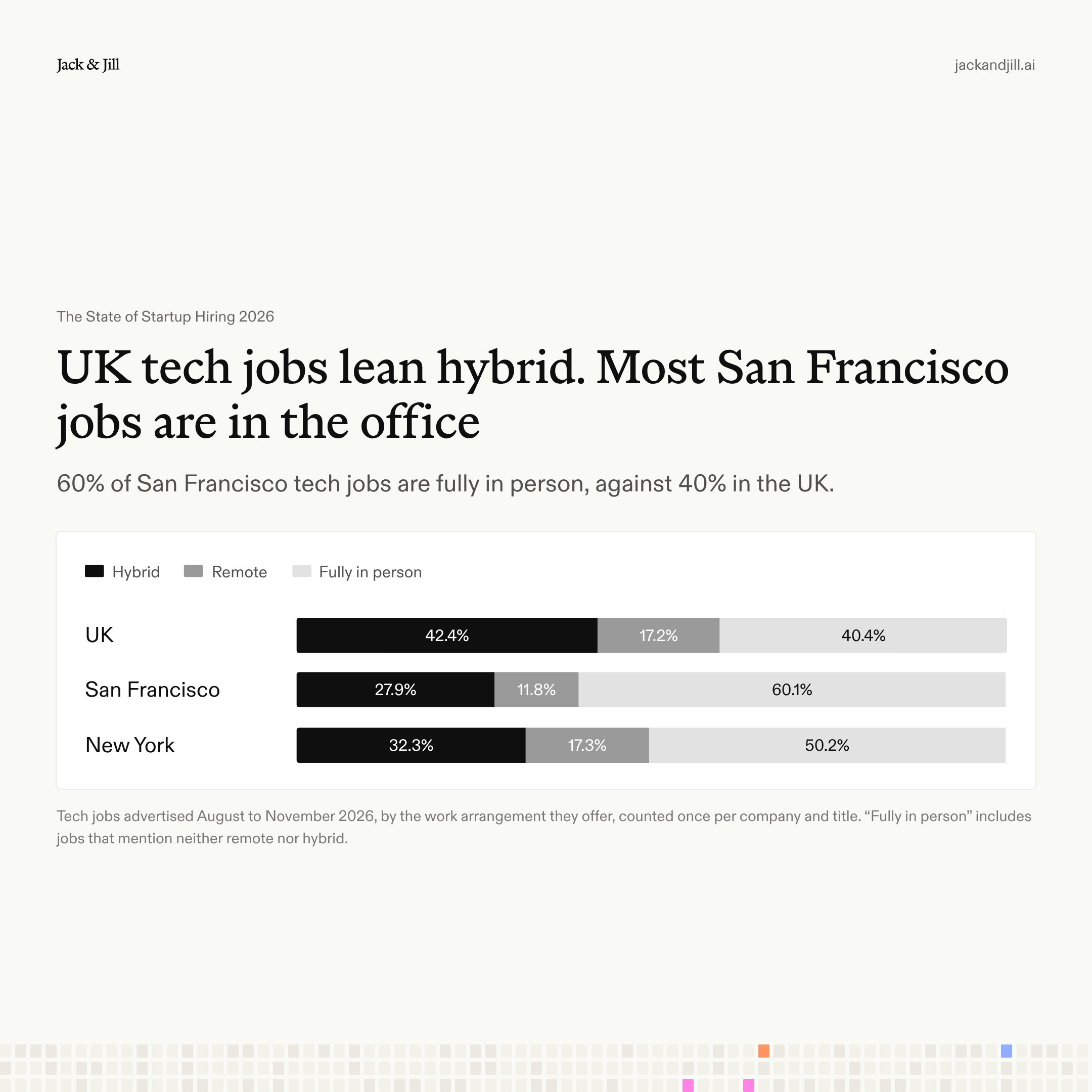
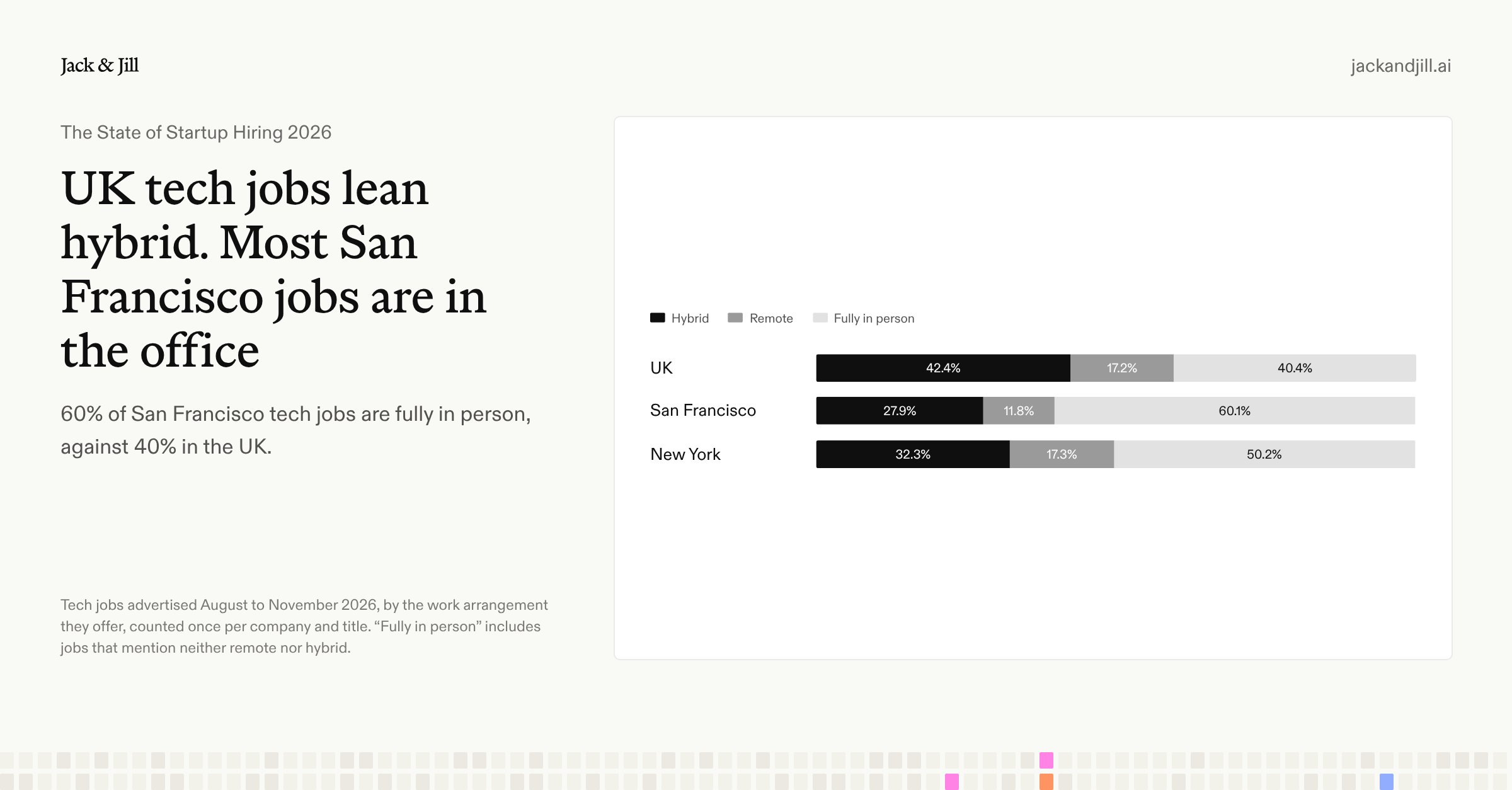
UK tech jobs lean hybrid. Most San Francisco jobs are in the office
60% of San Francisco tech jobs are fully in person, against 40% in the UK.
HybridRemoteFully in person
UK
42.4%17.2%40.4%
San Francisco
27.9%11.8%60.1%
New York
32.3%17.3%50.2%
Tech jobs advertised August to November 2026, by the work arrangement they offer, counted once per company and title. “Fully in person” includes jobs that mention neither remote nor hybrid.
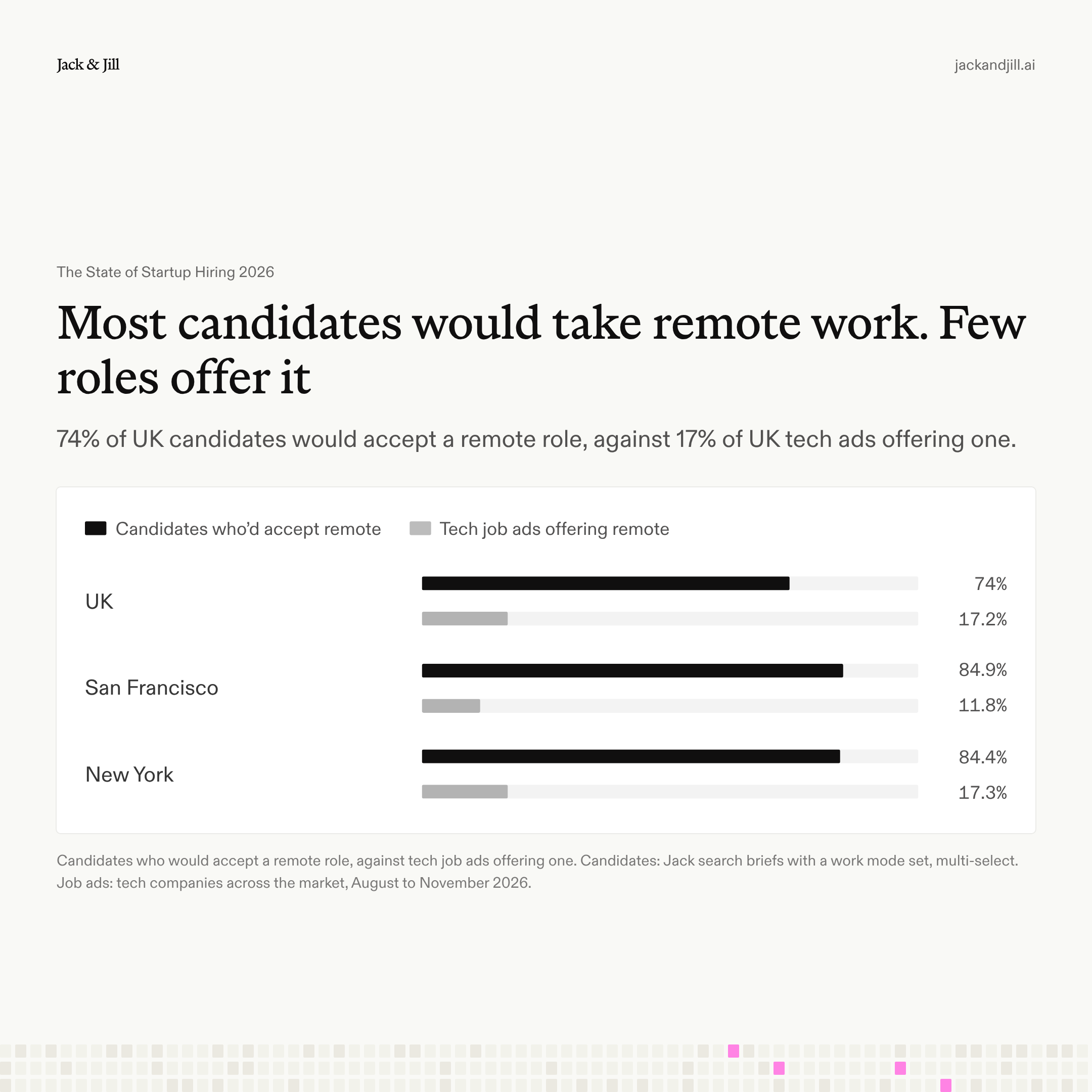
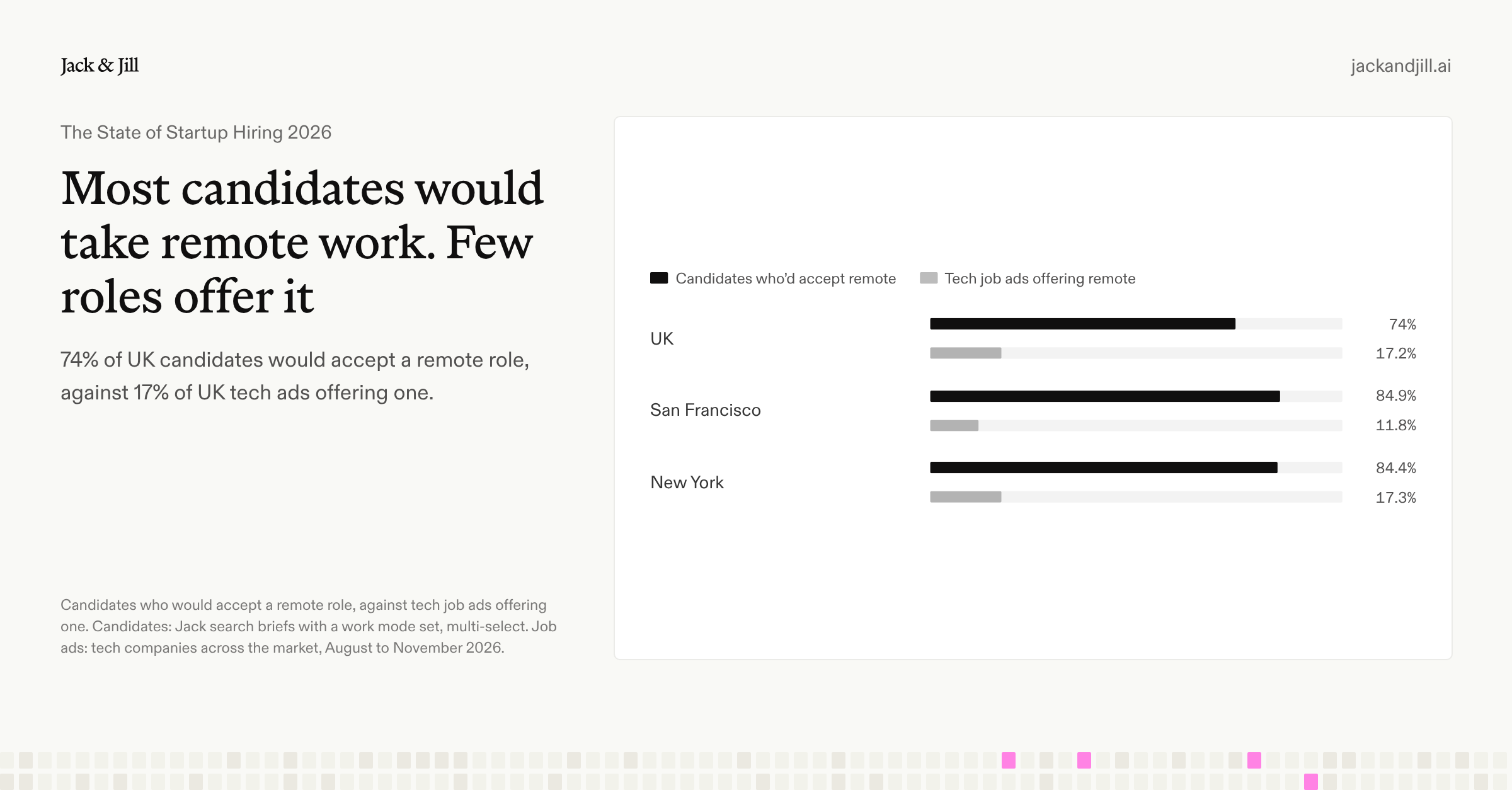
Most candidates would take remote work. Few roles offer it
74% of UK candidates would accept a remote role, against 17% of UK tech ads offering one.
Candidates who would accept a remote role, against tech job ads offering one. Candidates: Jack search briefs with a work mode set, multi-select. Job ads: tech companies across the market, August to November 2026.
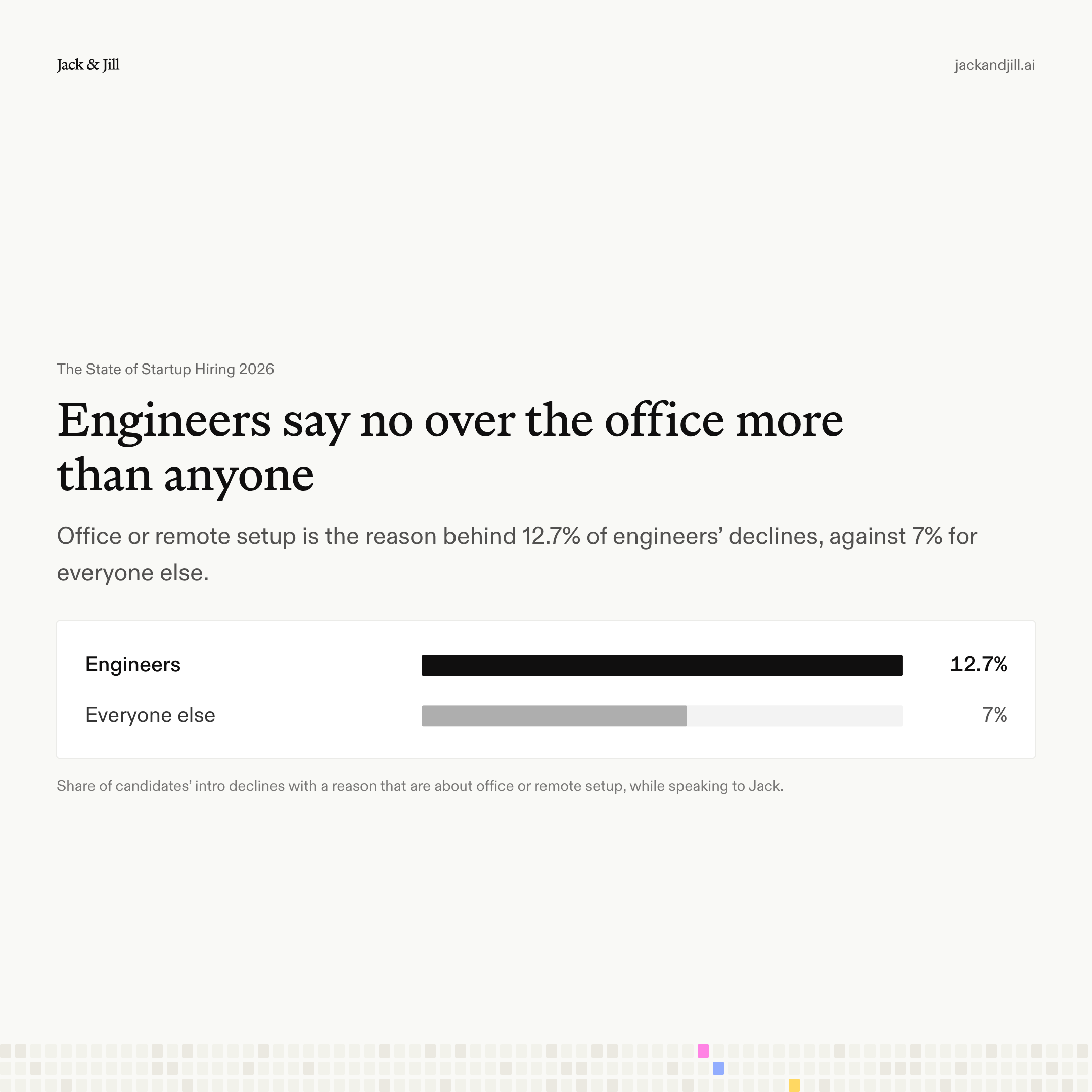
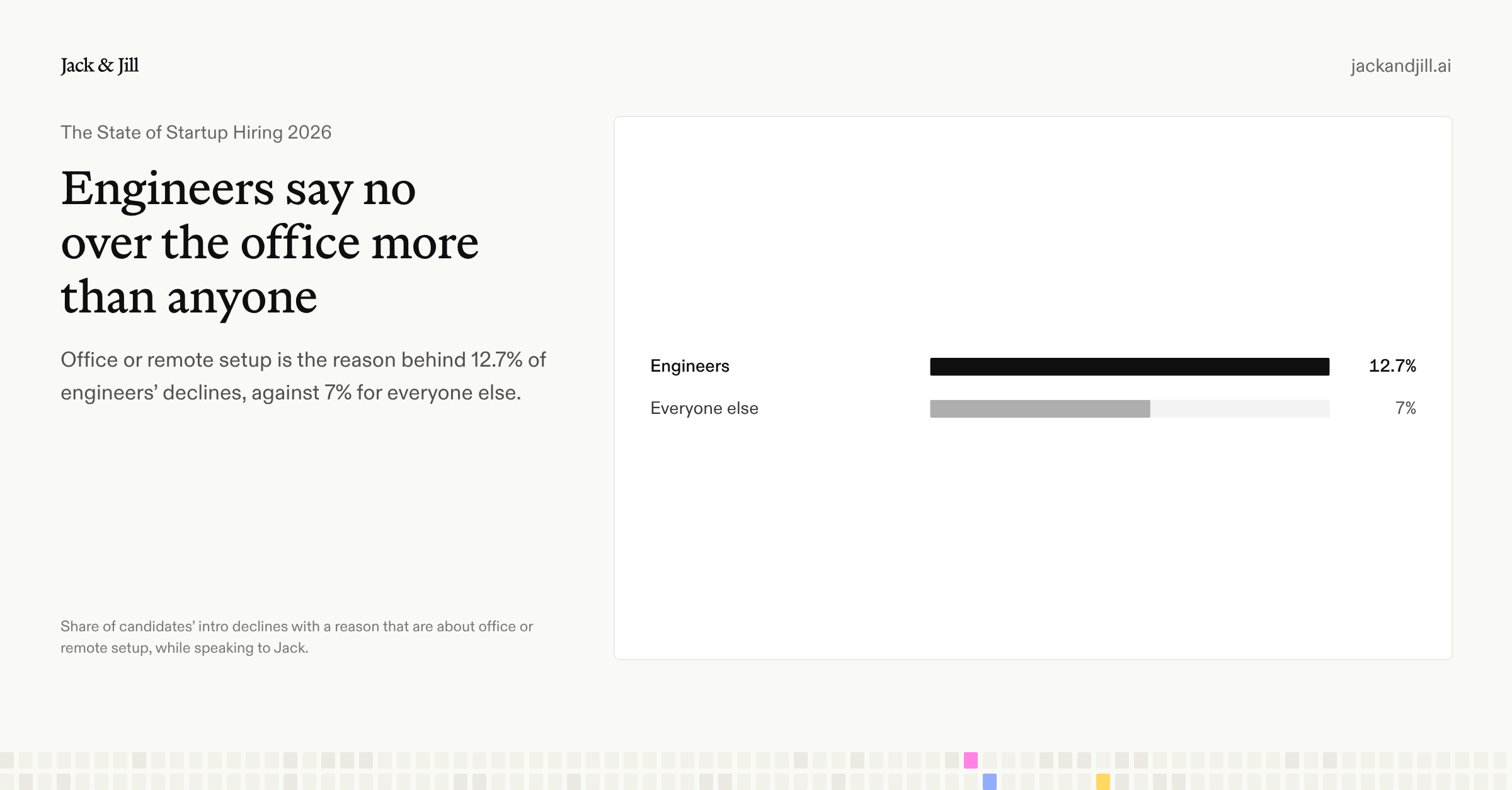
Engineers say no over the office more than anyone
Office or remote setup is the reason behind 12.7% of engineers’ declines, against 7% for everyone else.
Engineers12.7%
Everyone else7%
Share of candidates’ intro declines with a reason that are about office or remote setup, while speaking to Jack.
How hiring is changing
Polished, AI-assisted applications have drained the signal from inbound, so teams test the work directly and lean on people they already know. The roles they find hardest to fill are hybrids that rarely come in one person.
Channels
Inbound applications carry less signal than they used to
AI has made applications polished and similar, and inbound has lost much of its signal. Many teams lean harder on outbound (which saturates candidates’ inboxes in turn), referrals and events. At the scale that AI facilitates, outbound can pile attention on the people who are easiest to find.
“From the 1700 applications, we had 1100 identical answers. Those individuals think they have done a fantastic job, and they gave a great answer. But it wasn’t their answer.”
Jim Miller
Leads the People team, Ashby
“AI is decimating the value of inbound and job ads (when every application is perfectly tailored to your JD, it’s hard to tell what’s legit), so we go out and find people.”
Dale Player
Head of Talent, Worldover
“I outbound to candidates the same way I outbound to sales prospects, with very targeted messaging. If I can get a 30 minutes conversation, I feel confident we can both determine if it will or won’t be a fit.”
Travis Marceau
Head of GTM, E2B
Assessment
The interview is moving back into the room
Teams are moving towards in-person meetings and interviews.
“Instead of doing things like a LeetCode interview, that doesn’t really give you any signal on how someone uses AI and how they perform in the actual job… we do a full day assessment that replicates the type of work that they will do as an employee of Black Forest Labs”
Justine Lambert
Head of Talent Acquisition, Black Forest Labs
“We’ve been investing more in interviewer training, particularly around asking better follow-up questions… We’re also bringing in-person interviews back into the process for all our hybrid roles, while keeping our remote roles fully remote.”
SM
Sam Mullaly
Talent Lead, Goodlord
Relationships
The best hires start before there’s a job
The best hires reportedly come from people teams already know. Many teams are increasingly investing in this, from referral bonuses to chess nights.
“Good people know good people, and referral-to-hire conversion is around 10%, versus inbound applications, which typically sit at under 1%.”
Rob Holdstock
Lendable
“The strongest hires rarely start with a job post. They start with a conversation that might not turn into anything for a year or two.”
Erin Danielle Walker
Senior Technical Sourcer, Listen Labs
Roles
The hardest roles are hybrids
Hybrid roles have grown hugely in popularity, yet they are hard to hire for. See Hybrid roles take centre stage for more.
“Sourcing senior ML talent is already tough, but finding candidates who pair top-tier technical rigour with executive-level commercial presence is our biggest hurdle.”
Nicola Manning
Head of Talent Acquisition, Faculty
“We index highly on ‘dual profiles’, people who’ve done two different things and excelled at both. The pattern that actually predicts best hires is dual spike: doctor + engineer, lawyer + PE, quant + consultant.”
Benjamin Preisler
Chief of Staff, Riplo
People
AI is making the human side matter more
Talent leaders want candidates to show up as themselves, with potentially imperfect answers that actually represent the candidates and their ideas.
“The best way to stand out is to be a human. … Be a human and don’t let the AI engines that you’re deploying overwrite who you are.”
Jim Miller
Leads the People team, Ashby
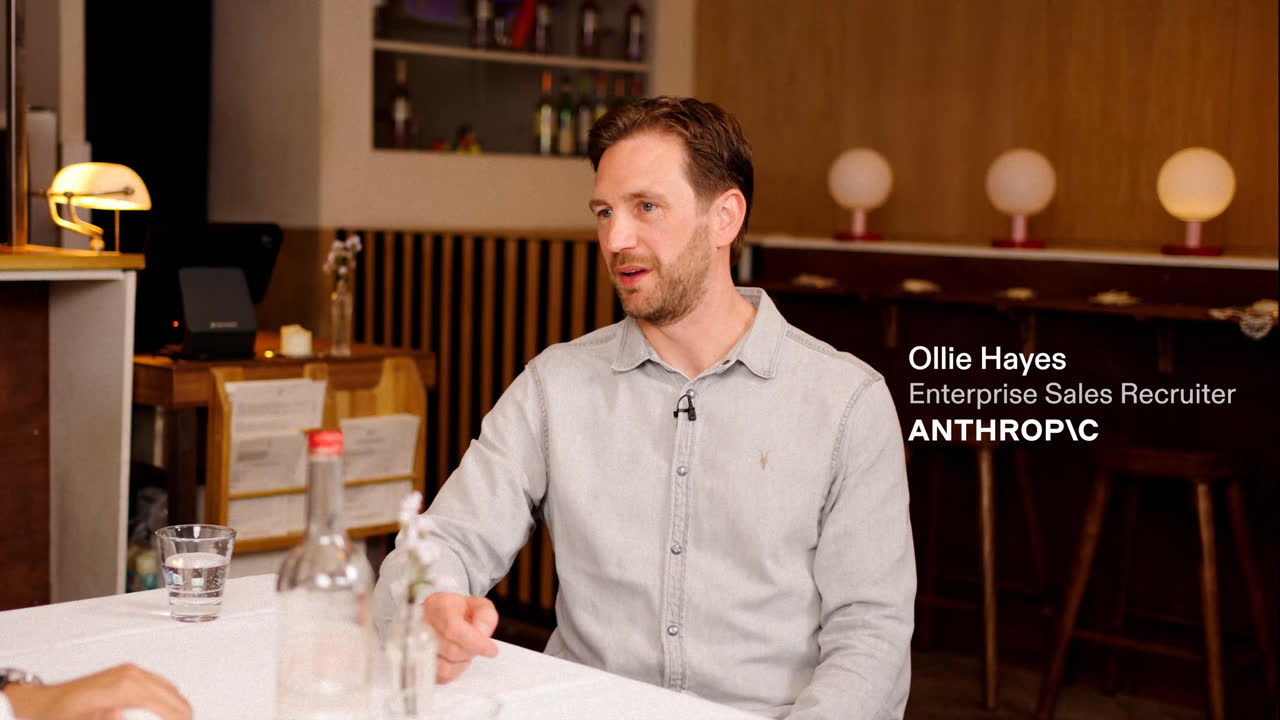
“When you come into an interview and you put on this really polished formal mask, you can drain that excitement out of the conversation and people walk away not knowing if that person really wants the job, which is a huge shame.”
Ollie Hayes
Enterprise Sales recruiter, Anthropic
Who hires from the Most Wanted 100
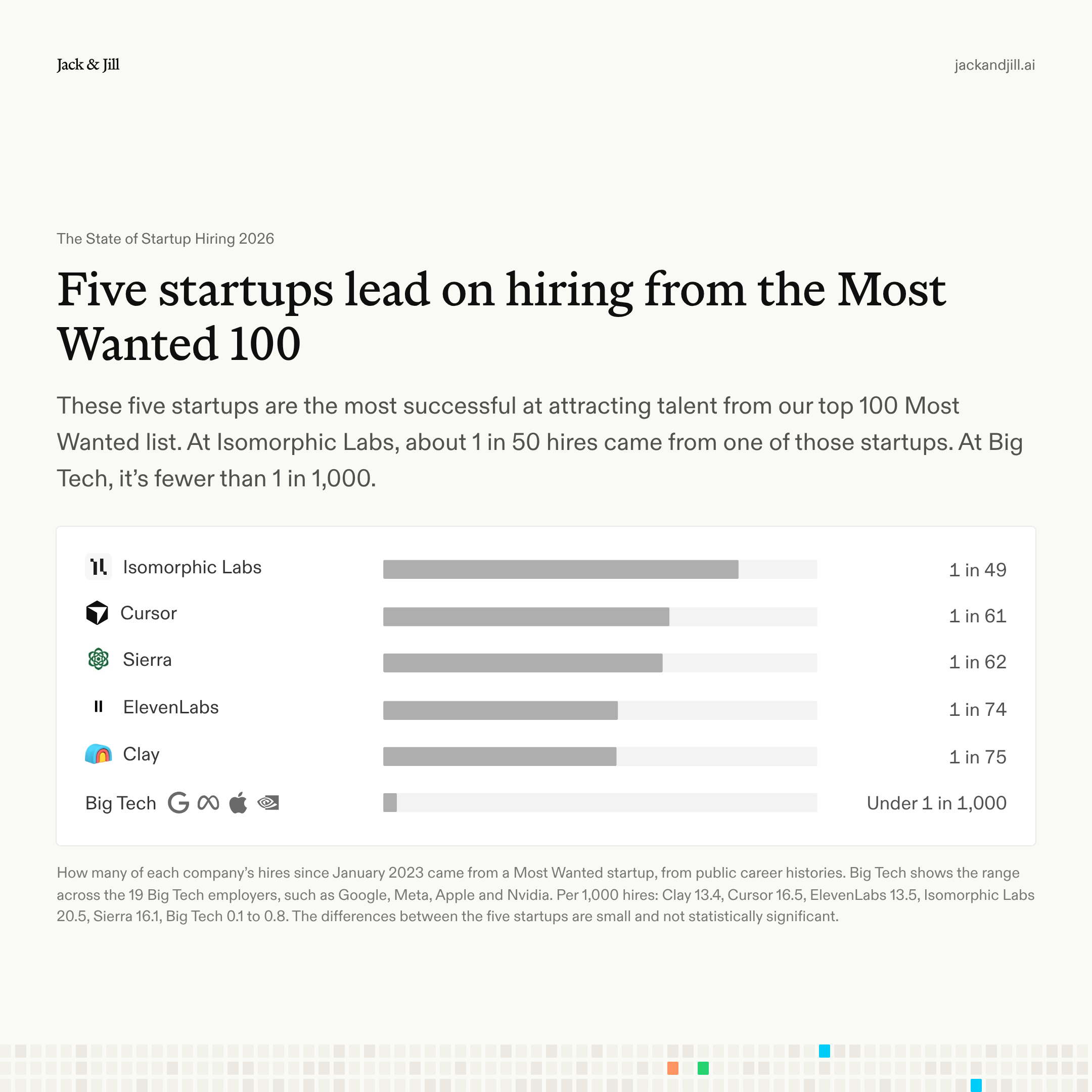
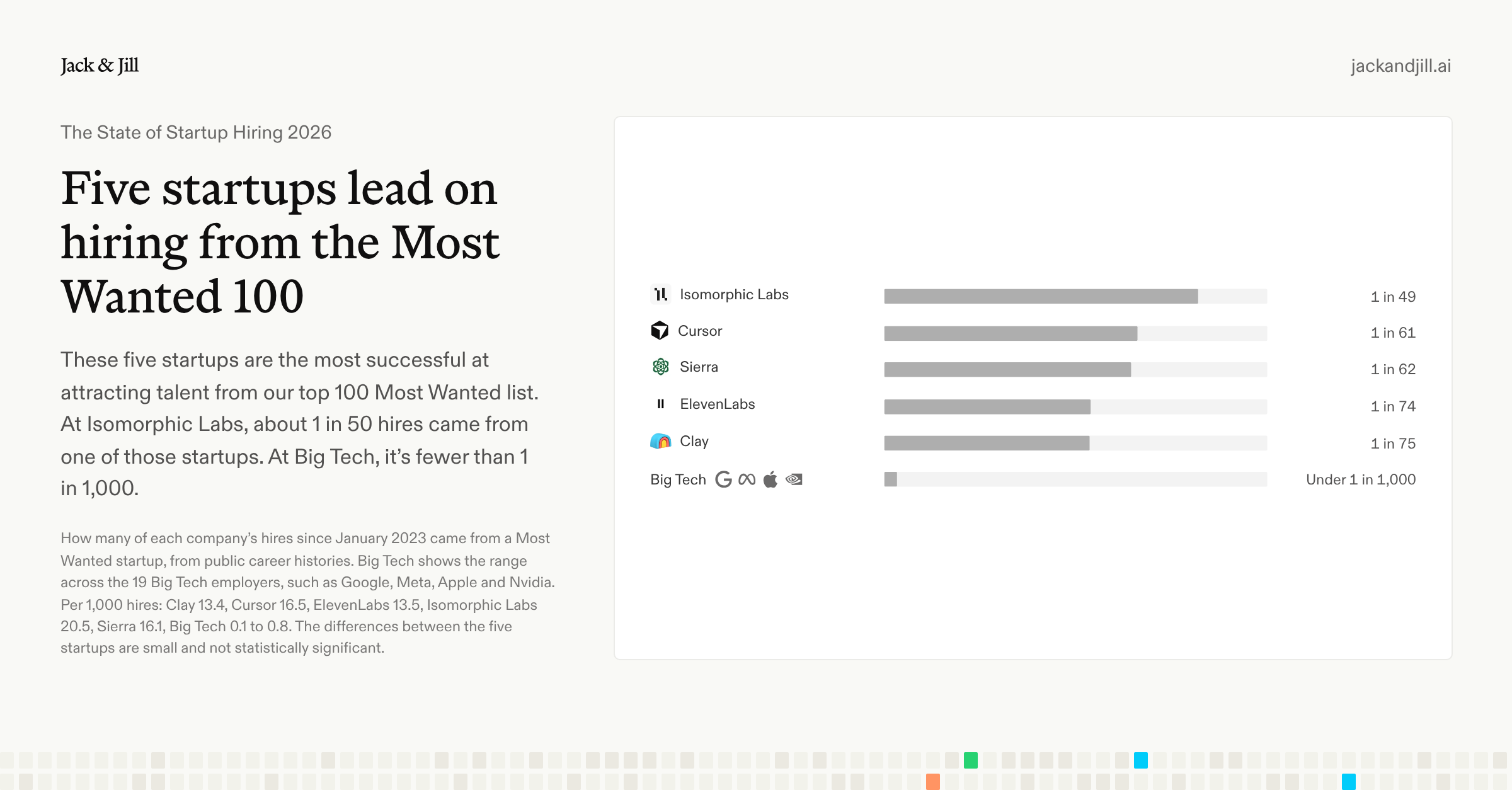
Big Tech sends far more people to the Most Wanted startups than it gets back. And the companies best at poaching from those startups are AI startups.
1,744
people moved from Big Tech to a Most Wanted startup since 2023
Big Tech here means 19 employers, listed in How we did it.
255
moved the other way, from a Most Wanted startup to Big Tech
Half of the people who leave these startups join another startup.
6.8 to 1
people join from Big Tech for every one who leaves for it
Big Tech sends these startups far more people than it takes.
Hiring AI and product engineers who own more of the cycle from idea to production.
Read answers
“The pattern that actually predicts best hires is dual spike: doctor + engineer, lawyer + PE, quant + consultant.”
Benjamin Preisler, Riplo
Read all answers
Building Worldover’s recruiting OS and hiring product-implementation (FDE) talent for chemicals and cosmetics customers.
Read answers
“Every role gets its own video and brochure in place of a JD.”
Dale Player, Worldover
Read all answers
Hires generalist software engineers who can work across the stack.
Read answers
“The strongest hires rarely start with a job post. They start with a conversation that might not turn into anything for a year or two.”
Erin Danielle Walker, Listen Labs
Read all answers
Helped scale Peec AI from 25 to over 100 people in 10 months, with a talent team of two for most of the year.
Read answers
“Even people who aren’t actively looking now ask ChatGPT, Claude or Perplexity what their next career step should be, and AI search has become a real candidate channel for us.”
Ineta Svedaite, Peec AI
Read all answers
Hired Resi’s first Content & Growth Lead this year, a role she says “barely existed a couple of years ago”.
Read answers
“This type of role barely existed a couple of years ago, and finding all of that in one person was tough.”
Grew Lendable’s talent team from 5 to 14 people in the last 12 months. Launching his own agency in January: stay tuned!
Read answers
“Good people know good people, and referral-to-hire conversion is around 10%, versus inbound applications, which typically sit at under 1%.”
Rob Holdstock, Lendable
Read all answers
SM
Talent Lead at Goodlord.
Read answers
“Inbound applications are higher than we’ve ever seen.”
Sam Mullaly, Goodlord
Read all answers
Hires across Multiverse’s CEO office and COO, and is running a hiring sprint for AI Workshop Leads.
Read answers
“Referrals have really taken off this year, as great people know great people!”
Sarah Mans, Multiverse
Read all answers
Has found many of E2B’s go-to-market hires himself, with outbound he runs like sales prospecting.
Read answers
“I outbound to candidates the same way I outbound to sales prospects, with very targeted messaging.”
Travis Marceau, E2B
Read all answers
How do Attio, Anima and PromptMates hire? They work with Jill. Read their stories
How we did it
Over 400,000 candidates speaking to Jack, talent-team data from Jill, April to November 2026, and input from talent leaders at startups and scale-ups. Here’s how we did it and where the limits are.
Who the candidates are
Over 400,000 candidates speak to Jack, our AI career agent, and talk with him about what they want next. The largest groups are in the UK, San Francisco and New York, and many are engineers. Their searches lean towards AI and startups, so the data describes Jack’s candidates, not all workers.
Search briefs
Jack writes a summary of each candidate’s search: what they want, where, and for how much. Charts that cite search briefs draw on those summaries.
Intro declines
When a hiring manager asks to meet a candidate through Jack, the candidate can decline. We classified their responses.
Talent teams speaking to Jill
Part 2 uses every live Jill role created between April and November 2026, excluding demo and internal accounts, in the UK, San Francisco, New York and elsewhere. Jill writes her brief with the hiring manager, so a requirement may partly reflect Jill’s prompting. Jill’s customers are mostly startups and scale-ups, and changes in who signs up can move the mix of roles.
Job ads across the market
We also track millions of job postings globally, counted once per company and title. Charts that cite general job postings draw on these.
Pass reasons
Every time a hiring manager passed on a candidate Jill showed them. We used the pick-list reason or a model’s reading of the hiring manager’s note, and left out passes with no reason or an uninformative one.
Big Tech
In the talent flow figures, Big Tech means 19 employers: Google, Meta, Amazon (including AWS), Microsoft, Apple, Netflix, Nvidia, Salesforce, Oracle, IBM, Adobe, TikTok/ByteDance, Uber, LinkedIn, Intel, Cisco, SAP, Spotify and Airbnb. AI labs such as OpenAI, Anthropic and Google DeepMind are counted separately.
Privacy
Every candidate figure is an aggregate. No candidate is quoted or identifiable.
■ ■ ■
Meet your next great hire.
See how Jill finds the strongest candidates for your team.

















 Jack & Jill · A report on startup hiring, November 2026
 Isomorphic Labs1 in 49
 Sierra1 in 62
 ElevenLabs1 in 74
 Clay1 in 75
 5:02
 Jim MillerLeads the People team, AshbyFinding talent that isn’t on LinkedInWatch
 4:11
 Victoria WellerLeads Operations, ElevenLabsHow the recruiter’s job is changingWatch
 4:56
 Ollie HayesEnterprise Sales recruiter, AnthropicWhy “why Anthropic?” is his first questionWatch
 5:43
 Justine LambertHead of TA, Black Forest LabsWhy inbound has lost its signalWatch